• Fri frakt över 249 kr
  • •
  • Snabba leveranser
  • •
  • Billiga böcker
Kundservice

Du är på sajten för privatpersoner.

Företag, bibliotek eller offentlig verksamhet?

Du handlar på classic.bokus.com, där alla dina funktioner finns intakta.
Till classic.bokus.com
Bokus logotyp. Gå till startsidan.
  • Erbjudanden
  • Nyheter
  • Student
  • Topplistor
  • Barn & ungdom
  • Bokus Play
  • E-böcker
  • Pocketböcker
  • Spel & pussel

10% rabatt på allt med kod NYSTART10 →

Sidfot

Mina sidor

    Hjälp

    • Kundservice
    • Vanliga frågor och svar
    • Frakt och leverans
    • Retur vid ångerrätt
    • Reklamera vara
    • Betalning
    • Köpvillkor
    • Allmänna villkor
    • Information om webbplatsens tillgänglighet

    Om Bokus

    • Om oss
    • Pressrum
    • För studenter
    • För företag
    • För bibliotek och offentlig verksamhet
    • För leverantörer
    • Hållbarhet

    Populärt

    • Aktuella erbjudanden
    • Presentkort
    • Studentlitteratur
    • Nya böcker
    • Topplistor
    • Signerade böcker
    • Engelska böcker

    Inspiration

    • Boktips
    • BookTok
    • Populära bokserier
    • Barnbokskaraktärer
    • Populära författare
    Logotyp för Bokus
    Följ oss på Facebook (extern länk)Följ oss på Instagram (extern länk)Följ oss på YouTube (extern länk)Följ oss på TikTok (extern länk)
    bokus @ CookiesAnpassa cookiesIntegritetspolicyKöpvillkor
    Till Citymail hemsida (extern länk)Till Budbee hemsida (extern länk)Till Postnord hemsida (extern länk)Till Schenker hemsida (extern länk)Till Early Bird hemsida (extern länk)Till Walleys hemsida (extern länk)
    1. Psykologi och pedagogik
    2. Pedagogik
    3. Pedagogisk metodik

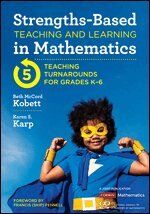
    Strengths-Based Teaching and Learning in Mathematics

    Five Teaching Turnarounds for Grades K-6

    AvBeth McCord Kobett,Karen S. Karp

    Häftad, Engelska, 2020

    Del i serien Corwin Mathematics Series

    424 kr

    Skickas . Fri frakt över 249 kr.

    Beskrivning

    “This book is a game changer! Strengths-Based Teaching and Learning in Mathematics: 5 Teaching Turnarounds for Grades K- 6 goes beyond simply providing information by sharing a pathway for changing practice. . . Focusing on our students’ strengths should be routine and can be lost in the day-to-day teaching demands. A teacher using these approaches can change the trajectory of students’ lives forever. All teachers need this resource!    

    Connie S. Schrock
    Emporia State University
    National Council of Supervisors of Mathematics President, 2017-2019

    NEW COVID RESOURCES ADDED:  A Parent’s Toolkit to Strengths-Based Learning in Math is now available on the book’s companion website to support families engaged in math learning at home. This toolkit provides a variety of home-based activities and games for families to engage in together.

    Your game plan for unlocking mathematics by focusing on students’ strengths.

    We often evaluate student thinking and their work from a deficit point of view, particularly in mathematics, where many teachers have been taught that their role is to diagnose and eradicate students’ misconceptions. But what if instead of focusing on what students don’t know or haven’t mastered, we identify their mathematical strengths and build next instructional steps on students’ points of power?

    Beth McCord Kobett and Karen S. Karp answer this question and others by highlighting five key teaching turnarounds for improving students’ mathematics learning: identify teaching strengths, discover and leverage students’ strengths, design instruction from a strengths-based perspective, help students identify their points of power, and promote strengths in the school community and at home. Each chapter provides opportunities to stop and consider current practice, reflect, and transfer practice while also sharing

    ·         Downloadable resources, activities, and tools

    ·         Examples of student work within Grades K–6

    ·         Real teachers’ notes and reflections for discussion

    It’s time to turn around our approach to mathematics instruction, end deficit thinking, and nurture each student’s mathematical strengths by emphasizing what makes them each unique and powerful. 

    Produktinformation

    • Utgivningsdatum:2020-07-08
    • Mått:177 x 254 x 19 mm
    • Vikt:520 g
    • Format:Häftad
    • Språk:Engelska
    • Serie:Corwin Mathematics Series
    • Antal sidor:272
    • Upplaga:1
    • Förlag:SAGE Publications
    • ISBN:9781544374932

    Utforska kategorier

    • Pedagogisk metodik inom Psykologi och pedagogik

    Mer om författaren

    Beth McCord Kobett serves as Professor and Dean in the School of Education at Stevenson University, where she works closely with early childhood, elementary, and middle school preservice teachers. She brings experience as a classroom teacher, mathematics specialist, and university supervisor.  Beth served on the NCTM Board and served as president of Association of Maryland Mathematics Teacher Educators. Beth has authored ten mathematics education books and supports professional learning efforts nationwide. She has been honored with awards such as the MCTM Mathematics Educator of the Year and Stevenson’s Rose Dawson Award for Excellence in Teaching. Deeply committed to her students, she strives to create a supportive, strengths-based learning environment that fosters curiosity, collaboration, and meaningful growth. Karen S. Karp is a mathematics educator who focuses on the intersection of mathematics education and special education. She is a former professor at Johns Hopkins University and at the University of Louisville, where she is professor emerita. Early in her career, she received a Development Award from the Joseph P. Kennedy, Jr. Foundation to support more seamless integration between general education and special education. She is the author or co-author of numerous publications including Assisting Students Struggling With Mathematics: Intervention in the Elementary Grades and Elementary and Middle School Mathematics. Karen was on the writing team of the NCTM/CEC joint position statement on Teaching Mathematics to Students with Learning Disabilities. In 2024, she chaired the Topic Study Group on Teaching Mathematics to Students with Special Needs at the International Congress on Mathematical Education in Australia. She holds teaching/administrative certifications in elementary education, secondary mathematics, K–12 special education, and K–12 educational administration.

    Recensioner i media

    "Too many of us perseverate on "fixing" our students and ourselves. Focusing instead on the strengths students bring to the classroom and redirecting the effective practices we already employ, Kobett and Karp turn this thinking on its head. By leveraging their tools and protocols we can confront and unpack our beliefs, transform our instruction, and create the positive and supportive learning environments our students deserve. This is an indispensable resource for educators committed to ensuring that each and every student experiences joy, wonder, and success in mathematics!"

    Innehållsförteckning

    • ForewordIntroduction – An Invitation to TurnaroundWhy Strengths-Based Instruction?Who is Strengths-Based Mathematics Teaching For?What are Mathematics Strengths we See in Students?Exploring Your Own Math IdentityMoving to a Strengths-Based PerspectivePractices that Build a Strengths CycleThe Five Teaching TurnaroundsChapter 1 - Identify Your Teaching StrengthsWhat Do You Believe About Your Students′ Learning?What Do Students Think You Believe?SummaryChapter 2 - Turnaround Mathematical Proficiencies, Processes, and PracticesBuilding Mathematical Proficiency Through a Strengths-Based LensBuilding Mathematical Practices and Dispositions Through a Strengths-Based LensBuilding Strengths in Problem SolvingBuilding Strengths in CommunicationBuilding Strengths in Reasoning and ProofBuilding Strengths in ConnectionsBuilding Strengths in RepresentationsSummaryChapter 3 - Your Students’ Mathematics Content StrengthsBuilding Mathematical Content Knowledge Through a Strengths-Based LensBuilding and Recognizing Strengths in the Meaning of Number and Operations and Algebraic ThinkingCount to show how numbers represent quantityCount to show how numbers represent quantityDevelop Strategies to Add, Subtract, Multiply, and DivideBuilding and Recognizing Strengths in Understanding Number and Operations - FractionsBuilding and Recognizing Strengths in Geometryvan Heile’s Geometric Conceptual Understanding Level 0: Visualizationvan Heile’s Geometric Conceptual Understanding Level 1: AnalysisSummaryChapter 4 – Turnaround Grouping PracticesPlanning Effective Strength-Based InstructionFixed versus Flexible Grouping PracticesLong-Term Whole-Class Ability GroupingSmall-Group In-Class Ability GroupingFlexible Grouping StrategiesStrength’s Based Flexible Grouping PracticesMixed-Strength Whole-Group InstructionHomogeneous-Strength Small GroupsTargeted Small Group Instruction Through a Strengths-Based LensSummaryChapter 5 – Turnaround TasksHigh Cognitive TasksTurnaround a Task: Designing a Personalized, Strengths-Based Instructional TaskIndividualized PersonalizationFunds of KnowledgeThree Perspectives for Adapting a Task to Support Student′s StrengthsAccess and EquityMathematical GoalsFormative AssessmentPromoting Strengths Through Parallel TasksExploratory Discourse About TasksMath Amendments: Revising the Task SolutionSummaryChapter 6 - Turnaround FeedbackThe Importance of Feedback in a Strengths-Based ClassroomTeacher-to-Student Feedback From a Strengths PerspectiveTeacher to Student Feedback LoopElements of Teacher to Student FeedbackStudent-to-Teacher Feedback from a Strengths PerspectivePrior to the LessonDuring the LessonClosing the LessonStudent-to-Student Feedback from a Strengths PerspectiveClassroom-Based Formative Assessment and FeedbackObservationInterviewShow MeHinge QuestionExit TaskSummaryChapter 7 - Turnaround Students’ IdentitiesWindows and MirrorsOur Teacher MirrorTranslation TaskDon′t Miss an Opportunity to Recognize a Student′s Points of PowerStudents′ Productive DispositionsStudents Self Analyze their Strong PointsSummaryChapter 8 - Turnaround Professional Learning CommunitiesSupporting Teachers′ StrengthsThe Appreciative Inquiry (AI) FrameworkWhole School AgreementSummaryChapter 9 - Turnaround Family CommunicationEngaging Families in Strengths-Based TalkIncorporating Family and Community StrengthsWorking Together to Share Mathematical IdeasFamily Math ResourcesConferences with Family Members from a Strengths-Based PerspectiveSummaryEpilogue - Turnaround ReflectionReferences