• Fri frakt över 249 kr
  • •
  • Snabba leveranser
  • •
  • Billiga böcker
Kundservice

Du är på sajten för privatpersoner.

Företag, bibliotek eller offentlig verksamhet?

Du handlar på classic.bokus.com, där alla dina funktioner finns intakta.
Till classic.bokus.com
Bokus logotyp. Gå till startsidan.
  • Erbjudanden
  • Nyheter
  • Student
  • Topplistor
  • Barn & ungdom
  • Bokus Play
  • E-böcker
  • Pocketböcker
  • Spel & pussel

10% rabatt på allt med kod NYSTART10 →

Sidfot

Mina sidor

    Hjälp

    • Kundservice
    • Vanliga frågor och svar
    • Frakt och leverans
    • Retur vid ångerrätt
    • Reklamera vara
    • Betalning
    • Köpvillkor
    • Allmänna villkor
    • Information om webbplatsens tillgänglighet

    Om Bokus

    • Om oss
    • Pressrum
    • För studenter
    • För företag
    • För bibliotek och offentlig verksamhet
    • För leverantörer
    • Hållbarhet

    Populärt

    • Aktuella erbjudanden
    • Presentkort
    • Studentlitteratur
    • Nya böcker
    • Topplistor
    • Signerade böcker
    • Engelska böcker

    Inspiration

    • Boktips
    • BookTok
    • Populära bokserier
    • Barnbokskaraktärer
    • Populära författare
    Logotyp för Bokus
    Följ oss på Facebook (extern länk)Följ oss på Instagram (extern länk)Följ oss på YouTube (extern länk)Följ oss på TikTok (extern länk)
    bokus @ CookiesAnpassa cookiesIntegritetspolicyKöpvillkor
    Till Citymail hemsida (extern länk)Till Budbee hemsida (extern länk)Till Postnord hemsida (extern länk)Till Schenker hemsida (extern länk)Till Early Bird hemsida (extern länk)Till Walleys hemsida (extern länk)
    1. Samhälle och politik
    2. Sociologi och antropologi
    3. Antropologi

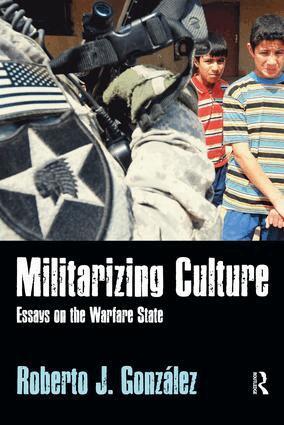
    Militarizing Culture

    Essays on the Warfare State

    AvRoberto J González

    Inbunden, Engelska, 2010

    2 423 kr

    Beställningsvara. Skickas inom 10-15 vardagar. Fri frakt över 249 kr.

    Fler format och utgåvor

    E-bok

    721 kr

    E-bok

    721 kr

    Häftad

    611 kr

    Beskrivning

    Militarizing Culture is a rousing critique of the American warfare state by a leading cultural commentator. Roberto J. González reveals troubling trends in the post-9/11 era, as the military industrial complex infiltrates new arenas of cultural life, from economic and educational arenas to family relationships. One of the nation’s foremost critics of the Human Terrain System program, González makes passionate arguments against the engagement of social scientists and the use of anthropological theory and methods in military operations. Despite the pervasive presence of militarism and violence in our society, González insists that warfare is not an inevitable part of human nature, and charts a path toward the decommissioning of culture.

    Produktinformation

    • Utgivningsdatum:2010-09-01
    • Mått:152 x 229 x undefined mm
    • Vikt:408 g
    • Format:Inbunden
    • Språk:Engelska
    • Antal sidor:209
    • Förlag:Left Coast Press Inc
    • ISBN:9781598745597

    Utforska kategorier

    • Antropologi inom Samhälle och politik
    • Centralt styre och förvaltning inom Samhälle och politik
    • Vapen och utrustning inom Samhälle och politik

    Mer om författaren

    Roberto J. González is Associate Professor of Anthropology at San José State University. After receiving a bachelor’s degree from the University of Texas, Austin, in 1992, he began his graduate studies in anthropology at the University of California, Berkeley. He received his PhD there in 1998. His doctoral research analyzed the agricultural theories and practices of subsistence farmers in southern Mexico. His first book, Zapotec Science: Farming and Food in the Northern Sierra of Oaxaca (2001) is based upon this work, and it won the first annual Julian Steward Award from the Anthropology and Environment Section of the American Anthropological Association. More recently, Dr. González has published an edited volume, Anthropologists in the Public Sphere: Speaking Out on War, Peace, and American Power (2004) and the book American Counterinsurgency: Human Science and the Human Terrain (2009). He has written many articles in academic journals and other periodicals, including the Los Angeles Times, the San Francisco Chronicle, In These Times, and Z Magazine, and he has been interviewed for programs produced by National Public Radio and the British Broadcasting Corporation, among others. He is a founding member of the Network of Concerned Anthropologists.

    Recensioner i media

    "...This critically important book pulls back the shades to reveal the true face of the US empire project. Roberto Gonzalez takes us through how, from an early age, Americans become desensitized to militarism and how vast swaths of our culture are steeped in it. We are shown a spy camp for children in Washington DC designed to increase the pool of future applicants for spy agencies. We are also shown how, via a process of 'normalizing the unthinkable,' torture has become accepted by a large portion of US citizens as a legitimate tool for American foreign policy. As a result, social scientists have volunteered for the Human Terrain System, an integral part of the US military's machinery that aims to colonize the people of Iraq and Afghanistan by using "...cultural knowledge"... to better wage the so-called war on terror. Militarizing Culture is a must read for those who want to know the truth, and for those who want to do something about it."...--Dahr Jamail, independent journalist and author of Beyond the Green Zone: Dispatches from an Unembedded Journalist in Iraq "Gonzalez documents the process by which military organizations and ideologies invade our daily life, a democracy reshaped by war. Powerful, persuasive, and timely!" --Laura Nader, Professor of Anthropology, University of California, Berkeley "...Militarizing Culture lives up to its title. This is an elegantly written, thoughtful, well-developed analysis of the US war machine and the problematic role of anthropology in supporting that machine. In this provocative collection of essays Roberto Gonzalez lays bare the controlling processes and legitimizing mechanisms that encourage the artistic, academic, and cultural embrace of militarism, and result in the societal-wide shattering of long-held taboos. In a world where violence is entertainment, torture is an acceptable norm, and academia is merely another means to achieve military ends, Gonzalez critically challenges his colleagues to consider their own individual and collective complicity. Rejecting the increased presence of "...cultural mercenaries"... and social science as "...a tool kit for empire"... he argues for an aggressive effort to demilitarize American society by exploding the myths that surround and perpetuate militarism. This provocative book is a must read."... - Barbara Rose Johnston, Senior Research Fellow, Center for Political Ecology "...[Gonzalez] brings a sharp critique of power relations that situates the production and consumption of anthropological knowledge within the larger political economy and military industrial complex dominating American society. Militarizing Culture describes the rise of "...mercenary anthropology,"... as the U.S. Army increasingly draws on anthropologist contractors to aid in the control of occupied people who find themselves in the way of American empire. Militarizing Culture is a well-written, timely book that can be used in a variety of anthropology courses, ranging from social theory to applied anthropology, contemporary culture, and anthropological ethics. This topical collection of essays should be read by every anthropologist."... -David H. Price, Journal of Anthropological Research

    Innehållsförteckning

    • List of Illustrations, Acknowledgments, Introduction: Militarizing Culture, Part I: Basic Training, Chapter 1: Spy Camp for Kids, Chapter 2: Shattered Taboo, Part II: Enlisting Culture, Chapter 3: Towards Mercenary Anthropology?, Chapter 4: The Arab Mind and Abu Ghraib, Chapter 5: Human Terrain, Part III: Controlling Behavior, Chapter 6: Counterinsurgency in the Colonies, Chapter 7: Going “Tribal”, Afterword: Decommissioning Culture, Glossary, References, Index, About the Author