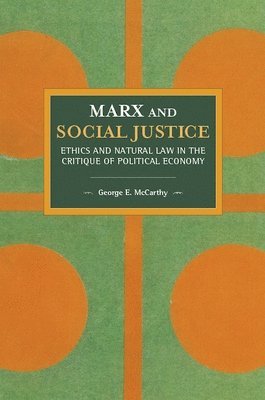
Marx And Social Justice
Ethics and Natural Law in the Critique of Political Economy
412 kr
Beställningsvara. Skickas inom 5-8 vardagar. Fri frakt över 249 kr.
Du är på sajten för privatpersoner.
412 kr
Beställningsvara. Skickas inom 5-8 vardagar. Fri frakt över 249 kr.
George E. McCarthy is Professor of Sociology at Kenyon College, Gambier, Ohio. He received an M.A. and Ph.D. (1972) in philosophy from Boston College and an M.A. and Ph.D. (1979) in sociology from the Graduate Faculty, New School for Social Research. He has been a research fellow at the universities of Frankfurt/Main, Munich, and Kassel, Germany. He is the author of a number of works, including Marx and the Ancients: Classical Ethics, Social Justice, and Nineteenth-Century Political Economy (Rowman & Littlefield, 1990) and Classical Horizons: The Origins of Sociology in Ancient Greece (SUNY Press, 2002).
“George E. McCarthy [...] presents a new reading of Karl Marx’s theory of social justice and provides a detailed and comprehensive overview of the ethical, political and economic foundations of this theory.” —Xuanpu Zhuang, Marx & Philosophy Review of Books
Du är på sajten för privatpersoner.
412 kr
Beställningsvara. Skickas inom 5-8 vardagar. Fri frakt över 249 kr.
George E. McCarthy is Professor of Sociology at Kenyon College, Gambier, Ohio. He received an M.A. and Ph.D. (1972) in philosophy from Boston College and an M.A. and Ph.D. (1979) in sociology from the Graduate Faculty, New School for Social Research. He has been a research fellow at the universities of Frankfurt/Main, Munich, and Kassel, Germany. He is the author of a number of works, including Marx and the Ancients: Classical Ethics, Social Justice, and Nineteenth-Century Political Economy (Rowman & Littlefield, 1990) and Classical Horizons: The Origins of Sociology in Ancient Greece (SUNY Press, 2002).
“George E. McCarthy [...] presents a new reading of Karl Marx’s theory of social justice and provides a detailed and comprehensive overview of the ethical, political and economic foundations of this theory.” —Xuanpu Zhuang, Marx & Philosophy Review of Books