• Fri frakt över 249 kr
  • •
  • Snabba leveranser
  • •
  • Billiga böcker
Kundservice

Du är på sajten för privatpersoner.

Företag, bibliotek eller offentlig verksamhet?

Du handlar på classic.bokus.com, där alla dina funktioner finns intakta.
Till classic.bokus.com
Bokus logotyp. Gå till startsidan.
  • Erbjudanden
  • Nyheter
  • Student
  • Topplistor
  • Barn & ungdom
  • Bokus Play
  • E-böcker
  • Pocketböcker
  • Spel & pussel

10% rabatt på allt med kod: NYSTART10 →

Sidfot

Mina sidor

    Hjälp

    • Kundservice
    • Vanliga frågor och svar
    • Frakt och leverans
    • Retur vid ångerrätt
    • Reklamera vara
    • Betalning
    • Köpvillkor
    • Allmänna villkor
    • Information om webbplatsens tillgänglighet

    Om Bokus

    • Om oss
    • Pressrum
    • För studenter
    • För företag
    • För bibliotek och offentlig verksamhet
    • För leverantörer
    • Hållbarhet

    Populärt

    • Aktuella erbjudanden
    • Presentkort
    • Studentlitteratur
    • Nya böcker
    • Topplistor
    • Signerade böcker
    • Engelska böcker

    Inspiration

    • Boktips
    • BookTok
    • Populära bokserier
    • Barnbokskaraktärer
    • Populära författare
    Logotyp för Bokus
    Följ oss på Facebook (extern länk)Följ oss på Instagram (extern länk)Följ oss på YouTube (extern länk)Följ oss på TikTok (extern länk)
    bokus @ CookiesAnpassa cookiesIntegritetspolicyKöpvillkor
    Till Citymail hemsida (extern länk)Till Budbee hemsida (extern länk)Till Postnord hemsida (extern länk)Till Schenker hemsida (extern länk)Till Early Bird hemsida (extern länk)Till Walleys hemsida (extern länk)
    1. Naturvetenskap och teknik
    2. Matematik och naturvetenskap
    3. Matematik

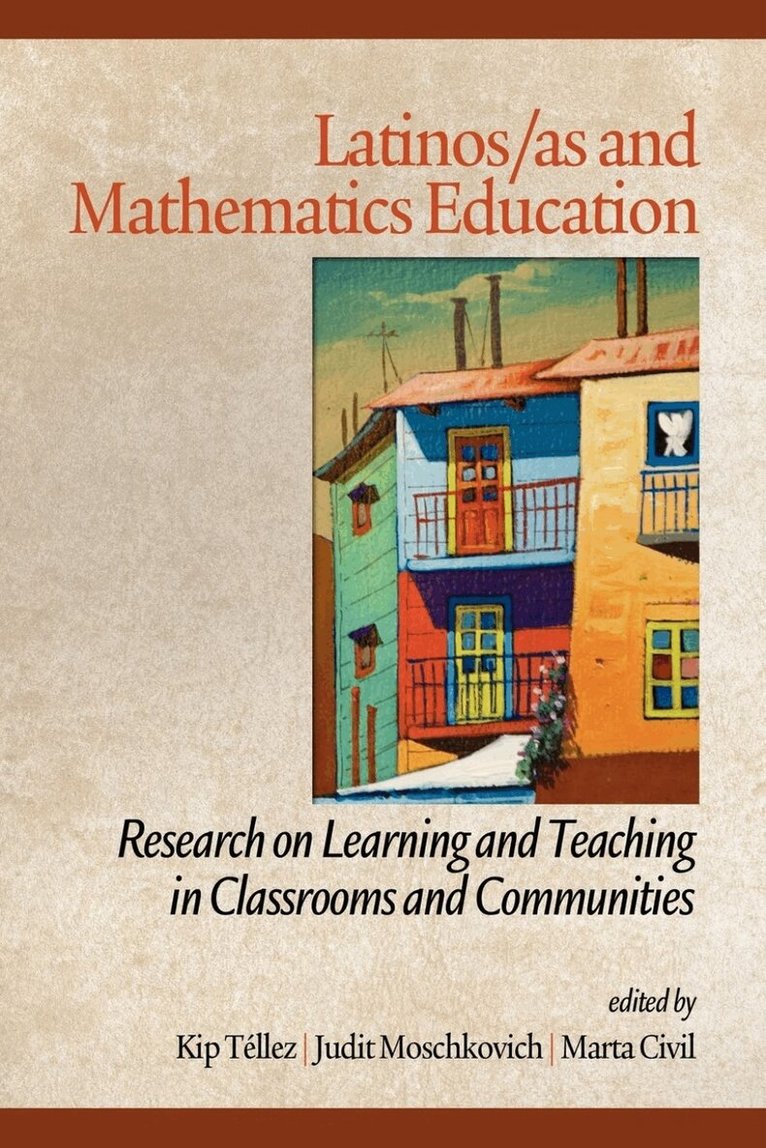
    Latinos/As and Mathematics Education

    Research on Learning and Teaching in Classrooms and Communities

    AvKip Téllez,Judit Moschkovich

    Inbunden, Engelska, 2011

    Del i serien Research in Educational Diversity and Excellence

    1 171 kr

    Beställningsvara. Skickas inom 5-8 vardagar. Fri frakt över 249 kr.

    Beskrivning

    This book that explores the mathematics education of Latinos/as in 13 original research studies. Each chapter represents research that grounds mathematics instruction for Latinos/as in the resources to be found in culture and language. By inverting the deficit perspective, this volume redresses the shortcomings found in the previous literature on Latino/a learners. Each study frames language (e.g. bilingualism) not as an obstacle to learning, but as a resource for mathematical reasoning. Other chapters explore the notion of cultural variation not as a liability but as a tool for educators to build upon in the teaching of mathematics. Specifically, the book reframes culture as a focus on the practices, objects, inscriptions, or people that connect mathematical concepts to student thinking and experiences, both in and out of school.The book's four sections divide the research: The first section of the book focuses on mathematic learning in classrooms, specifically exploring bilingual, Latino/a students; the second section explores Latino/a learners in communities, including the role parents can play in advancing learning; the third section includes chapters focused on teacher professional growth; the final section concerns the assessment (and mis-assessment) of Latino/a learners. The research shared in this volume provides ample evidence that mathematics educators who choose to ignore language or culture in their pedagogy risk shortchanging their Latino/a students.

    Produktinformation

    • Utgivningsdatum:2011-05-09
    • Mått:156 x 234 x 21 mm
    • Vikt:684 g
    • Format:Inbunden
    • Språk:Engelska
    • Serie:Research in Educational Diversity and Excellence
    • Antal sidor:362
    • Förlag:Emerald Publishing Inc
    • ISBN:9781617354212

    Utforska kategorier

    • Matematik inom Naturvetenskap och teknik
    • Sociologi inom Samhälle och politik
    • Undervisning i specifika ämnen inom Psykologi och pedagogik

    Innehållsförteckning

    • Preface.Chapter 1. Latinos/as and Mathematics Education: Why This Book Now? Kip Tellez, Judit Moschkovich, and Marta Civil.Chapter 2. Latino/a Students' Understanding of Equivalence: Use of Two Standards-Based Curricula in Eighth-Grade Algebra; Nancy O'Rode.Chapter 3. Bilingual Students Using Two Languages during Peer Mathematics Discussions: Que Significa? Estudiantes Bilingues Usando Dos Idiomas en sus Discusiones Matematicas: What Does it Mean? William Zahner and Judit Moschkovich.Chapter 4. Student Resistance in a Fifth-Grade Mathematics Class; Heather Cavell.Chapter 5. Situating Mexican Mothers' Dialogues in the Proximities of Contexts of Mathematical Practice; Higinio Dominguez.Chapter 6. Conversations Around Mathematics Education with Latino Parents in Two Borderland Communities: The Influence of Two Contrasting Language Policies; Jesus M. Acosta-Iriqui, Marta Civil, Javier Diez-Palomar, Mary E. Marshall, and Beatriz Quintos-Alonso.Chapter 7. Latino/a Bilingual Elementary Students Pose and Investigate Problems Grounded in Community Settings; Erin E. Turner, Maura Varley Gutierrez, and Javier Diez-Palomar.Chapter 8. A Case Study of Multigenerational Mathematics Participation in an After-School Setting: Capitalizing on Latinas/os Funds of Knowledge; Hector Morales, Jr., Eugenia Vomvoridi-Ivanovi, and Lena Licon Khisty.Chapter 9. Algebraic and Geometric Representations of Perimeter with Algebra Blocks: Professional Development for Teachers of Latino English Language Learners; Cynthia O. Anhalt and Matthew Ondrus.Chapter 10. Situating Mathematics Professional Development: A Bilingual Teacher and Researchers' Collaboration; Sandra I. Musanti, Mary E. Marshall, Karla Ceballos, and Sylvia Celedon-Pattichis.Chapter 11. Mathematics Learning with a Vision of Social Justice: Using the Lens of Communities of Practice; Beatriz Quintos, Marta Civil, and Olga Torres.Chapter 12. English Language Learners' Conceptual Understanding of Fractions: An Interactive Interview Approach as a Means to Learn with Understanding; Libni Berenice Castellon, Laura G. Burr, and Richard S. Kitchen.Chapter 13. Language Issues in Mathematics and the Assessment of English Language Learners; Guillermo Solano-Flores.Chapter 14. Teacher Quality, Academic Tracking and the Mathematics Performance of Latino English Learners; Eduardo Mosqueda.About the Contributors.