• Fri frakt över 249 kr
  • •
  • Snabba leveranser
  • •
  • Billiga böcker
Kundservice

Du är på sajten för privatpersoner.

Företag, bibliotek eller offentlig verksamhet?

Du handlar på classic.bokus.com, där alla dina funktioner finns intakta.
Till classic.bokus.com
Bokus logotyp. Gå till startsidan.
  • Erbjudanden
  • Nyheter
  • Student
  • Topplistor
  • Barn & ungdom
  • Bokus Play
  • E-böcker
  • Pocketböcker
  • Spel & pussel

10% rabatt på allt med kod: NYSTART10 →

Sidfot

Mina sidor

    Hjälp

    • Kundservice
    • Vanliga frågor och svar
    • Frakt och leverans
    • Retur vid ångerrätt
    • Reklamera vara
    • Betalning
    • Köpvillkor
    • Allmänna villkor
    • Information om webbplatsens tillgänglighet

    Om Bokus

    • Om oss
    • Pressrum
    • För studenter
    • För företag
    • För bibliotek och offentlig verksamhet
    • För leverantörer
    • Hållbarhet

    Populärt

    • Aktuella erbjudanden
    • Presentkort
    • Studentlitteratur
    • Nya böcker
    • Topplistor
    • Signerade böcker
    • Engelska böcker

    Inspiration

    • Boktips
    • BookTok
    • Populära bokserier
    • Barnbokskaraktärer
    • Populära författare
    Logotyp för Bokus
    Följ oss på Facebook (extern länk)Följ oss på Instagram (extern länk)Följ oss på YouTube (extern länk)Följ oss på TikTok (extern länk)
    bokus @ CookiesAnpassa cookiesIntegritetspolicyKöpvillkor
    Till Citymail hemsida (extern länk)Till Budbee hemsida (extern länk)Till Postnord hemsida (extern länk)Till Schenker hemsida (extern länk)Till Early Bird hemsida (extern länk)Till Walleys hemsida (extern länk)
    1. Samhälle och politik
    2. Samhälle och kultur
    3. Kultur och medier
    4. Referensverk och tvärvetenskap

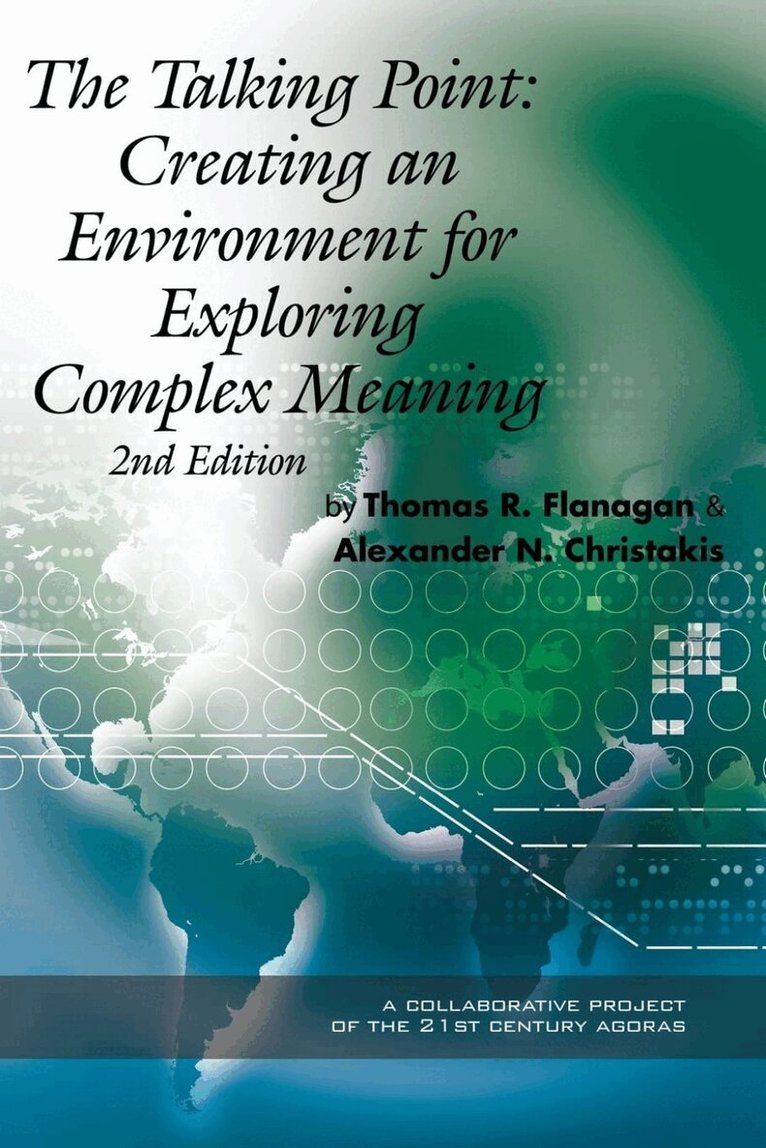
    Talking Point

    Creating an Environment for Exploring Complex Meaning

    AvThomas R. Flanagan,Alexander N. Christakis

    Häftad, Engelska, 2021

    539 kr

    Beställningsvara. Skickas inom 5-8 vardagar. Fri frakt över 249 kr.

    Fler format och utgåvor

    Inbunden

    989 kr

    Beskrivning

    The Talking Point is all about how people learn within groups. People can be much smarter than crowds if you measure “smart” as decision-making speed. Crowds can be much wiser than individuals if you measure wisdom by depth of understanding. It is possible to understand a great deal of information yet (or maybe because of this) you can also be slow to make decisions. If rushed, crowds will make poor decisions in spite of their wisdom. So... to get good group decisions on a time scale that will keep pace with policy development needs and social necessities, groups have to be supported so that their decision-making process can be accelerated. Much has been said and written about this problem over the years. It is dangerous to have the power of groups without the wisdom of groups, and it is tragic to have the wisdom of groups without the power of groups. The Talking Point presents a meeting point for the wisdom and power of groups through the use of Structured Dialogic Design. With hopeful intentions, as a culture we have poisoned the well just when we need it most. We have touted design charettes and stakeholder processes as engagement vehicles and then ignored, marginalized or corrupted the very input that we swore to hold as sacred. This has created a myth that large scale collaboration is not possible, and the myth has led to considerable disillusionment among would-be participants and could-be sponsors. Structured Dialogic Design seeks to bust the myth about our limited capabilities to sustain boundary spanning collaboration. To bust this myth, Structured Dialogic Design needs to usher in a new wave of collaborative planning. Scholars have identified the Structured Dialogic Design methodology as the cutting edge of “third phase” science - where the reality of a situation embraces interactions between objective findings and subjective intentions. The Talking Point provides a window for observing how Structured Dialogic Design has been put into practice and paints a panorama of the issues that confront complex social system design. This book is itself a bridge between scholarship and practice, written to be accessible yet anchored to major themes in cognitive psychology, information systems, social systems, and models of group learning. The book is an invitation for transformational leaders and those who support transformational leaders to pick up a new tool in the essential quest to put our nation and our world back on track toward sustainable futures. The Talking Point is a fresh source of water in a world that is thirsty for new ways of solving complex problems.

    Produktinformation

    • Utgivningsdatum:2021-12-13
    • Mått:156 x 234 x 13 mm
    • Vikt:349 g
    • Format:Häftad
    • Språk:Engelska
    • Antal sidor:244
    • Upplaga:2
    • Förlag:Emerald Publishing Inc
    • ISBN:9781648026706

    Utforska kategorier

    • Referensverk och tvärvetenskap inom Samhälle och politik
    • Pedagogisk psykologi inom Psykologi och pedagogik
    • Pedagogik inom Psykologi och pedagogik

    Innehållsförteckning

    • Prologue.Preface: A New Paradigm for Collaborative Language.Section I. The Practice.Chapter 1. The Phone Call: Working With Sponsors Of Collaborative-learning.Chapter 2. The Design Management Team: Setting the Scope of Work.Chapter 3. The Participants: Stakeholder Identification and Recruitment.Chapter 4. The Learning Environment: Setting up a Colaboratory.Chapter 5. The Work: Agenda and Activities.Chapter 6. The Results: Subjective and Objective Assessments.Section II. The Arena.Chapter 7. About The Technology Of Dialogue: Words, Meanings, And Understandings.Chapter 8. About Creating Meaning: How We Think as Groups and Individuals.Chapter 9. About the Nature of Leadership: Power Politics Expressed in Dialogue.Chapter 10. About the Art of Sensing Importance: Setting Priorities.Chapter 11. About Collaborative Learning: Information Overload in Real Time.Chapter 12. Epilogue: Why Do People Happily and Hopefully Struggle to Collaborate?Appendix I: The Structured Dialogic Design Process.Appendix II. The Institute for 21st Century Agoras.References.About the Authors.