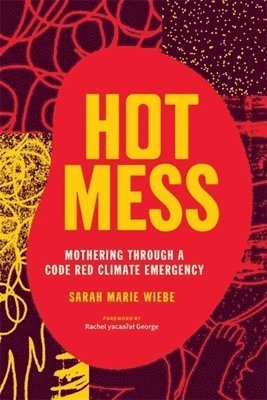
Häftad, Engelska, 2024
Hot Mess
Mothering Through a Code Red Climate Emergency
231 kr
Skickas måndag 9/11. Fri frakt över 249 kr.
Beskrivning
Produktinformation
- Utgivningsdatum: 2024-10-29
- Mått: 127 x 178 x 14 mm
- Vikt: 192 g
- Format: Häftad
- Språk: Engelska
- Antal sidor: 144
- Förlag: Fernwood Publishing Co Ltd
- Medarbetare: Rachel yacaaʔał George
- ISBN: 9781773635668
Utforska kategorier
Mer om författaren
Sarah Marie Wiebe grew up on Coast Salish territory in British Columbia, BC. She is an assistant professor in the School of Public Administration at the University of Victoria and an adjunct professor at the University of Hawai'i, Mānoa with a focus on community development and environmental sustainability. She is a co-founder of the FERN Collaborative (Feminist Environmental Research Network) and author of Life against States of Emergency: Revitalizing Treaty Relations from Attawapiskat. Her book Everyday Exposure: Indigenous Mobilization and Environmental Justice in Canada's Chemical Valley won the Charles Taylor Book Award and examines policy responses to the impact of pollution on the Aamjiwnaang First Nation's environmental health. She is a co-editor of Biopolitical Disaster and Creating Spaces of Engagement. Her teaching and research interests emphasize political ecology, policy justice and deliberative dialogue. As a collaborative researcher and community filmmaker, she incorporates mixed media storytelling into her sustainability-focused research and teaching.
Recensioner i media
“Rooted in her own experience of the climate crisis as a new mother, Sarah Marie Wiebe takes us through the deep and necessary work of care in times of overlapping crises. Combining incisive analysis with lyrical narrative, Wiebe bravely guides her reader through the mess of our times; this mess is sometimes joyful, sometimes painful, and always hot. Timely and gripping, this book is a powerful rallying cry for radical care.” - Rebecca Hall, author of Refracted Economies: Diamond Mining and Social Reproduction in the North; “Wiebe’s critical ecofeminist and maternal analysis delves into the slow sensory politics of crisis. She demonstrates how the messiness of our scaling grief – both personal and collective, ecological and otherwise – is intimately tied to structures of neoliberalism, settler colonialism, patriarchy, racism, capitalism, and global extractivism.” - Jeffrey Ansloos, associate professor, Indigenous health and social policy, University of Toronto; “Hot Mess makes you deeply aware of how fires, smoke, drought, pollution, and climate emergencies are embodied experiences. Wiebe makes a compelling argument for how the world we live in requires a prismatic thinking that considers how these embodied experiences become entangled with structural inequalities, historical systematic exclusions, and relations of domination with the non-human world. However, instead of being flooded with anxiety and powerlessness, the author calls upon all of us to make friends with our bodies, the bodies of others and those of the non-human world. Centering a mother-child relationship, Wiebe asks what our environmental future may look like if we enacted relationships of care, respect and reciprocity with the non-human world and Indigenous communities. This is a text that we all should read.” - Isabel Altamirano Jiménez, Canada Research Chair in Comparative Indigenous Feminist Studies; “A testament to the power of maternal activism in the face of environmental collapse, this book offers essential insights for integrating climate resilience into our lives and scholarship. The book’s acknowledgment of Indigenous practices and experiences with feminist perspectives on care and community are not just compelling, but imperative for our times. Hot Mess is a call to action for parents and policymakers alike to prioritize care and community for the inseparable health of our planet and our children.” - Renée Monchalin, University of Victoria, Public Health and Social Policy; “In Hot Mess, Sarah Marie Wiebe dances between theory, story, data, and experience to focus our attention on the complex, messy, interconnected, embodied global challenge of climate change. Drawing on critical ecofeminism, a range of Indigenous knowledges, and her own research and experiences of pregnancy, birth and mothering, Wiebe calls on us to challenge extractivism and cultivate relationships of care for the sake of our collective ability to live well into the future.” - Leah Levac, associate professor and Canada Research Chair (Tier 2) in Critical Community Engagement and Public Policy, Department of Political Science, University of Guelph
Betyg & recensioner
0 recensioner
Inga recensioner tillgängliga.