Inbunden, Engelska, 2026
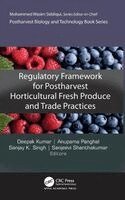
Regulatory Framework for Postharvest Horticultural Fresh Produce and Trade Practices
Av Deepak Kumar, Anupama Panghal, Sanjay K. Singh, Sanjeevi Shanthakumar
Del i serien Postharvest Biology and Technology
2152 kr
Kommande
Beskrivning
Produktinformation
- Utgivningsdatum: 2026-11-24
- Mått: 152 x 229 x undefined mm
- Format: Inbunden
- Språk: Engelska
- Serie: Postharvest Biology and Technology
- Antal sidor: 560
- Förlag: Apple Academic Press Inc.
- ISBN: 9781779643049
Utforska kategorier
Mer om författaren
Deepak Kumar, PhD, is presently working as Executive Director at Nextnode Bioscience Pvt. Ltd., Kadi, and Director (R&D) of the DSIR-recognized laboratory of Shri Ram Solvent Extractions Pvt. Ltd. He is the author or co-author of 25 peer-reviewed journal articles, seven books, one patent, and 30 book chapters. He has been involved in the quality production of biofertilizers and biopesticides for the last 12 years. Dr. Kumar is a Certified Farm Advisor (organic farming, certified by MANAGE, Government of India) and a Food Safety Mitra (certified by Food Safety and Standards Authority of India). Dr. Kumar was selected as an AYE mentor by IFCI Venture Capital Funds Limited (an Indian government undertaking) for SC/ST (Scheduled Caste/Scheduled Tribe) mentorship under the Ministry of Social Justice and Empowerment, Government of India. He has received many prestigious awards from different scientific and market research organizations. He also completed and guided six indigenous and externally funded (DSIR and DST) research projects. Dr. Kumar recently developed and licensed a neem endophytic mycoflora-based mycofertilizer, namely AsperPhos. He is a technical consultant for more than a dozen companies, providing customized technical support. He is an active member of several associations and bodies as well.Anupama Panghal, PhD, is an Associate Professor at the National Institute of Food Technology Entrepreneurship and Management (NIFTEM), Sonipat, India. She has more than 18 years of academic and industrial experience, primarily at NIFTEM Kundli. Dr. Panghal earlier worked at Thapar University, Patiala, as an assistant professor, and at the National Agricultural Cooperative Marketing Federation of India, New Delhi, as an assistant manager. She was also selected by the Government of India under the Faculty Secondment Scheme of the Indian Ministry of Human Resource Development, as a visiting professor at the Asian Institute of Technology, Bangkok, Thailand. Her research interests include agri-business management, supply chain and logistics management, entrepreneurship management, etc. She has authored one book on the topic of futures trading of agricultural commodities, edited four books, and authored or co-authored several papers in international and national journals of repute, including in indexed journals. In addition, she has contributed chapters to a few edited books. She has worked as principal investigator of a Ministry of Food Processing Industries (India) funded research project titled “Blockchain-Based Traceability Solution for Agri-Food Supply Chains in India,” among other research projects. She has been called for expert lectures several times and is a reviewer for many reputed journals. She is a lifetime member of the Agricultural Economics Research Review (AERA) and the Asian Productivity Organization (APO). Dr. Panghal has a PhD in business management, an MBA, and a BSc.Sanjay K. Singh, PhD, is currently a Scientist ‘G’ and In-Charge at the Biodiversity and Paleobiology Group, Agharkar Research Institute, Pune, Maharashtra, India. With vast experience in fungal biology and plant pathology, Dr. Singh has made a major contribution by establishing a state-of-the-art National Facility for Culture Collection of Fungi with financial support from Department of Science and Technology, Govt. of India, in 2008, wherein he established an exclusive repository for fungi as the National Fungal Culture Collection of India (NFCCI), affiliated with the World Federation for Culture Collection. More than 700 academic research institutions and about 100 industries spread across 28 states in India are beneficiaries of this facility. Dr. Singh received specialized training with world-renowned researcher Prof. Gary A. Strobel, Montana State University, USA, on the biology of endophytes and their bioactive metabolites. He supervised Dr. Frank Ackiah, from Ghana, who was selected for the CV Raman International Fellowship for African Researchers. Dr. Singh is an elected fellow of the Maharashtra Academy of Sciences and the Indian Phytopathological Society, and an honorary fellow of the Society for Biotechnology (India). He has several postdoctoral fellowships as well. Dr. Singh has operated 14 projects; published more than 115 research papers, three books, and 20 book chapters; and delivered more than 30 invited lectures at symposiums, seminars, and workshops. He has organized conferences and capacity-building national-level workshops and served as a reviewer and editorial board member for several journals.Sanjeevi Shanthakumar, PhD, is the Director of the Gujarat National Law University, Gandhinagar, Gujarat, India. With about 30 years of teaching, he has experience at several universities, including Hidayatullah National Law University, Chhattisgarh, India. He has authored three books on environmental law and two books on human rights law published as well as a number of research articles on contemporary legal issues in various national and international journals and edited volumes. He has presented papers and delivered keynote addresses at many national and international conferences in India and abroad. Recently, he was elected to represent South and West Asia at the IUCN Academy of Environmental Law. He is also President of the Gujarat International Maritime Arbitration Centre as well as Chair of the Environmental Law Study Group of the International Association of Law Schools and a member of the Teaching and Capacity Building Committee of the IUCN Academy of Environmental Law. He is also serving as the country focal point for India for the Asian Development Bank project on the Environment and Climate Change Law. He is also a member of the Standing Committee on Legal Education, Bar Council of India, and a member of the Advisory Board for Development of Legal Education and Legal Profession, Bar Council of India. Along with this, Prof. S. Shanthakumar is a member of the Special Task Force, a school and higher Chhattisgarh State Planning Commission. He had executed the Environmental Law Capacity Building Project, funded by the World Bank through CEERA, NLSIU, the Law Teaching and Legal Research Skills Project of the British Council; and Cardiff University, U.K. He is also the recipient of prestigious awards, including the Environmental Law Champions Development Award from the Asian Development Bank, Philippines, and the Best Social Scientist Award from the Indian Society of Criminology. At the IP Fest 2020, Prof. Shanthakumar was recognized as the IP director of the year. He had travelled around the globe extensively and had the privilege of being invited to deliver lectures at 30 premier universities in various countries. Before joining legal academia, he had practiced at the Madras High Court for seven years. His areas of specialization are environmental law, human rights law, international law, and constitutional law. He is an alumnus of Madras University, Chennai, where he earned his graduation, post-graduation, and doctorate degrees in law.
Betyg & recensioner
0 recensioner
Inga recensioner tillgängliga.