• Fri frakt över 249 kr
  • •
  • Snabba leveranser
  • •
  • Billiga böcker
Kundservice

Du är på sajten för privatpersoner.

Företag, bibliotek eller offentlig verksamhet?

Du handlar på classic.bokus.com, där alla dina funktioner finns intakta.
Till classic.bokus.com
Bokus logotyp. Gå till startsidan.
  • Erbjudanden
  • Nyheter
  • Student
  • Topplistor
  • Barn & ungdom
  • Bokus Play
  • E-böcker
  • Pocketböcker
  • Spel & pussel

10% rabatt på allt med kod: NYSTART10 →

Sidfot

Mina sidor

    Hjälp

    • Kundservice
    • Vanliga frågor och svar
    • Frakt och leverans
    • Retur vid ångerrätt
    • Reklamera vara
    • Betalning
    • Köpvillkor
    • Allmänna villkor
    • Information om webbplatsens tillgänglighet

    Om Bokus

    • Om oss
    • Pressrum
    • För studenter
    • För företag
    • För bibliotek och offentlig verksamhet
    • För leverantörer
    • Hållbarhet

    Populärt

    • Aktuella erbjudanden
    • Presentkort
    • Studentlitteratur
    • Nya böcker
    • Topplistor
    • Signerade böcker
    • Engelska böcker

    Inspiration

    • Boktips
    • BookTok
    • Populära bokserier
    • Barnbokskaraktärer
    • Populära författare
    Logotyp för Bokus
    Följ oss på Facebook (extern länk)Följ oss på Instagram (extern länk)Följ oss på YouTube (extern länk)Följ oss på TikTok (extern länk)
    bokus @ CookiesAnpassa cookiesIntegritetspolicyKöpvillkor
    Till Citymail hemsida (extern länk)Till Budbee hemsida (extern länk)Till Postnord hemsida (extern länk)Till Schenker hemsida (extern länk)Till Early Bird hemsida (extern länk)Till Walleys hemsida (extern länk)
    1. Naturvetenskap och teknik
    2. Matematik och naturvetenskap
    3. Kemi
    4. Analytisk kemi

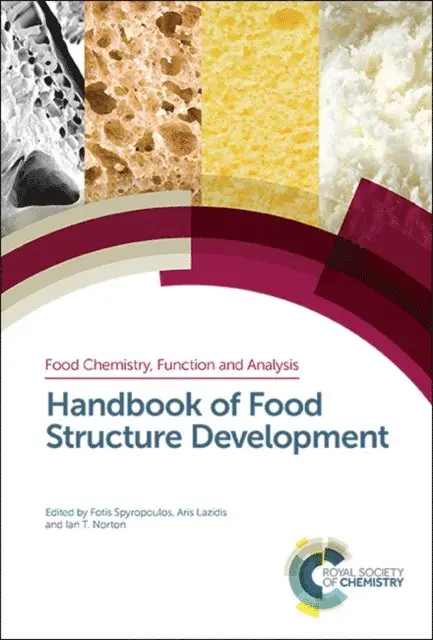
    Handbook of Food Structure Development

    AvFotis Spyropoulos,Aris Lazidis

    Inbunden, Engelska, 2019

    Del i serien Food Chemistry, Function and Analysis

    2 209 kr

    Beställningsvara. Skickas inom 5-8 vardagar. Fri frakt över 249 kr.

    Beskrivning

    The most useful properties of food, i.e. the ones that are detected through look, touch and taste, are a manifestation of the food’s structure. Studies about how this structure develops or can be manipulated during food production and processing are a vital part of research in food science. This book provides the status of research on food structure and how it develops through the interplay between processing routes and formulation elements. It covers food structure development across a range of food settings and consider how this alters in order to design food with specific functionalities and performance. Food structure has to be considered across a range of length scales and the book includes a section focusing on analytical and theoretical approaches that can be taken to analyse/characterise food structure from the nano- to the macro-scale. The book concludes by outlining the main challenges arising within the field and the opportunities that these create in terms of establishing or growing future research activities.Edited and written by world class contributors, this book brings the literature up-to-date by detailing how the technology and applications have moved on over the past 10 years. It serves as a reference for researchers in food science and chemistry, food processing and food texture and structure.

    Produktinformation

    • Utgivningsdatum:2019-10-31
    • Mått:156 x 234 x 32 mm
    • Vikt:937 g
    • Format:Inbunden
    • Språk:Engelska
    • Serie:Food Chemistry, Function and Analysis
    • Antal sidor:498
    • Förlag:Royal Society of Chemistry
    • ISBN:9781788012164

    Utforska kategorier

    • Analytisk kemi inom Naturvetenskap och teknik
    • Tillverkningsindustri inom Ekonomi och Ledarskap
    • Tillverkningsteknik inom Naturvetenskap och teknik

    Innehållsförteckning

    • The Role of Hydrocolloids in the Development of Food Structure;The Role of Proteins in the Development of Food Structure;Food Structure Development in Emulsion Systems;The Role of Bubbles in the Development of Food Structure;Food Structure Development in Oil and Fat Systems;Food Structure Development in Chocolate;Food Structure Development in Cereal and Snack Products;Food Structure Development for Rheological/Tribological Performance;Developing Food Structure for Mechanical Performance;Design Structures for Optimal Sensory Performance;The Development of Food Structures for the Encapsulation and Delivery of Bioactive Compounds;Food Structure Analysis Using Light and Confocal Microscopy;Food Structure Characterisation Using Small-angle Scattering Methods;Applications of Scanning Electron Microscopy and Atomic Force Microscopy to Food Structure Characterisation;Modelling and Computer Simulation Approaches to Understand and Predict Food Structure Development: Structuring by Gelation and Self-association of Biomolecules;Development of Food Structure via Sustainable Processing Systems;Food Structure Development/Production Through Flexible Processes: The Use of Electric Fields to Enable Food Manufacturing;Development of Health Food Structures: Reduction of Sugar, Salt and Fat;Food Structure Development for Specific Population Groups