• Fri frakt över 249 kr
  • •
  • Snabba leveranser
  • •
  • Billiga böcker
Kundservice

Du är på sajten för privatpersoner.

Företag, bibliotek eller offentlig verksamhet?

Du handlar på classic.bokus.com, där alla dina funktioner finns intakta.
Till classic.bokus.com
Bokus logotyp. Gå till startsidan.
  • Erbjudanden
  • Nyheter
  • Student
  • Topplistor
  • Barn & ungdom
  • Bokus Play
  • E-böcker
  • Pocketböcker
  • Spel & pussel

10% rabatt på allt med kod: NYSTART10 →

Sidfot

Mina sidor

    Hjälp

    • Kundservice
    • Vanliga frågor och svar
    • Frakt och leverans
    • Retur vid ångerrätt
    • Reklamera vara
    • Betalning
    • Köpvillkor
    • Allmänna villkor
    • Information om webbplatsens tillgänglighet

    Om Bokus

    • Om oss
    • Pressrum
    • För studenter
    • För företag
    • För bibliotek och offentlig verksamhet
    • För leverantörer
    • Hållbarhet

    Populärt

    • Aktuella erbjudanden
    • Presentkort
    • Studentlitteratur
    • Nya böcker
    • Topplistor
    • Signerade böcker
    • Engelska böcker

    Inspiration

    • Boktips
    • BookTok
    • Populära bokserier
    • Barnbokskaraktärer
    • Populära författare
    Logotyp för Bokus
    Följ oss på Facebook (extern länk)Följ oss på Instagram (extern länk)Följ oss på YouTube (extern länk)Följ oss på TikTok (extern länk)
    bokus @ CookiesAnpassa cookiesIntegritetspolicyKöpvillkor
    Till Citymail hemsida (extern länk)Till Budbee hemsida (extern länk)Till Postnord hemsida (extern länk)Till Schenker hemsida (extern länk)Till Early Bird hemsida (extern länk)Till Walleys hemsida (extern länk)
    1. Samhälle och politik
    2. Sociologi och antropologi
    3. Antropologi

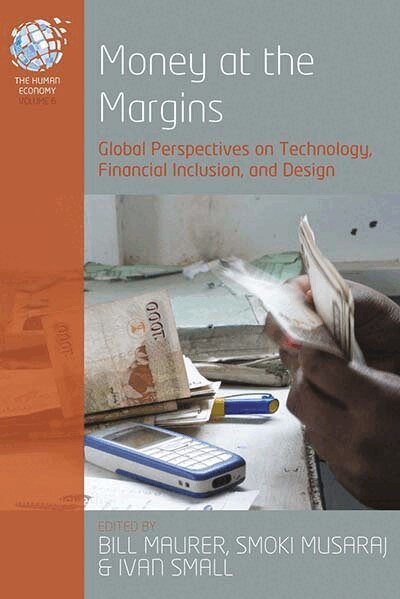
    Money at the Margins

    Global Perspectives on Technology, Financial Inclusion, and Design

    AvBill Maurer,Smoki Musaraj

    Häftad, Engelska, 2019

    Del i serien Human Economy

    440 kr

    Beställningsvara. Skickas inom 5-8 vardagar. Fri frakt över 249 kr.

    Beskrivning

    Mobile money, e-commerce, cash cards, retail credit cards, and more—as new monetary technologies become increasingly available, the global South has cautiously embraced these mediums as a potential solution to the issue of financial inclusion. How, if at all, do new forms of dematerialized money impact people’s everyday financial lives? In what way do technologies interact with financial repertoires and other socio-cultural institutions? How do these technologies of financial inclusion shape the global politics and geographies of difference and inequality? These questions are at the heart of Money at the Margins, a groundbreaking exploration of the uses and socio-cultural impact of new forms of money and financial services.

    Produktinformation

    • Utgivningsdatum:2019-03-19
    • Mått:152 x 229 x 18 mm
    • Vikt:485 g
    • Format:Häftad
    • Språk:Engelska
    • Serie:Human Economy
    • Antal sidor:334
    • Förlag:Berghahn Books
    • ISBN:9781789200485

    Utforska kategorier

    • Antropologi inom Samhälle och politik
    • Referensverk och tvärvetenskap inom Samhälle och politik
    • Ekonomisk politik inom Ekonomi och Ledarskap

    Mer om författaren

    Bill Maurer is Dean of Social Sciences and Professor of Anthropology and Law, University of California, Irvine. He is the Director of the Institute for Money, Technology and Financial Inclusion (IMTFI), and author of How Would You Like to Pay? How Technology is Changing the Future of Money (2015) among many other publications.

    Recensioner i media

    “This is an insightful collection that evokes the traditional ethnographic project of studying ‘out of the way’ places…One of the volume’s real strengths is its geographical breadth, in terms both of the cases analysed and of the authors’ background. The studies are drawn from research conducted in twelve different countries on four continents: Africa, Asia, South America, and North America.” • JRAI“[This volume]… is a welcome addition that describes, often in vibrant detail, how people are already engaging in financial activities and how their acts of saving, loaning, hedging, and investing are intimately linked to performances of personhood, understandings of morality, and even expressions of desire… The collection offers insights for scholars and policy makers alike who are concerned with the consequences and futures of payment systems for the unbanked. The volume will also work in the classroom, as the chapters offer compelling case studies that do justice to the tremendous variation and the social complexity of people’s monetary repertoires and payment systems, underscoring how the margins are not examples of failed development but rather sites that generate insight and innovation.” • Current Anthropology“Indispensable reading material for scholars as well as industry specialists interested in payment infrastructures and the questions of money and value, this book entails fruitful applications for classroom use. One can hope that this innovative volume will inspire a similarly creative following that continues to combine empirical and industry-based insights with those of anthropological theory, along with an inclusive platform of diverse collaborators.” • American Ethnologist“This very important collection adds unique ethnographic case studies from a wide variety of geographic contexts to the growing literature on financial inclusion.” • Anke Schwittay, University of Sussex

    Innehållsförteckning

    • List of IllustrationsAcknowledgementsIntroduction: Money and Finance at the MarginsSmoki Musaraj and Ivan V. SmallPART I: IN/EXCLUSIONThe Question of InclusionAnanya RoyChapter 1. A Living Fence: Financial Inclusion and Exclusion on the Haitian-Dominican Republic BorderErin B. Taylor and Heather A. HorstChapter 2. Capital Mobilization among Somali Refugee Business Community in Nairobi, KenyaKenneth Omeje and John Mwangi GithigaroChapter 3. The Use of Mobile-Money Technology among Vulnerable Populations in Kenya: Opportunities and Challenges for Poverty ReductionNdunge Kiiti and Jane Wanza MutindaPART II: VALUE AND WEALTHWhat do Value and Wealth Do? “Life” Goes On, Whatever “Life” Is.Jane I. GuyerChapter 4. Dhikuti Economies: The Moral and Social Ecologies of Rotating Finance in the Kathmandu ValleySepideh Azarshahri BajracharyaChapter 5. Chiastic Currency Spheres: Postsocialist “Conversions” in Cuba’s Dual EconomyMrinalini TankhaChapter 6. Carola and Saraswathi: Juggling Wealth in India and in MexicoMagadalena Villarreal, Isabelle Guérin, and K. S. Santosh KumarPART III: TECHNOLOGY AND SOCIAL RELATIONSInfrastructures of Digital MoneyJenna BurrellChapter 7. ‘Financial Inclusion Means Your Money Isn’t With You’: Conflicts over Social Grants and Financial Services in South AfricaKevin P. DonovanChapter 8. Social Networks of Mobile Money in KenyaSibel Kusimba, Gabriel Kunyu, and Elizabeth GrossChapter 9. Accounting in the Margin: Financial Ecologies in between Big and Small DataJosé Ossandón, Tomás Ariztía, Macarena Barros, and Camila PeraltaPART IV: DESIGN AND PRACTICEDesign and PracticeJoshua E. BlumenstockChapter 10. Understanding Social Relations and Payments among Rural EthiopiansWoldmariam F. MesfinChapter 11. Delivering Cash Grants to Indigenous Peoples through Cash Cards versus Over-the-Counter Modalities: The Case of the 4Ps Conditional Cash Transfer Program in Palawan, PhilippinesAnatoly "Jing" Gusto and Emily RoqueChapter 12. Effects of Mobile Banking on the Savings Practices of Low Income Users: The Indian ExperienceMani A. NandhiChapter 13. Betting on Chance in Colombia: Using Empirical Work on Game Networks to Develop Practical Design GuidelinesAna María Echeverry and Coppelia Herrán CuartasAfterwordBill MaurerIndex