• Fri frakt över 249 kr
  • •
  • Snabba leveranser
  • •
  • Billiga böcker
Kundservice

Du är på sajten för privatpersoner.

Företag, bibliotek eller offentlig verksamhet?

Du handlar på classic.bokus.com, där alla dina funktioner finns intakta.
Till classic.bokus.com
Bokus logotyp. Gå till startsidan.
  • Erbjudanden
  • Nyheter
  • Student
  • Topplistor
  • Barn & ungdom
  • Bokus Play
  • E-böcker
  • Pocketböcker
  • Spel & pussel

10% rabatt på allt med kod: NYSTART10 →

Sidfot

Mina sidor

    Hjälp

    • Kundservice
    • Vanliga frågor och svar
    • Frakt och leverans
    • Retur vid ångerrätt
    • Reklamera vara
    • Betalning
    • Köpvillkor
    • Allmänna villkor
    • Information om webbplatsens tillgänglighet

    Om Bokus

    • Om oss
    • Pressrum
    • För studenter
    • För företag
    • För bibliotek och offentlig verksamhet
    • För leverantörer
    • Hållbarhet

    Populärt

    • Aktuella erbjudanden
    • Presentkort
    • Studentlitteratur
    • Nya böcker
    • Topplistor
    • Signerade böcker
    • Engelska böcker

    Inspiration

    • Boktips
    • BookTok
    • Populära bokserier
    • Barnbokskaraktärer
    • Populära författare
    Logotyp för Bokus
    Följ oss på Facebook (extern länk)Följ oss på Instagram (extern länk)Följ oss på YouTube (extern länk)Följ oss på TikTok (extern länk)
    bokus @ CookiesAnpassa cookiesIntegritetspolicyKöpvillkor
    Till Citymail hemsida (extern länk)Till Budbee hemsida (extern länk)Till Postnord hemsida (extern länk)Till Schenker hemsida (extern länk)Till Early Bird hemsida (extern länk)Till Walleys hemsida (extern länk)
    1. Samhälle och politik
    2. Samhälle och kultur
    3. Kultur och medier
    4. Kulturvetenskap

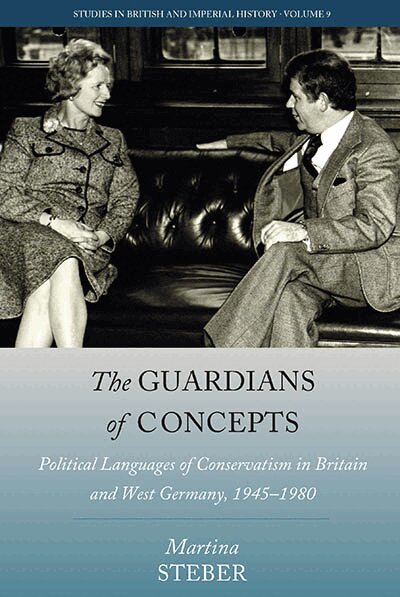
    Guardians of Concepts

    Political Languages of Conservatism in Britain and West Germany, 1945-1980

    AvMartina Steber

    Inbunden, Engelska, 2023

    Del i serien Studies in British and Imperial History

    2 464 kr

    Beställningsvara. Skickas inom 5-8 vardagar. Fri frakt över 249 kr.

    Beskrivning

    Since 1945, what ‘conservative’ means has troubled intellectuals, politicians and parties in the United Kingdom and West Germany. In Britain conservatism was an accepted term of the political vocabulary, denoting a particular tradition of political thought and practice. In West Germany, by contrast, conservatism was a difficult concept for the young democracy to swallow. It carried a heavy antiliberal and antidemocratic burden and led people to question whether there was a place for conservatism within democratic culture after all.The Guardians of Concepts scrutinizes the debates about conservatism in the UK and the Federal Republic of Germany from the late 1940s to the early 1980s. Informed by historical semantics, it conceives of conservatism as a flexible linguistic structure, and shows the importance of language for the self-understanding of many conservatives, who not by chance, have regarded themselves as the guardians of concepts. The intense national and transnational debates about the meaning of conservatism had far-reaching consequences and continue to influence politics today.

    Produktinformation

    • Utgivningsdatum:2023-01-13
    • Mått:152 x 229 x 40 mm
    • Vikt:940 g
    • Format:Inbunden
    • Språk:Engelska
    • Serie:Studies in British and Imperial History
    • Antal sidor:556
    • Förlag:Berghahn Books
    • ISBN:9781800738263

    Utforska kategorier

    • Kulturvetenskap inom Samhälle och politik
    • Politiska partier inom Samhälle och politik
    • Språkvetenskap och lingvistik inom Språk och ordböcker

    Mer om författaren

    Martina Steber is Second Deputy Director of the Leibniz Institute for Contemporary History, Munich, and Professor of Modern History at the University of Augsburg. Beforehand she held positions at the German Historical Institute London, the University of Konstanz and the University of Wuppertal. Her publications include: Ethnische Gewissheiten. Die Ordnung des Regionalen im bayerischen Schwaben vom Kaiserreich bis zum NS-Regime (2010); Visions of Community in Nazi Germany. Social Engineering and Private Lives (ed. with B. Gotto, 2014); and Germany and 'the West': The History of a Modern Concept (ed. with R. Bavaj, 2015).

    Innehållsförteckning

    • AcknowledgmentsList of abbreviationsIntroductionChapter 1. Conservatism and Toryism: Concepts of self-description in the political languages of conservatism in the United Kingdom1.1.Conservatism, Toryism and the party: Determinants in conceptual formation since the late eighteenth century1.2. New, progressive, modern: Conservatism and Toryism, 1945-19631.2.1. Striving towards the future: The delicate balance of the temporal dimensions and modern conservatism1.2.2.Being conservative: Michael Oakeshott’s solitary voice in the 1950s1.2.3. Committing to balance: Harold Macmillan and the middle way1.2.4. The loss of legitimacy of modern conservatism in the early 1960s1.3. A Conceptual-Political Gap and Alternatives to Fill it: Edward Heath and the crux of political language, 1964-19751.3.1. The Great Divide and managerial pragmatism1.3.2 Critical minds and intellectual mobilization: Heath’s critics in the party and their focus on vocabulary1.3.3. A Better Tomorrow: Prime Minister Heath and the collapse of a horizon of expectation1.4. Strategies of conceptual politics: Thatcherism and its concepts of self-description, 1975-19791.4.1.A clear, coherent political philosophy: The claim to conceptual interpretative authority1.4.2. An Opening to the Future: The realignment of temporal dimensions in Thatcherism1.4.3. Right or Centre? Concepts of political orientation and the dichotomy of political languageChapter 2. The Arduous Quest for Conservatism in the Federal Republic of Germany2.1. Challenged by liberal democracy: The concept of conservatism in the early Federal Republic of Germany2.1.1.Conservatism after the catastrophe: Determinants of conceptualization in the early post-war period2.1.2. Silence and tentative conceptual definitions: Conservatism in the West German debates on the Weimar New Right2.1.3. A self-confident appropriation: The German Party’s concept of conservatism2.1.4. Conservative positions and the ChristianAbendland: The Abendland Movement2.1.5. Between abashed silence and ambivalent thematization: Intellectual Interpretations of the concept of conservatism2.2. Christian politics in secular times: Discourses of self-understanding in the CDU and CSU during the late 1950s and early 1960s2.2.1. An Explosive Party Conference Speech: Eugen Gerstenmaier and Liberalism in the UnionParties2.2.2. The Christian-Social Wing of the Union and the High C2.2.3. Attempts at a conceptual compromise: Christian politics and conservatism2.2.4. The Self-Image of a ChristianWorldview Party2.2.5. Politics in the style of the Union: Self-attributions and the structural principles of political language2.3. ‘We carry concepts of concealed language around with us’: language loss, language criticism and conceptual offensives in the 1960s and 1970s2.3.1. The loss of language in the Union of the 1960s and Strauß’ conceptual initiative2.3.2. The Union parties’ language-policy offensive: Sematest and linguistic policy consulting in the 1970s2.3.3. Intellectual language criticism with conservative aims2.4. ‘1968’, 1969 and the reformulation of the political languages of conservatism2.4.1. In a ‘struggle over naming’: intellectual conservatism in a liberal spirit2.4.2. Right-wing instead of conservative: German continuities or the second variant on the concept of conservatism2.4.3.Conservative parties? The linguistic-political challenge of the CDU and CSU2.4.4.Parties of the centre: Conceptual deficits and the programmatic renewal of the UnionChapter 3. Initial conclusions: Political languages of conservatism in comparison – conceptual divergences and structural similaritiesChapter 4. Entering into European conversation: CDU, CSU and the Conservative Party in their search for a common political language4.1. A History of Mutual Acknowledgement. The Cooperation among the CDU, CSU and Conservative Party from the 1950s to the 1980s4.2. Conservative Connections? CDU, CSU and the Conservative Party and the solution for conceptual predicaments in Europe4.3. Antisocialist Agreement in 1970s Europe: Strauß, Thatcher and Kohl in their Struggle for FreedomConclusionGlossaryBibliographyIndex