• Fri frakt över 249 kr
  • •
  • Snabba leveranser
  • •
  • Billiga böcker
Kundservice

Du är på sajten för privatpersoner.

Företag, bibliotek eller offentlig verksamhet?

Du handlar på classic.bokus.com, där alla dina funktioner finns intakta.
Till classic.bokus.com
Bokus logotyp. Gå till startsidan.
  • Erbjudanden
  • Nyheter
  • Student
  • Topplistor
  • Barn & ungdom
  • Bokus Play
  • E-böcker
  • Pocketböcker
  • Spel & pussel

10% rabatt på allt med kod: NYSTART10 →

Sidfot

Mina sidor

    Hjälp

    • Kundservice
    • Vanliga frågor och svar
    • Frakt och leverans
    • Retur vid ångerrätt
    • Reklamera vara
    • Betalning
    • Köpvillkor
    • Allmänna villkor
    • Information om webbplatsens tillgänglighet

    Om Bokus

    • Om oss
    • Pressrum
    • För studenter
    • För företag
    • För bibliotek och offentlig verksamhet
    • För leverantörer
    • Hållbarhet

    Populärt

    • Aktuella erbjudanden
    • Presentkort
    • Studentlitteratur
    • Nya böcker
    • Topplistor
    • Signerade böcker
    • Engelska böcker

    Inspiration

    • Boktips
    • BookTok
    • Populära bokserier
    • Barnbokskaraktärer
    • Populära författare
    Logotyp för Bokus
    Följ oss på Facebook (extern länk)Följ oss på Instagram (extern länk)Följ oss på YouTube (extern länk)Följ oss på TikTok (extern länk)
    bokus @ CookiesAnpassa cookiesIntegritetspolicyKöpvillkor
    Till Citymail hemsida (extern länk)Till Budbee hemsida (extern länk)Till Postnord hemsida (extern länk)Till Schenker hemsida (extern länk)Till Early Bird hemsida (extern länk)Till Walleys hemsida (extern länk)
    1. Samhälle och politik
    2. Samhälle och kultur
    3. Kultur och medier
    4. Referensverk och tvärvetenskap

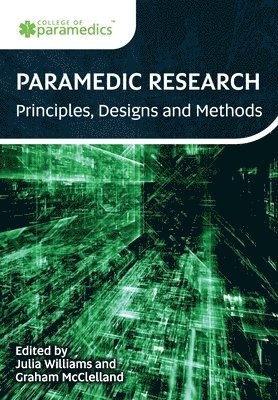
    Paramedic Research

    Principles, Designs and Methods

    AvJulia Williams,Graham McClelland

    Häftad, Engelska, 2025

    617 kr

    Skickas . Fri frakt över 249 kr.

    Beskrivning

    Research is fundamental in generating evidence to inform best practice. Not only does it drive improvements in patient care, but it also fosters the ongoing advancement of a profession. As the paramedic profession grows, so does the need for robust research.Paramedic Research: Principles, Designs and Methods harnesses the expertise of over 40 contributors, from across the UK and beyond, each offering a wealth of insight and experience. The result is a practical resource which guides you through the entirety of the research process, from identifying areas needing investigation and designing research questions to data collection, analysis and presenting your findings in a meaningful way.Context is everything, so this book draws on examples of research undertaken in settings that are familiar to unplanned, urgent and emergency care staff. This allows you to focus on the essential elements of research philosophies, principles and constructs without needing to learn about new healthcare environments.If you are hoping to master the transformative power of research within the prehospital and emergency care setting, understand its relevance and embrace it as an integral component of clinical practice, then this book is for you.

    Produktinformation

    • Utgivningsdatum:2025-06-13
    • Mått:171 x 246 x 18 mm
    • Vikt:782 g
    • Format:Häftad
    • Språk:Engelska
    • Antal sidor:322
    • Förlag:Class Publishing Ltd
    • ISBN:9781801611350

    Utforska kategorier

    • Referensverk och tvärvetenskap inom Samhälle och politik
    • Förlossningsvård inom Medicin
    • Medicinsk utrustning och medicinska tekniker inom Medicin

    Mer om författaren

    Julia Williams, PhD, PhD, PGCert ED, PG Cert; BSc (Hons), Dip HE FCPara.Professor of Paramedic Science and Director of the Paramedic Clinical Research Unit (ParaCRU) at the University of Hertfordshire, UK. Julia, a registered paramedic and Professor of Paramedic Science at the University of Hertfordshire, has been involved in paramedic education and development since 1996. As Head of Research for the College of Paramedics, she actively promotes paramedics' contributions to clinical research and advocates for their involvement in health and care research studies. Julia has extensive experience with qualitative, quantitative, and mixed-methods research in paramedic practice, emergency and urgent care, paramedic education, and workforce wellbeing, both in the UK and overseas. She has led research in the South East Coast Ambulance Service NHS Foundation Trust since 2005 and is a member of the National Ambulance Research Steering Group (NARSG). Julia has served on multiple trial steering groups, funding panels, and committees. She is also the Editor-in-Chief of the British Paramedic Journal and has mentored several paramedic PhD students. She firmly believes that a career in paramedic research is full of opportunities and exciting challenges, and hopes this book will be a valuable resource for everyone interested in research at all different levels.Graham McClelland, PhD, FCPara.Vice-Chancellor’s Fellow / Assistant Professor in Health, Dept. of Nursing, Midwifery & Health, Faculty of Health and Life Sciences, Northumbria UniversityHonorary Research Fellow, North East Ambulance Service NHS Foundation Trust, Visiting Clinical Researcher, Stroke Research Group, Newcastle University, Visiting Professor, School of Health and Social Work, University of Hertfordshire.Graham is a registered paramedic and Vice Chancellor’s Fellow at Northumbria University. Graham joined the North East Ambulance Service in 2003 and worked in a variety of clinical roles until he started getting involved in research which took him down a different career path.Graham is a pragmatic, applied healthcare researcher who has been involved in studies across the breadth of conditions encountered by paramedics, but his main focus has been on stroke. In addition to this Graham has served on the editorial board of the British Paramedic Journal since it was setup, is a reviewer for multiple journals and funding bodies and has been a member of both NHS and university ethics committees. Graham is privileged to be able to support, mentor and supervise paramedics from internships through to PhD students. He thinks this is an exciting time to be involved in prehospital and emergency care research and hopes that paramedic researchers will continue to seek ways to improve the care delivered to patients.

    Recensioner i media

    A rich and sophisticated resource for contemporary paramedic research, each page is infused with the experiences of its impressive authorship who strike the balance well between theoretical concepts and their practical application.Professor Nigel Rees – Paramedic, Assistant Director Welsh Ambulance Services University NHS Trust and Honorary Professor Warwick University Medical School

    Innehållsförteckning

    • SECTION 11 Introduction: paramedic research: what’s it all about?Julia Williams and Graham McClelland 2 Why do we need evidence-based practice?Jamie Scott and Karl Bloomer 3 Making sense of the research processKristy Sanderson and Larissa Prothero 4 Clinical audit, quality improvement, service evaluation and innovation: what are they?Duncan Robertson and Mary Peters  5 Research paradigmsCheryl Cameron, Adam Greene and Alan M. Batt 6 The role of existing literature in research: searching, retrieving and evaluationWilliam Broughton and Ian Maconochie 7 Developing research questions: avoiding the ‘so what’ factorScott Devenish and Julia Williams SECTION 2  8 Quantitative research designHelen Snooks and Christopher Stein 9 Data collection in observational studiesTim Edwards and Jack Barrett 10 Data collection in experimental studiesRuth Fisher and Elicia Austin 11 Making sense of quantitative dataJohn Talbot, Hayley Stagg and Anthony Herbland 12 Qualitative research designGeorgina Murphy-Jones and Joel Symonds 13 Qualitative data collectionMike Brady and Enrico Dippenaar 14 Making sense of qualitative dataUrsula Rolfe and Alison Porter 15 Mixed methods research designGregory A. Whitley and Scott Munro SECTION 316 Ethics and governance in researchGeorgette Eaton and Helen Pocock 17 Involving service users in researchSarah Black and Karl Charlton 18 Health economics: its role in health researchJamie Miles and Peter McMeekin 19 Sharing research findingsJames Yates and Peter Gregory  20 Developing a successful research proposalJanette Turner and Andy Newton 21 Obtaining research funding: hints and tipsGraham McClelland and Fiona Bell 22 Research careers for paramedicsKim Kirby and Graham McClelland 23 Conclusion: next stepsGraham McClelland and Julia Williams