• Fri frakt över 249 kr
  • •
  • Snabba leveranser
  • •
  • Billiga böcker
Kundservice

Du är på sajten för privatpersoner.

Företag, bibliotek eller offentlig verksamhet?

Du handlar på classic.bokus.com, där alla dina funktioner finns intakta.
Till classic.bokus.com
Bokus logotyp. Gå till startsidan.
  • Erbjudanden
  • Nyheter
  • Student
  • Topplistor
  • Barn & ungdom
  • Bokus Play
  • E-böcker
  • Pocketböcker
  • Spel & pussel

10% rabatt på allt med kod: NYSTART10 →

Sidfot

Mina sidor

    Hjälp

    • Kundservice
    • Vanliga frågor och svar
    • Frakt och leverans
    • Retur vid ångerrätt
    • Reklamera vara
    • Betalning
    • Köpvillkor
    • Allmänna villkor
    • Information om webbplatsens tillgänglighet

    Om Bokus

    • Om oss
    • Pressrum
    • För studenter
    • För företag
    • För bibliotek och offentlig verksamhet
    • För leverantörer
    • Hållbarhet

    Populärt

    • Aktuella erbjudanden
    • Presentkort
    • Studentlitteratur
    • Nya böcker
    • Topplistor
    • Signerade böcker
    • Engelska böcker

    Inspiration

    • Boktips
    • BookTok
    • Populära bokserier
    • Barnbokskaraktärer
    • Populära författare
    Logotyp för Bokus
    Följ oss på Facebook (extern länk)Följ oss på Instagram (extern länk)Följ oss på YouTube (extern länk)Följ oss på TikTok (extern länk)
    bokus @ CookiesAnpassa cookiesIntegritetspolicyKöpvillkor
    Till Citymail hemsida (extern länk)Till Budbee hemsida (extern länk)Till Postnord hemsida (extern länk)Till Schenker hemsida (extern länk)Till Early Bird hemsida (extern länk)Till Walleys hemsida (extern länk)
    1. Historia och arkeologi
    2. Historia
    3. Europas historia
    4. Medeltiden

    Persuasive Agency of Objects and Practices in Alfred the Great’s Reform Program

    AvGeorgina Pitt

    Inbunden, Engelska, 2024

    Del i serien CARMEN Visual and Material Cultures

    2 192 kr

    Beställningsvara. Skickas inom 5-8 vardagar. Fri frakt över 249 kr.

    Fler format och utgåvor

    Häftad

    538 kr

    Beskrivning

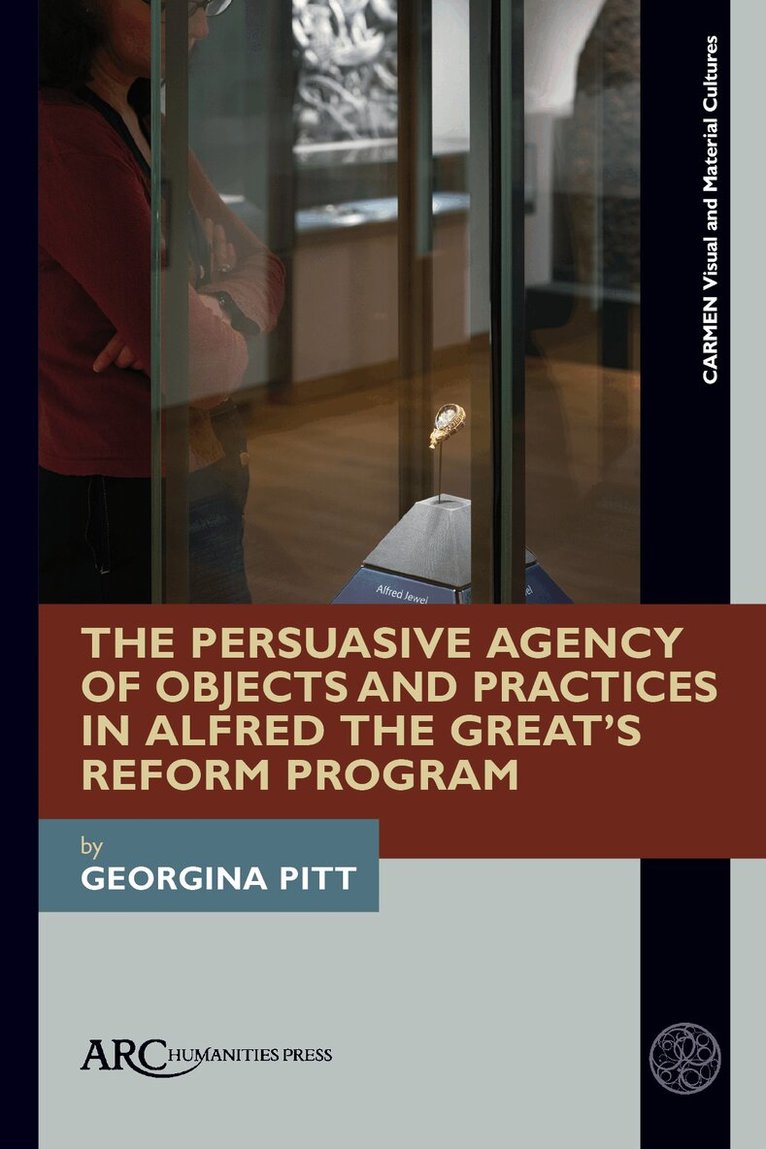
    Alfred the Great's early English kingdom was the only one to resist Viking conquest. His reform program strengthened the kingdom and enabled it to hold fast against the Vikings. But texts are largely silent on the process of reform. There has been a tendency to assume that these reforms would obviously be beneficial, but Alfred’s elites were not to know that in advance. What motivated them to do as their king bid them?This book analyzes how objects and behaviours shaped aristocratic response to the reform program, using assemblage theory and social practice theory. The Alfred Jewel (as shown on the cover) exercised a powerful persuasive agency in Alfredian reform. Broadening the frame of inquiry beyond textual evidence, giving objects and behaviours their due, permits a richer and more nuanced understanding.

    Produktinformation

    • Utgivningsdatum:2024-08-31
    • Mått:152 x 229 x 23 mm
    • Vikt:558 g
    • Format:Inbunden
    • Språk:Engelska
    • Serie:CARMEN Visual and Material Cultures
    • Antal sidor:242
    • Förlag:Arc Humanities Press
    • ISBN:9781802700848

    Utforska kategorier

    • Medeltiden inom Historia och arkeologi
    • Socialhistoria och kulturhistoria inom Historia och arkeologi
    • Arkeologiska perioder och områden inom Historia och arkeologi

    Mer om författaren

    Georgina Pitt is an Honorary Research Fellow at the University of Western Australia. Her research focuses on the early medieval period, across the disciplines of history, literary studies, and archaeology. She has published on Alfredian reform, Sutton Hoo, and the medieval experience of war.

    Recensioner i media

    Georgina Pitt’s study of the literature, material culture, and military reforms connected to Alfred the Great offers a multifaceted interpretation of learning and politics in Wessex and its neighbors in the late ninth century. This clearly written and engaging book will be of great use to historians and literary scholars alike. At the heart of Pitt’s book is the idea of persuasion, indicated in the “Persuasive Agency” of the title. Alfredian persuasiveness, Pitt suggests, is made up of the qualities of friendliness, informality, and accessibility. This friendliness, a recurring theme throughout Pitt’s book, is closely linked to loyalty, which is at the core of Alfredian ideology, as Pitt sees it. Through the ideology that she identifies, Pitt draws together all aspects of what she views as Alfred’s reform program: his military reforms, the educational program, his law-code (known as the domboc), the Anglo-Saxon Chronicle (ASC), the translations attributed to or commissioned by the king, and the conceptualization of his subjects as the Angelcynn. The coherent unification of all these different aspects of Alfred’s reign is facilitated by Pitt’s use of assemblage theory, which supports the identification of different actants in an assemblage.[...]This study offers a phenomenological approach to Alfred’s reign integrated with assemblage and social practice theory. With this book, Pitt demonstrates how these theories can be used productively for the study of a particular moment in medieval history. The great success of this theoretical approach is the drawing together of the seemingly quite disparate elements of Alfred’s reign into what can be seen as a coherent and organized reform program. Pitt’s book represents an important contribution to Alfredian studies, and, in its effective use of assemblage and social practice theory, to the fields of medieval history and literature more broadly.

    Innehållsförteckning

    • List of IllustrationsAcknowledgementsAuthor’s NoteAbbreviationsPrelude. The Enigmatic Alfred JewelChapter 1. IntroductionChapter 2. Military Innovation: Performing Alfredian IdeologyChapter 3. Alfredian IdeologyChapter 4. Alfredian Learning and Its Implications for Alfredian ReformChapter 5. Text-Bodies: A Crucial ActantChapter 6. Social Practices: Routinized Ways of Doing ThingsChapter 7. The Enigmatic Alfred Jewel: A Powerful Player in Alfredian ReformCoda. Looking Forward: Alfred’s SuccessorsBibliographyIndex