• Fri frakt över 249 kr
  • •
  • Snabba leveranser
  • •
  • Billiga böcker
Kundservice

Du är på sajten för privatpersoner.

Företag, bibliotek eller offentlig verksamhet?

Du handlar på classic.bokus.com, där alla dina funktioner finns intakta.
Till classic.bokus.com
Bokus logotyp. Gå till startsidan.
  • Erbjudanden
  • Nyheter
  • Student
  • Topplistor
  • Barn & ungdom
  • Bokus Play
  • E-böcker
  • Pocketböcker
  • Spel & pussel

10% rabatt på allt med kod: NYSTART10 →

Sidfot

Mina sidor

    Hjälp

    • Kundservice
    • Vanliga frågor och svar
    • Frakt och leverans
    • Retur vid ångerrätt
    • Reklamera vara
    • Betalning
    • Köpvillkor
    • Allmänna villkor
    • Information om webbplatsens tillgänglighet

    Om Bokus

    • Om oss
    • Pressrum
    • För studenter
    • För företag
    • För bibliotek och offentlig verksamhet
    • För leverantörer
    • Hållbarhet

    Populärt

    • Aktuella erbjudanden
    • Presentkort
    • Studentlitteratur
    • Nya böcker
    • Topplistor
    • Signerade böcker
    • Engelska böcker

    Inspiration

    • Boktips
    • BookTok
    • Populära bokserier
    • Barnbokskaraktärer
    • Populära författare
    Logotyp för Bokus
    Följ oss på Facebook (extern länk)Följ oss på Instagram (extern länk)Följ oss på YouTube (extern länk)Följ oss på TikTok (extern länk)
    bokus @ CookiesAnpassa cookiesIntegritetspolicyKöpvillkor
    Till Citymail hemsida (extern länk)Till Budbee hemsida (extern länk)Till Postnord hemsida (extern länk)Till Schenker hemsida (extern länk)Till Early Bird hemsida (extern länk)Till Walleys hemsida (extern länk)
    1. Medicin
    2. Omvårdnad och medicinska stödfunktioner
    3. Biomedicinsk teknik
    • Nyhet

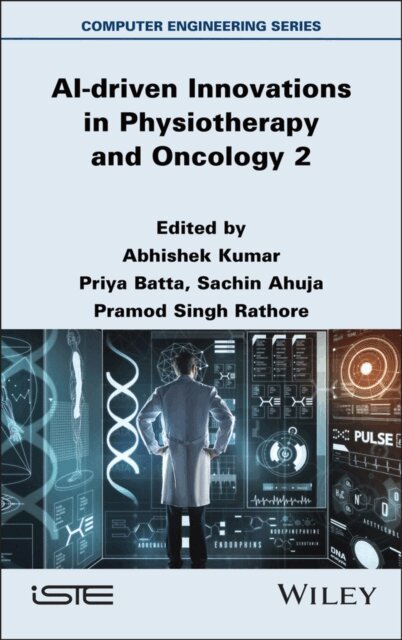
    AI-driven Innovations in Physiotherapy and Oncology 5

    AvAbhishek Kumar,Priya Batta

    Inbunden, Engelska, 2026

    Del i serien ISTE Invoiced

    1 776 kr

    Beställningsvara. Skickas inom 5-8 vardagar. Fri frakt över 249 kr.

    Beskrivning

    AI-driven Innovations in Physiotherapy and Oncology 5 explores how artificial intelligence (AI) is transforming modern healthcare by enabling smarter, more precise and patient-centered approaches. This book highlights the application of machine learning, deep learning and data analytics in enhancing rehabilitation and cancer care, from movement analysis and personalized physiotherapy to early detection and precision oncology.Combining both theory and practice, this book presents interdisciplinary insights for researchers, clinicians and academicians, while addressing real-world implementations, emerging trends and ethical considerations. The book also positions AI as a key driver in advancing next-generation healthcare systems and improving clinical outcomes.

    Produktinformation

    • Utgivningsdatum:2026-07-13
    • Format:Inbunden
    • Språk:Engelska
    • Serie:ISTE Invoiced
    • Antal sidor:272
    • Förlag:ISTE Ltd
    • ISBN:9781836691334

    Utforska kategorier

    • Biomedicinsk teknik inom Medicin
    • Biokemisk teknik inom Naturvetenskap och teknik
    • Artificiell intelligens inom Data och IT

    Mer om författaren

    Abhishek Kumar is an assistant director and professor in the Department of Computer Science and Engineering at Chandigarh University, Mohali, India. His expertise spans AI, renewable energy and image processing.Priya Batta is an associate professor at Amity School of Engineering and Technology, Amity University Punjab, Mohali, India. Her research specializes in AI, blockchain and the IoT.Sachin Ahuja is the Executive Director of Engineering and a professor at Chandigarh University, Mohali, India. His research specializes in AI, machine learning and data mining.Pramod Singh Rathore is an assistant professor at Manipal University Jaipur, India. His research interests include NS2, networks, data mining and DBMS.

    Innehållsförteckning

    • Preface xviiAbhishek KUMAR, Priya BATTA, Sachin AHUJA and Pramod Singh RATHOREIntroduction xixAbhishek KUMAR, Priya BATTA, Sachin AHUJA and Pramod Singh RATHOREChapter 1. Physiotherapy Patient Records Enhanced with Natural Language Processing 1Mandar MALAWADE and Rasika Ranjit CHAFLE1.1. Introduction 21.2. Physiotherapy patient records: structure, content and challenges 31.3. Fundamentals of NLP in healthcare 6\1.4. Applications of NLP in physiotherapy records 91.5. Technological frameworks for NLP in physiotherapy 131.6. Clinical benefits and opportunities 171.7. Conclusion 181.8. References 19Chapter 2. Neural Network Models for Optimizing Rehabilitation Timelines 23Namrata KADAM and K. GAVHALE2.1. Introduction and background 232.2. Core neural network architectures for rehabilitation 262.3. Applications of neural networks in rehabilitation timeline optimization 302.4. Neural network-based rehabilitation timeline optimization problems 342.5. Conclusions of neural network-enhanced rehabilitation timeline optimization 362.6. Conclusion 382.7. References 39Chapter 3. AI and Digital Twins for Personalized Physiotherapy Simulations 43Chandrakant PATIL and Swapna KAMBLE3.1. Introduction 443.2. Digital twin technology in healthcare 453.3. AI foundations for physiotherapy simulations 473.4. Integration of AI and digital twins for personalized physiotherapy 493.5. Applications in musculoskeletal rehabilitation 513.6. Applications in neurological rehabilitation 523.7. Real-time monitoring and predictive analytics 543.8. Challenges and ethical considerations 553.9. Future directions 563.10. Conclusion 583.11. References 59Chapter 4. ML for Outcome Prediction in Orthopedic Physiotherapy 61Poonam PATIL and Jiwan DEHANKAR4.1. Introduction 624.2. ML in healthcare and physiotherapy 634.3. Data sources for outcome prediction in orthopedic physiotherapy 654.4. ML algorithms for outcome prediction 684.5. Applications in orthopedic physiotherapy 704.6. Challenges and limitations 744.7. Future directions and clinical implications 754.8. Conclusion 764.9. References 77Chapter 5. Computer-Vision-based Fall-Risk Assessment in Physiotherapy Patients 81T. Poovishnu DEVI and Chandrayani ROKDE5.1. Introduction 825.2. Methodologies for computer-vision-based fall-risk assessment 835.3. Applications of computer-vision-based fall-risk assessment in physiotherapy 875.4. Challenges and limitations 895.5. Future directions and research opportunities 915.6. Conclusion 945.7. References 95Chapter 6. AI-Enhanced Virtual Reality Environments for Immersive Physiotherapy 99S. ANANDH and P. BAINALWAR6.1. Introduction 1006.2. Foundations of AI and VR in physiotherapy 1016.3. Immersive virtual environments for rehabilitation 1036.4. AI algorithms for personalized physiotherapy 1056.7. Clinical evidence and case studies 1106.8. Challenges, ethical issues and limitations 1116.9. Future directions in AI-enhanced VR physiotherapy 1136.10. Conclusion 1156.11. References 116Chapter 7. Predictive Modeling of Muscle Recovery Using DL 119Suraj KANASE and Kalpana MALPE7.1. Introduction 1207.2. Physiological basis of muscle recovery 1217.3. Traditional approaches to prediction 1237.4. DL techniques for predictive modeling 1247.5. Data sources and modalities 1277.6. Model architectures and frameworks 1307.7. Clinical applications and case studies 1327.8. Challenges and limitations 1347.9. Conclusion 1367.10. References 136Chapter 8. AI and Cloud-Based Platforms for Remote Physiotherapy Supervision 141Sandeep SHINDE and Shamla MANTRI8.1. Introduction 1428.2. AI in remote physiotherapy supervision 1438.3. Cloud-based platforms for telerehabilitation 1468.4. Synergistic integration of AI and cloud technologies 1488.5. Clinical applications and case studies 1538.6. Benefits and opportunities 1558.7. Challenges and limitations 1578.8. Future directions 1598.9. Conclusion 1618.10. References 162Chapter 9. ML Algorithms for Movement Quality Scoring in Physiotherapy Sessions 165Vaishali JAGTAP and G.M. VAIDYA9.1. Introduction 1669.2. Data acquisition methods for movement analysis 1679.3. Feature extraction and preprocessing 1709.4. ML algorithms for MQS 1729.5. Applications in physiotherapy sessions 1759.6. Challenges and limitations 1789.7. Future directions 1809.8. Conclusion 1819.9. References 182Chapter 10. AI-Powered Rehabilitation Robotics for Assisted Physiotherapy 185Mandar MALAWADE and Fazil SHEIKH10.1. Introduction 18610.2. Overview of rehabilitation robotics 18710.3. AI in rehabilitation robotics 18910.4. AI techniques for assisted physiotherapy 19010.5. Applications in neurological and musculoskeletal rehabilitation 19410.6. Human–robot interaction and patient engagement 19510.7. IoMT and wearable integration 19710.8. Challenges and limitations 19910.9. Future directions 20010.10. Conclusion 20110.11. References 201Chapter 11. Therapeutic Approaches in Cerebral Palsy 205Mandar MALAWADE and G. VARADHARAJULU11.1. Introduction 20611.2. Therapeutic approaches in cerebral palsy 20811.3. Neurodevelopmental therapy (NDT) 20911.4. Sensory integration (SI) 21011.5. Play therapy 21111.6. Combining NDT with sensory integration or play therapy 21211.7. Conclusion 21311.8. References 214Chapter 12. Knowledge, Attitude and Practice of Breast Self-Examination Among Women in the Era of AI-Driven Innovations in Physiotherapy and Oncology 217Ankita DURGAWALE, Vaishali JAGTAP, Trupti YADAV and Rujuta NENE12.1. Introduction 21812.2. Breast self-examination: concept, importance and current recommendations 22012.3. Knowledge of breast self-examination among women 22212.4. Attitude toward breast self-examination 22312.5. Practice of breast self-examination 22412.6. Role of AI in breast cancer screening and early detection 22412.7. AI-driven innovations in physiotherapy for breast cancer care 22512.8. Integrating AI with breast self-examination education and practice 22612.9. Conclusion 22812.10. References 228List of Authors 233Index 237