• Fri frakt över 249 kr
  • •
  • Snabba leveranser
  • •
  • Billiga böcker
Kundservice

Du är på sajten för privatpersoner.

Företag, bibliotek eller offentlig verksamhet?

Du handlar på classic.bokus.com, där alla dina funktioner finns intakta.
Till classic.bokus.com
Bokus logotyp. Gå till startsidan.
  • Erbjudanden
  • Nyheter
  • Student
  • Topplistor
  • Barn & ungdom
  • Bokus Play
  • E-böcker
  • Pocketböcker
  • Spel & pussel

10% rabatt på allt med kod NYSTART10 →

Sidfot

Mina sidor

    Hjälp

    • Kundservice
    • Vanliga frågor och svar
    • Frakt och leverans
    • Retur vid ångerrätt
    • Reklamera vara
    • Betalning
    • Köpvillkor
    • Allmänna villkor
    • Information om webbplatsens tillgänglighet

    Om Bokus

    • Om oss
    • Pressrum
    • För studenter
    • För företag
    • För bibliotek och offentlig verksamhet
    • För leverantörer
    • Hållbarhet

    Populärt

    • Aktuella erbjudanden
    • Presentkort
    • Studentlitteratur
    • Nya böcker
    • Topplistor
    • Signerade böcker
    • Engelska böcker

    Inspiration

    • Boktips
    • BookTok
    • Populära bokserier
    • Barnbokskaraktärer
    • Populära författare
    Logotyp för Bokus
    Följ oss på Facebook (extern länk)Följ oss på Instagram (extern länk)Följ oss på YouTube (extern länk)Följ oss på TikTok (extern länk)
    bokus @ CookiesAnpassa cookiesIntegritetspolicyKöpvillkor
    Till Citymail hemsida (extern länk)Till Budbee hemsida (extern länk)Till Postnord hemsida (extern länk)Till Schenker hemsida (extern länk)Till Early Bird hemsida (extern länk)Till Walleys hemsida (extern länk)
    1. Kultur
    2. Arkitektur

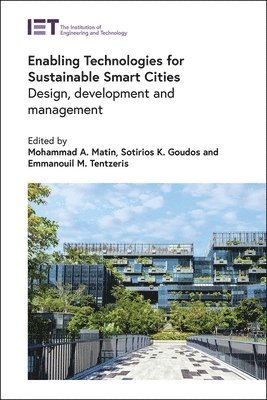
    Enabling Technologies for Sustainable Smart Cities

    Design, development and management

    AvMohammad A Matin,Mohammad A. Matin

    Inbunden, Engelska, 2025

    Del i serien Built Environment

    1 808 kr

    Beställningsvara. Skickas inom 3-6 vardagar. Fri frakt över 249 kr.

    Beskrivning

    As populations rise and cities draw ever-larger populations, smart cities are emerging around the world to cater for the need for sustainable urban development. The exploration of recent advances in information and communication technology (ICT), sensing and energy engineering offers promising enablers for creating, implementing, and promoting sustainable development strategies to address the challenges of this expanding urbanization.The aim of this book is to equip readers with the conceptual and practical knowledge they need to comprehend and put into practice the technological concepts involved in the design, development, and management of smart cities. The authors explore enabling technologies, capabilities, solutions and strategies to support sustainable smart cities including smart homes, zero energy buildings, smart sensing, Internet of Things (IoT), autonomous IoT, secure IoT, federated learning, data security, network security, privacy-preserving and decentralized intelligence, clean hydrogen and energy harvesting technologies.With contributions from global experts, this reference is a valuable resource for researchers, engineers, technologists and urban planners in the fields of smart city and urban sustainable development. Lecturers and advanced students will find the book useful as a course reference and for wider reading.

    Produktinformation

    • Utgivningsdatum:2025-11-04
    • Mått:156 x 234 x 16 mm
    • Vikt:540 g
    • Format:Inbunden
    • Språk:Engelska
    • Serie:Built Environment
    • Antal sidor:253
    • Förlag:Institution of Engineering and Technology
    • ISBN:9781839539435

    Utforska kategorier

    • Arkitektur inom Kultur
    • Sociala grupper och identitet inom Samhälle och politik
    • Regional planering inom Naturvetenskap och teknik

    Mer om författaren

    Mohammad A. Matin is a professor in the Department of Electrical and Computer Engineering at North South University (NSU), Dhaka, Bangladesh. His research focuses on wireless sensor networks, antenna engineering, UWB communication, cognitive radio, and EM modelling. He has published over 150 peer-reviewed journal and conference papers. He is the author and editor of 17 academic books and 21 book chapters. He serves as a member of the journal editorial boards for IEEE Communications Magazine and IET Wireless Sensor Systems. He is a member of the IEEE Communications Society. He holds an MSc Engineering degree in Digital Communication from Loughborough University, and a PhD degree in Wireless Communication from Newcastle University, UK.Sotirios K. Goudos is a professor at the School of Physics, Aristotle University of Thessaloniki, Greece, director of the ELEDIA@AUTH lab, and a member of the ELEDIA Research Center Network. He is the founding editor-in-chief of the Open Access Journal and serves as associate editor for IEEE Transactions on Antenna and Propagation, IEEE ACCESS, and IEEE Open Journal of the Communication Society. He is the section editor-in-chief in the Information and Communication Technologies Section of the Technologies open-access journal. He has authored the book Emerging Evolutionary Algorithms for Antennas and Wireless Communications (IET, 2021).Emmanouil M. Tentzeris is Ed and Pat Joy Endowed Chair Professor with the School of ECE at Georgia Tech, USA. His research focuses on novel inkjet/3D printed and flexible RF electronics, sensing, antennas, packaging, IoT, wearables, and sustainable energy harvesting. He has published 850+ papers in journals and at conferences, 7 books, and 26 book chapters. He is a regular co-chair and TPC chair for numerous conferences and workshops including the ACES Symposium, IEEE APS Symposium, and IEEE Wireless Power Transfer Conference. He is a Fellow of IEEE and a Fellow of the Electromagnetics Academy. He is also an IEEE EPS distinguished lecturer and he has served as an IEEE Distinguished Microwave Lecturer and as an IEEE C-RFID distinguished lecturer. He holds an MS and a PhD degree in Electrical Engineering and Computer Science from the University of Michigan, Ann Arbor, USA.

    Innehållsförteckning

    • Chapter 1: Introduction to smart citiesChapter 2: Transformation of traditional home to smart homeChapter 3: Towards zero energy buildings: the smart-thermostat use caseChapter 4: Toward smart society innovations through federated learning: enabling privacy-preserving and decentralized intelligenceChapter 5: Multi-criteria evaluation of hydrogen electrolyzer technologies for electricity, heating, cooling, and sterilization in high-risk zones of hospitals in future African smart citiesChapter 6: Advancing education in smart cities: IoT technologies and systems for sustainable developmentChapter 7: Multi-source energy harvesting for autonomous IoT modules in smart citiesChapter 8: Data security for smart citiesChapter 9: Securing IoT technologies for smart cities - can chaos be the answer?Chapter 10: Conclusion and future perspectives toward sustainable smart cities