• Fri frakt över 249 kr
  • •
  • Snabba leveranser
  • •
  • Billiga böcker
Kundservice

Du är på sajten för privatpersoner.

Företag, bibliotek eller offentlig verksamhet?

Du handlar på classic.bokus.com, där alla dina funktioner finns intakta.
Till classic.bokus.com
Bokus logotyp. Gå till startsidan.
  • Erbjudanden
  • Nyheter
  • Student
  • Topplistor
  • Barn & ungdom
  • Bokus Play
  • E-böcker
  • Pocketböcker
  • Spel & pussel

10% rabatt på allt med kod NYSTART10 →

Sidfot

Mina sidor

    Hjälp

    • Kundservice
    • Vanliga frågor och svar
    • Frakt och leverans
    • Retur vid ångerrätt
    • Reklamera vara
    • Betalning
    • Köpvillkor
    • Allmänna villkor
    • Information om webbplatsens tillgänglighet

    Om Bokus

    • Om oss
    • Pressrum
    • För studenter
    • För företag
    • För bibliotek och offentlig verksamhet
    • För leverantörer
    • Hållbarhet

    Populärt

    • Aktuella erbjudanden
    • Presentkort
    • Studentlitteratur
    • Nya böcker
    • Topplistor
    • Signerade böcker
    • Engelska böcker

    Inspiration

    • Boktips
    • BookTok
    • Populära bokserier
    • Barnbokskaraktärer
    • Populära författare
    Logotyp för Bokus
    Följ oss på Facebook (extern länk)Följ oss på Instagram (extern länk)Följ oss på YouTube (extern länk)Följ oss på TikTok (extern länk)
    bokus @ CookiesAnpassa cookiesIntegritetspolicyKöpvillkor
    Till Citymail hemsida (extern länk)Till Budbee hemsida (extern länk)Till Postnord hemsida (extern länk)Till Schenker hemsida (extern länk)Till Early Bird hemsida (extern länk)Till Walleys hemsida (extern länk)
    1. Medicin
    2. Omvårdnad och medicinska stödfunktioner
    3. Rehabilitering

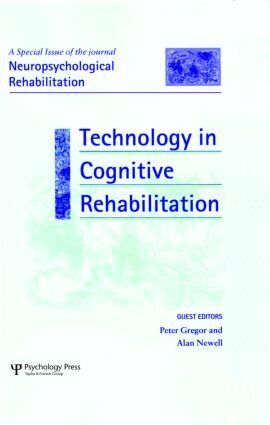
    Technology in Cognitive Rehabilitation

    A Special Issue of Neuropsychological Rehabilitation

    AvPeter Gregor,Alan Newell

    Inbunden, Engelska, 2004

    Del i serien Special Issues of Neuropsychological Rehabilitation

    2 495 kr

    Beställningsvara. Skickas inom 10-15 vardagar. Fri frakt över 249 kr.

    Beskrivning

    Communication and Information Technology has been used to support older and disabled people for over thirty years and there have been many successes in this field. Until recently, research has largely concentrated on people with physical or sensory dysfunction; computer technology has been increasingly used to support cognitive activities in able bodied people but its use to support people with disabilities has not had much widespread recognition. Yet well-designed C and IT systems have great potential to enhance the quality of life and independence of people with cognitive dysfunction, by: enabling them to retain a higher level of independence and control over their lives, providing appropriate levels of monitoring and supervision of 'at risk' people, without violating privacy, keeping people intellectually and physically active, and providing communications methods to reduce social isolation. This special issue of Neuropsychological Rehabilitation recognises the potential of information technology to provide support for people with cognitive dysfunction, including the use of computers to provide traditional prostheses, albeit within the cognitive domain. The selection of papers in this issue shows that the help and support available can be far more than the 'artificial replacement of part of the body' (the literal definition of prosthesis) and can include techniques to provide lifestyle support for people who would not be thought of as requiring 'prosthetic support'.

    Produktinformation

    • Utgivningsdatum:2004-04-01
    • Mått:156 x 234 x 17 mm
    • Vikt:640 g
    • Format:Inbunden
    • Språk:Engelska
    • Serie:Special Issues of Neuropsychological Rehabilitation
    • Antal sidor:260
    • Förlag:Taylor & Francis Ltd
    • ISBN:9781841699608

    Utforska kategorier

    • Rehabilitering inom Medicin
    • Neurokirurgi inom Medicin

    Innehållsförteckning

    • P. Gregor, A. Newell, Introduction to the Special Issue. E.F. LoPresti, A. Mihailidis, N. Kirsch, Assistive Technology for Cognitive Rehabilitation: State of the Art. T. Manly, J. Heutink, B. Davison, B. Gaynord, E. Greenfield, A. Parr, V. Ridgeway, I.H. Robertson, An Electronic Knot in the Handkerchief: 'Content Free Cueing' and the Maintenance of Attentive Control. E.A. Inglis, A. Szymkowiak, P. Gregor, A.F. Newell, N. Hine, B.A. Wilson, J. Evans, P. Shah, Usable Technology? Challenges in Designing a Memory Aid with Current Electronic Devices. N. Kapur, E.L. Glisky, B.A. Wilson, Technological Memory Aids for People with Memory Deficits. N. Alm, A. Astell, M. Ellis, R. Dye, G. Cowans, J. Campbell, A Cognitive Prosthesis and Communication Support for People with Dementia. A. Mihailidis, J.C. Barbenel, C. Eng, G. Fernie, The Efficacy of an Intelligent Cognitive Orthosis to Facilitate Handwashing by Persons with Moderate to Severe Dementia. D. Gartland, Considerations in the Selection and Use of Technology with People Who Have Cognitive Deficits following Acquired Brain Injury. M.A. Crerar, Aphasia Rehabilitation and the Strange Neglect of Speed. A.A. Rizzo, M. Schultheis, K.A. Kerns, C. Mateer, Analysis of Assets for Virtual Reality Applications in Neuropsychology. A.R. Carmichael, Evaluating Digital 'On-line' Background Noise Suppression: Clarifying Television Dialogue for Older, Hard of Hearing Viewers.