• Fri frakt över 249 kr
  • •
  • Snabba leveranser
  • •
  • Billiga böcker
Kundservice

Du är på sajten för privatpersoner.

Företag, bibliotek eller offentlig verksamhet?

Du handlar på classic.bokus.com, där alla dina funktioner finns intakta.
Till classic.bokus.com
Bokus logotyp. Gå till startsidan.
  • Erbjudanden
  • Nyheter
  • Student
  • Topplistor
  • Barn & ungdom
  • Bokus Play
  • E-böcker
  • Pocketböcker
  • Spel & pussel

Må bättre, för mindre! Upp till 50% rabatt på hälsoböcker

Sidfot

Mina sidor

    Hjälp

    • Kundservice
    • Vanliga frågor och svar
    • Frakt och leverans
    • Retur vid ångerrätt
    • Reklamera vara
    • Betalning
    • Köpvillkor
    • Allmänna villkor
    • Information om webbplatsens tillgänglighet

    Om Bokus

    • Om oss
    • Pressrum
    • För studenter
    • För företag
    • För bibliotek och offentlig verksamhet
    • För leverantörer
    • Hållbarhet

    Populärt

    • Aktuella erbjudanden
    • Presentkort
    • Studentlitteratur
    • Nya böcker
    • Topplistor
    • Signerade böcker
    • Engelska böcker

    Inspiration

    • Boktips
    • BookTok
    • Populära bokserier
    • Barnbokskaraktärer
    • Populära författare
    Logotyp för Bokus
    Följ oss på Facebook (extern länk)Följ oss på Instagram (extern länk)Följ oss på YouTube (extern länk)Följ oss på TikTok (extern länk)
    bokus @ CookiesAnpassa cookiesIntegritetspolicyKöpvillkor
    Till Citymail hemsida (extern länk)Till Budbee hemsida (extern länk)Till Postnord hemsida (extern länk)Till Schenker hemsida (extern länk)Till Early Bird hemsida (extern länk)Till Walleys hemsida (extern länk)
    1. Samhälle och politik
    2. Samhälle och kultur
    3. Sociala grupper och identitet
    4. Etnicitet

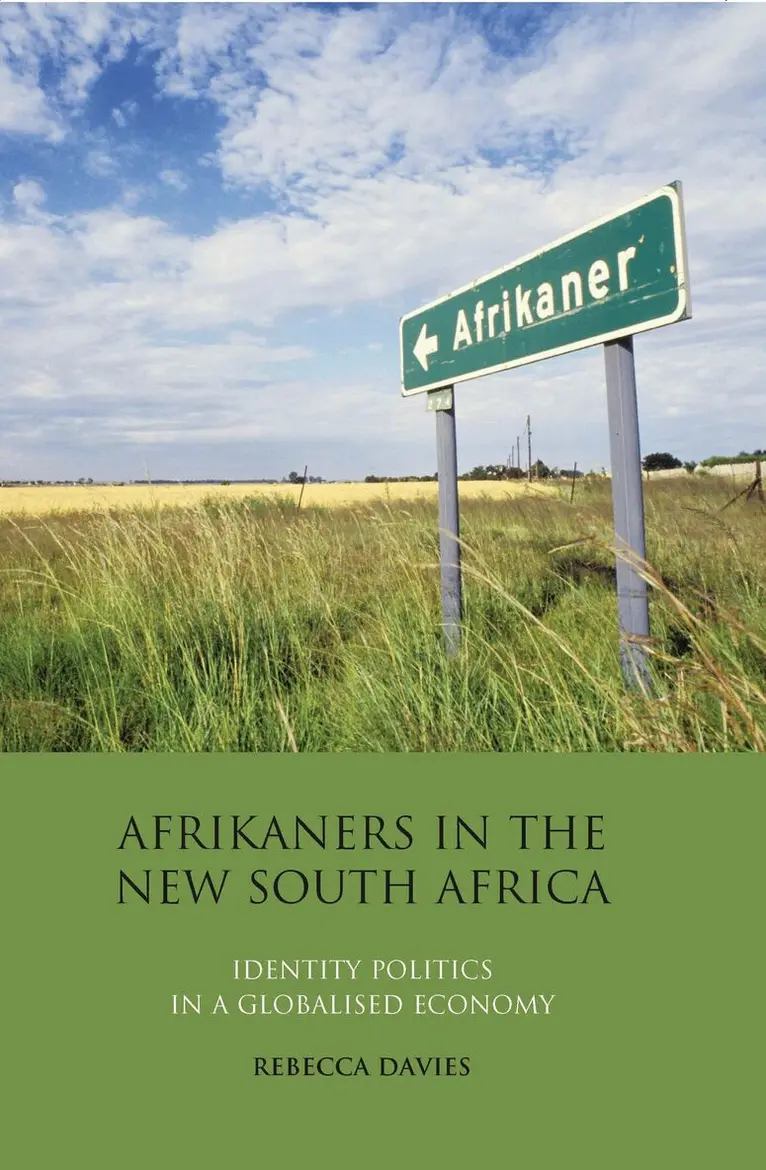
    Afrikaners in the New South Africa

    Identity Politics in a Globalised Economy

    AvRebecca Davies

    Inbunden, Engelska, 2009

    1 811 kr

    Beställningsvara. Skickas inom 10-15 vardagar. Fri frakt över 249 kr.

    Fler format och utgåvor

    E-bok

    2 020 kr

    Beskrivning

    How has the position of Afrikaners changed since the end of the Apartheid regime in South Africa? While the links between Afrikaner nationalist identity and the apartheid regime have been irrevocably altered, it is evident that this newly disempowered minority still commands a vast material and cultural capital. Certain Afrikaans speakers have become important players in the new South Africa and on the world stage. Davies argues that the global political economy and the closely associated ideology of globalization are major catalysts for change in Afrikaner identifications and positions. She identifies multiple Afrikaner constituencies and identities and shows how they play out in the complex social, economic and political landscape of South Africa.Accessible, informative and well-written, "Afrikaners in the New South Africa" is a vital contribution to our understanding of post-apartheid South Africa. It will be indispensable for those interested in South Africa, identity politics, globalization, international political economy and geography.

    Produktinformation

    • Utgivningsdatum:2009-07-30
    • Mått:138 x 216 x 22 mm
    • Vikt:390 g
    • Format:Inbunden
    • Språk:Engelska
    • Antal sidor:208
    • Förlag:Bloomsbury Publishing PLC
    • ISBN:9781845117856

    Utforska kategorier

    • Etnicitet inom Samhälle och politik
    • Politik och statsskick inom Samhälle och politik
    • Ekonomisk politik inom Ekonomi och Ledarskap

    Mer om författaren

    Rebecca Davies is Senior Lecturer in the Department of International Relations at Plymouth University where she teaches African politics. She holds a DPhil from the University of Stellenbosch in South Africa where she remains a visiting fellow at the Centre for Comparative and International Politics. She has taught at universities in Australia, South Africa and New Zealand.

    Recensioner i media

    "'This book will make a major theoretical contribution to the study of Afrikaners, ethnic mobilization and the politics of post-apartheid South Africa. It is well written and [makes] an original contribution to the field.... [T]he author shows us how in the post-apartheid era there has been a deep displacement in Afrikaner identifications. However, as the author equally demonstrates, Afrikaner nationalism remains significant as a political issue in South Africa because of the economic and cultural importance of (White) Afrikaans speakers. The integration of an Afrikaner bourgeoisie into the global political economy is something that contributes to both the strengthening of Afrikaners as an economic bloc at the elite level and also contributes to the increasing interrogation of what it fundamentally means to be an Afrikaner. The varieties of Afrikaner identities and how this plays out in the social, economic and political landscape of South Africa is of great importance and the author has really tackled the subject well. I think it will be a book of great interest to students of South Africa and will be well received by the academic community.' - Professor Ian Taylor, School of International Relations, University of St. Andrews 'This book skilfully explores the place and identity of 'Afrikanerdom' in post-apartheid South Africa.... The principal finding of the book is that the ideology of globalisation has acted as a major catalyst for change in Afrikaner identifications, resulting in these groups 'successfully' adapting to the post-apartheid agenda. In short, class-orientated and capital driven coalitions between the Afrikanerdom and the African National Congress have acted to preserve the privilege and power of Afrikaners. However, in so doing, the ethnic character and identities that previously prioritised and valued Afrikaner solidarity have been questioned and undermined. This book therefore makes an important contribution to our understanding of post-apartheid South Africa and provides a detailed empirical case study of the impacts of globalisation on identity reconstruction in a society in transition. The book will appeal to theorists, students and other readers concerned about globalisation and identity. It will be of particular interest to students reading International Political Economy, International Relations and Geography.' - Professor Richard Gibb, School of Geography, University of Plymouth"

    Innehållsförteckning

    • Acknowledgements; Preface; 1. Rebuilding the Future or Revisiting the Past?; Introduction; A political economy of post-apartheid Afrikaner identity; Theorising identity in a global era; 2. The Afrikaner Nationalist Project; Appropriating the past: The development of an Afrikaner identity; Moving towards consensus; A volk in retreat?; The nationalist project unravels; A class apart: The maturation of Afrikaner capital; 3. The Nature of Consensus in the 'New' South Africa; Consolidating dominance? The shape of the new hegemonic order; Neo-liberal orthodoxy and the capital transition. Connecting with the global consensus; Compromise on the domestic front; An African Renaissance?; 4. Contemporary Manifestations of Afrikaner Identity in an Era of Increasing Globalisation; Rethinking the cultural: The future of the Afrikaner past; The politics of transformation; The new discourse of minority rights; The culture industry; The rise of a globalised capital consensus; 5. The 'Logic of the Local' in Contemporary Afrikaner Identity Politics; The local tradition in Afrikaner nationalist politics; An alternative Afrikanerdom?; Recreating the cultural: New visions of Afrikaans; Reorienting the local: Politics at the provincial level; 6. Renewing the Consensus in a Post-Apartheid Era?; Bibliography; Index.