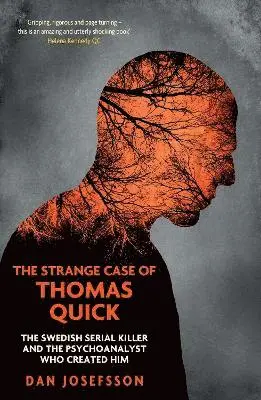
Häftad, Engelska, 2015
Strange Case of Thomas Quick
176 kr
Skickas tisdag 13/10
Beskrivning
Produktinformation
- Utgivningsdatum: 2015-09-03
- Mått: 153 x 234 x 35 mm
- Vikt: 594 g
- Format: Häftad
- Språk: Engelska
- Antal sidor: 528
- Förlag: Granta Books
- ISBN: 9781846275760
Utforska kategorier
Betyg & recensioner
1 recensioner, genomsnitt 5/5
- 5/5 Max
This book is available in English and Swedish, and will soon also be published in German and Danish. The writer (DJ) received the highest award for a reporter, The Golden Spade. But he literally deserves also to be appointed a doctor of honour at a department of jurisprudence. The defendant Thomas Quick knew literally nothing about any of the 8 murders for which he was convicted by 6 courts (each consisting of several judges). But a large team of prosecutor, policemen, psychiatrists, psychologists, PLUS THE DEFENCE COUNSEL, spent years in fabricating false evidence. There is no jury in Sweden. But there is no excuse for those many judges who believed the unanimous claim by the prosecutor team that TQ had proved himself to know things which only the murderer could know. Today TQ is acquitted of all murders, but only due to the immense contributions of DJ (and Hannes Råstam, another muckraking reporter). The book is exciting as a thriller. And this remains true even though DJ has examined the total body of documents, audio- and video-tapes. He has also done much wallraffing. It turned out that all clinicians at one psychiatric institution for mentally ill criminals were former patients of one single psychoanalyst in Stockholm, Margit Norell. There TQ was given recovered memory therapy in order to make him "recall" that he had committed all unsolved child murders in Scandinavia. His special therapist would once a week take a journey to Stockholm and get secret instructions from Norell about how to proceed next. - Another aspect. In Sweden it is not thought that legal evidence evaluation should be based on ordinary lay thinking, but on specific jurisprudential methods which are presented in books by experts. Students must learn these doctrines; and many of them will eventually be judges and prosecutors. But during half a century none of the experts has shown that these methods can be applied to real cases. In fact, the former president of the Supreme Court said at a semi-public meeting that judges would not be able to agree about what is a correct and an incorrect evidence evaluation. Here is another merit of DJ's book. By reading it students would learn much more about valid evidence evaluation than by all the present textbooks. - A little inside information. Elizabeth Loftus (the greatest expert in this area) has read the English manuscript before it was printed.