• Fri frakt över 249 kr
  • •
  • Snabba leveranser
  • •
  • Billiga böcker
Kundservice

Du är på sajten för privatpersoner.

Företag, bibliotek eller offentlig verksamhet?

Du handlar på classic.bokus.com, där alla dina funktioner finns intakta.
Till classic.bokus.com
Bokus logotyp. Gå till startsidan.
  • Erbjudanden
  • Student
  • Topplistor
  • Barn & ungdom
  • Bokus Play
  • E-böcker
  • Ljudböcker
  • Pocketböcker
  • Spel och pussel

5% studentrabatt – använd koden KURSBOK27 →

Sidfot

Mina sidor

    Hjälp

    • Kundservice
    • Vanliga frågor och svar
    • Frakt och leverans
    • Retur vid ångerrätt
    • Reklamera vara
    • Betalning
    • Köpvillkor
    • Allmänna villkor
    • Information om webbplatsens tillgänglighet

    Om Bokus

    • Om oss
    • Pressrum
    • För studenter
    • För företag
    • För bibliotek och offentlig verksamhet
    • För leverantörer
    • Hållbarhet

    Populärt

    • Aktuella erbjudanden
    • Presentkort
    • Studentlitteratur
    • Nya böcker
    • Topplistor
    • Signerade böcker
    • Engelska böcker

    Inspiration

    • Boktips
    • BookTok
    • Barnbokskaraktärer
    • Populära författare
    Logotyp för Bokus
    Följ oss på Facebook (extern länk)Följ oss på Instagram (extern länk)Följ oss på YouTube (extern länk)Följ oss på TikTok (extern länk)
    bokus @ CookiesAnpassa cookiesIntegritetspolicyKöpvillkor
    Till Citymail hemsida (extern länk)Till Budbee hemsida (extern länk)Till Postnord hemsida (extern länk)Till Schenker hemsida (extern länk)Till Early Bird hemsida (extern länk)Till Walleys hemsida (extern länk)
    1. Samhälle och politik
    2. Samhälle och kultur
    3. Kultur och medier
    4. Kulturvetenskap

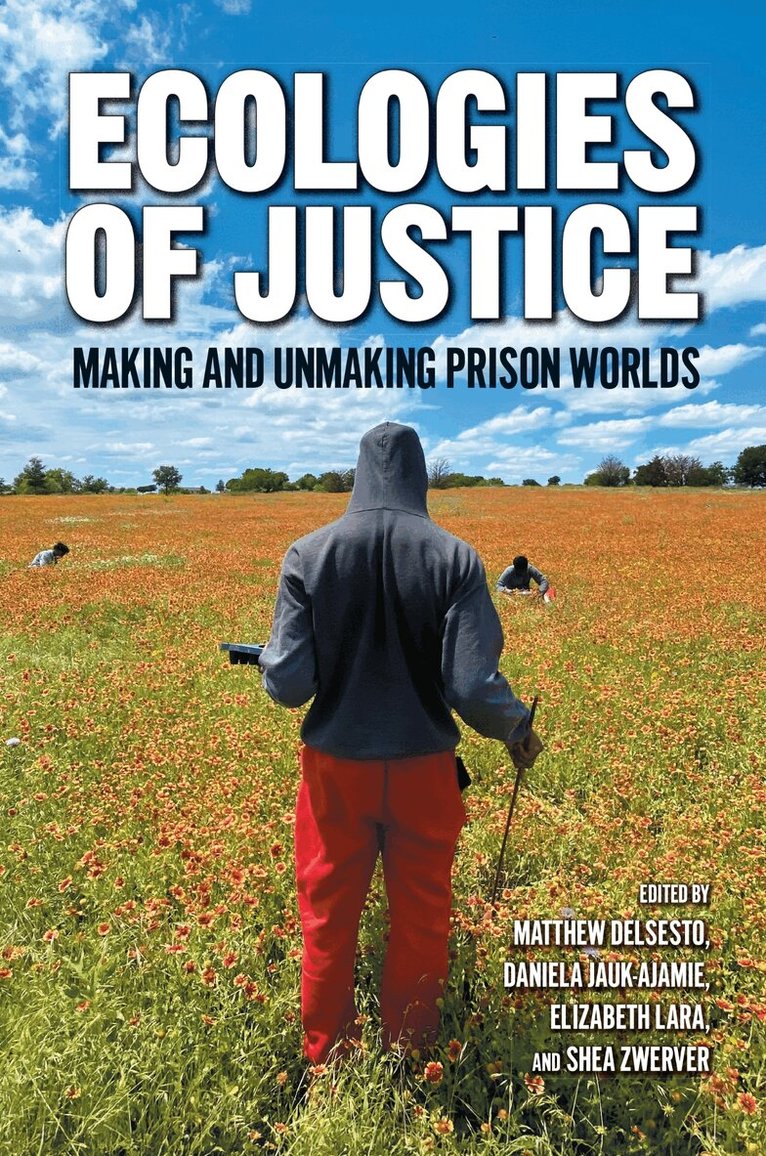
    Ecologies of Justice

    Making and Unmaking Prison Worlds

    AvMatthew DelSesto,Daniela Jauk-Ajamie

    Häftad, Engelska, 2026

    Del i serien Nature, Society, and Culture

    456 kr

    Kommande

    Beskrivning

    What is the role of multi-species ecologies in creating spaces that counteract the violence in carceral systems and environmental destruction? This book brings together, for the first time, contributions on issues related to prison, jail, and reentry programs, community-based interventions, environmental justice, and sustainability. Through rigorous analysis, detailed case studies, poetry, and personal reflections, the book offers ways of thinking and acting at the intersection of environmental issues and the carceral system. It gathers hard-earned wisdom and insight of researchers, activists, practitioners, and community leaders from within and beyond prison walls who have taken up their projects despite profound institutional constraints.Approaches in the book range from reform to abolition, as authors detail both practical interventions and imaginative courses of action. More than a contribution to academic knowledge, the book also uniquely highlights voices of those who are incarcerated, survivors of crime, and institutional stakeholders. In addition to writing about the carceral system based on research and personal experience, authors describe practices that are creating transformative spaces of environmental education, building effective pipelines for green workforce development, and sustaining reciprocal relationships for eco-social healing.

    Produktinformation

    • Utgivningsdatum:2026-11-10
    • Mått:156 x 235 x undefined mm
    • Vikt:454 g
    • Format:Häftad
    • Språk:Engelska
    • Serie:Nature, Society, and Culture
    • Antal sidor:334
    • Förlag:Rutgers University Press
    • ISBN:9781978840324

    Utforska kategorier

    • Kulturvetenskap inom Samhälle och politik
    • Kriminalvård och straff inom Samhälle och politik

    Mer om författaren

    Matthew Delsesto is a sociologist, author, and educator with over fifteen years of experience in prison education. He has led collaborative research projects, developed community engaged learning initiatives at universities, consulted with nonprofit organizations on outreach, strategy, and program evaluation, taught experiential learning courses on college campuses and in community-based settings, and worked to strengthen public engagement with city government. His research and practice have been funded by the National Science Foundation, Hearst Foundations, and the Center for Human Rights and International Justice. He is the author of Design and the Social Imagination (2022) and over a dozen publications in academic journals and other outlets.Daniela Jauk-Ajamie is an assistant professor of sociology and criminal justice studies at the University of Akron, Ohio. She is a certified clinical sociologist and serves on the board of the American Association of Applied and Clinical Sociology (AACS). She co-authored the book Gardening Behind Bars: Clinical Sociology and Food Justice in Incarcerated Settings (2024).Elizabeth Lara currently works as a garden educator, Dodger Stadium tour guide (with a specialization on the botanic garden tour), a facilitator for a domestic violence intervention program, and a freelance gardener. Her academic research focuses on gardens and horticultural history in current and former sites of incarceration in California. Her work "Prison Gardens and Growing Abolition" has been published in the edited collection The Promise of Multispecies Justice (2022).Shea Zwerver works to bring nature to carceral settings, increase access to nature to promote prosocial behavior, and improve quality of life through equity-driven practices. From 2016 to 2022, she served in multiple roles with Pennsylvania's Department of Conservation and Natural Resources. There, she conceptualized and coordinated a vocational and educational training program–the "Correctional Conservation Collaboration" at state prisons in arboriculture, forestry, and natural resource conservation.

    Recensioner i media

    "An imaginative montage of cutting-edge research, poetry, history, social criticism, and timely storytelling, this inspiring text puts the voices of incarcerated people, survivors of crime, horticultural educators, correctional reformers, and prison abolitionists in conversation with each other and with the wider ecology of nature to which we belong."— Stephen Pfohl, professor of sociology at Boston College"An amazing visual of how both style and topic can interplay to create collaboration. This volume brings together a multitude and range of issues to this collection. The authors, and editors, of this volume highlight how interlinked and interrelated topics of environmental justice, incarceration, reentry, multi-species ecologies, and beyond are to both understanding and moving away from traditional punitive and short-sided markers of justice. Further, this volume seeks to build bridges between reform and abolition to create broader efforts for a wider goal of a world beyond prisons." - Calvin John Smiley, author of Purgatory Citizenship: Reentry, Race, and Abolition"Ecologies of Justice is so rich and multidimensional; I applaud the public sociology orientation of the book and how it is written by multiple people from multiple perspectives at the intersection of carceral issues and ecology. The person-centered language also illustrates some of the disconnects between academic discourse and how people describe their own experiences of oppression." - Meghan Kallman, coauthor of The Conceivable Future: Planning Families and Taking Action in the Age of Climate Change"With forceful clarity, Ecologies of Justice asks us all to witness human and environmental 'healing as social practice' and 'position personal healing and transformation as a product of life-giving social and ecological relationships.' For all of us who tend to plants and place, and hope to tend to people with equal care and dignity, this compilation of brave, heartfelt research and results is just what our world needs now." - Jennifer Jewell, founder and host of Cultivating Place: Conversations on Natural History and the Human Impulse to Garden"Ecologies of Justice is a compelling exploration of the intersection between environmental justice and the carceral system. The voices of incarcerated individuals, survivors of crime, and institutional stakeholders highlight the transformative potential of ecological practices, from prison gardens to community-based environmental education. Poetry and reflections enhance the book's emotional resonance, illustrating justice and healing through connection to nature. More than academic discourse, it is a testament to resilience and innovation in creating a more just, sustainable world." - Christine Lynn Norton, professor of social work at Texas State University"This profound volume weaves a remarkable and informative tapestry from voices that raise awareness and pose solutions for two of our most urgent societal concerns: carceral and environmental. The editors have taken time and care to include expressions from diverse people and multiple genres—from poetry to expository—to ensure that the full range of textures and meanings has been included." - Nalini Nadkarni, professor and director of the Initiative to bring Science Programs to the Incarcerated (INSPIRE) at the University of Utah"Ecologies of Justice opens up a dynamic space of dialogue between fields of study and practice too often treated separately: environmental resilience and sustainability on the one hand and mass incarceration and the carceral state on the other. It firmly situates justice debates at the crossroads of environmental degradation and social exclusion." - Paul Draus, faculty director at the University of Michigan Detroit Center and professor of sociology at the University of Michigan-Dearborn"Ecologies of Justice offers an important reflection on the intersection between environmental justice, ecology, crime, and prison. The authorship is unique, comprised of practitioners, academics, community representatives, and the incarcerated community. This combination is rare but necessary, ensuring a well-rounded discussion of the ecologies of justice that places those most directly impacted at the center of the conversation." - Omi Hodwitz, associate professor at the Prison Education Initiative and the Department of Culture, Society, and Justice"We rarely think of prisons as places where new ideas take root. Given the brutality and degradation that define so much of American incarceration, that's understandable. Yet Ecologies of Justice reveals how prisons can become sites of creativity, renewal, and transformation. Inspiring and deeply thought-provoking, it offers a compelling vision for shrinking the carceral system while healing the environment." - James Forman, Jr., Pulitzer Prize-winning author of Locking Up Our Own: Crime and Punishment in Black America

    Innehållsförteckning

    • Contents Yarrow Frederick Livingston Introduction Matthew DelSesto, Daniela Jauk-Ajamie, Elizabeth Lara, and Shea ZwerverPart I: Contexts Jury Duty Frederick Livingston Chapter 1: The Environmental and the Carceral Matthew DelSesto, Daniela Jauk-Ajamie, Elizabeth Lara, and Shea Zwerver Chapter 2: Remembering a Leader, Continuing the Work Carlos Rosado Chapter 3: Soil Therapy Genea Richardson and Brendon Wilson Chapter 4: How Soil Acts as a Living Witness to Racial Violence Leanna First-Arai Chapter 5: The Politics of Concrete David Helps Chapter 6: Temporal Misalignment William Anderson Chapter 7: A Prison Tree Morgan Godvin Chapter 8: Healing Our Relationship to the Land Ki'Amber ThompsonPart II: Inside The Garden Sleeps Joe McManus Chapter 9: From Insight Garden Program to Land Together Elizabeth Lara Chapter 10: The Sustainability in Prisons Project Kelli Bush The Compost Pile Brian Auclair Chapter 11: Worm Farming in Washington State Nicholas Hacheney and Tomas Keen Chapter 12: Set Free Through Sustainability Juan Hernandez Chapter 13: Prison with Purpose Trip Finity Taylor and Cory Campbell Metamorphosis Frederick Livingston Chapter 14: Warrior and Weaver Work Rebekah Mende Chapter 15: Sustaining Oases Rima Green and Erika Rumbley Chapter 16: Liberatory Spaces in Prison Raquel Pinderhughes, Josie Phoenix, and Patrick Gazeley-RomneyPart III: Outside Meet Needs, Meet Growth Stephanie Moniz Chapter 17: Preparing for What's Next Through Farming and Community Kristen Powers and Linda Cayton Chapter 18: The Canoe Project Elizabeth Hawes Chapter 19: Food and Community as Disruptive Methodology Kelsey Timler and Nyki Kish Chapter 20: Growing Community Beyond the Fence Sam Phillips and Daniela Jauk-Ajamie Chapter 21: Therapeutic Horticulture as an Intervention with Women Who Have Experienced Abuse and Intimate Partner Violence Claire Renzetti, Diane Follingstad, Rachel Reeves and Caihing Li Chapter 22: Losing Paul and Finding Him in the Cardinal Judith Foster Son to Mother Brian Auclair Chapter 23: Becoming Ecosystem Participants Jarid Manos and Abiodun HendersonConclusion Matthew DelSesto Afterword Matthew Delsesto, Daniela Jauk-Ajamie, Elizabeth Lara, and Shea Zwerver Notes on Contributors