
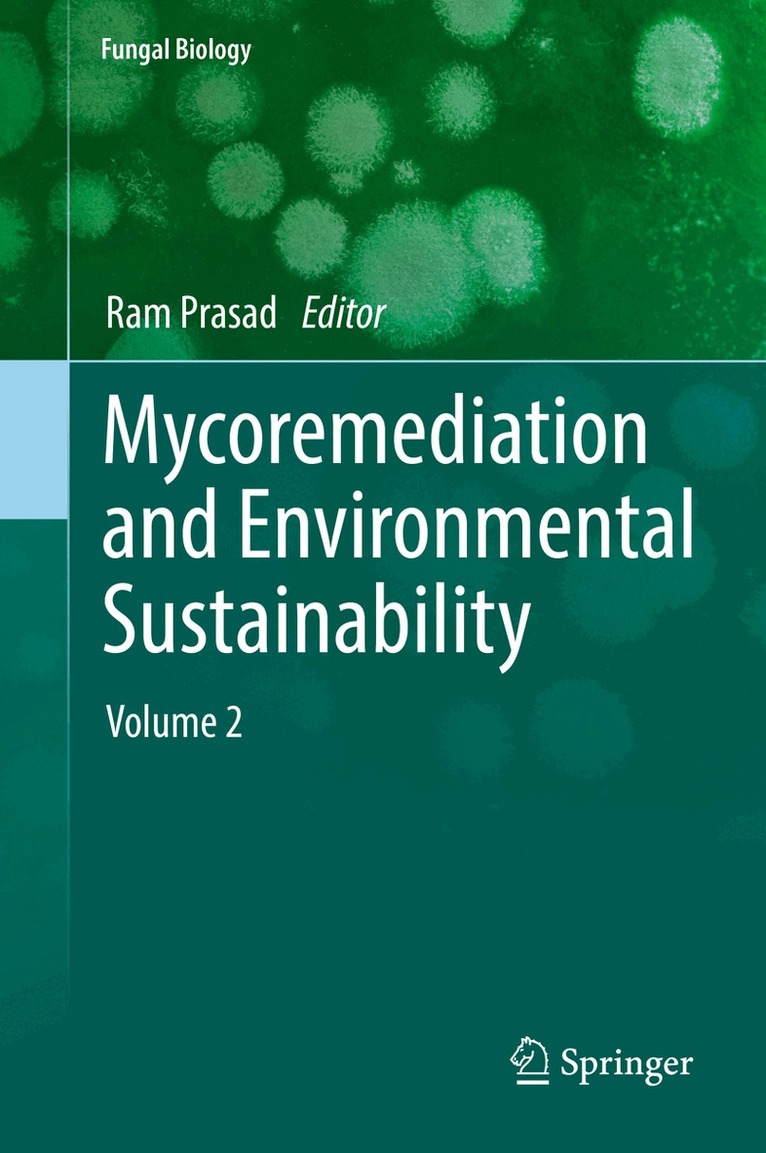
Mycoremediation and Environmental Sustainability
Volume 2
1 653 kr
Beställningsvara. Skickas inom 10-15 vardagar. Fri frakt över 249 kr.
Fler format och utgåvor
Beskrivning
Bioremediation is the use of microorganisms' metabolism to degrade waste contaminants (sewage, domestic, and industrial effluents) into non-toxic or less toxic materials by natural biological processes. Volume 2 offers new discussion of remediation through fungi—or mycoremediation—and its multifarious possibilities in applied remediation engineering and the future of environmental sustainability. Fungi have the biochemical and ecological capability to degrade environmental organic chemicals and to decrease the risk associated with metals, semi-metals, noble metals, and radionuclides, either by chemical modification or by manipulating chemical bioavailability. Additional expanded texts shows the capability of these fungi to form extended mycelia networks, the low specificity of their catabolic enzymes, and their use against pollutants as a growth substrate, making these fungi well suited for bioremediation processes. Their mycelia exhibit the robustness of adapting to highly limiting environmental conditions often experienced in the presence of persistent pollutants, which makes them more useful compared to other microbes. Despite dominating the living biomass in soil and being abundant in aquatic ecosystems, however, fungi have not been exploited for the bioremediation of such environments until this added Volume 2. This book covers the various types of fungi and associated fungal processes used to clean up waste and wastewaters in contaminated environments and discusses future potential applications.
Produktinformation
Utforska kategorier
Mer om författaren
Innehållsförteckning
Hoppa över listan

Mer från samma författare
Healthcare Strategies and Planning for Social Inclusion and Development
Shyambhavee Behera, Ram Prasad, Basanta Kumara Behera
E-bok
20211 381 kr
Healthcare Strategies and Planning for Social Inclusion and Development
Shyambhavee Behera, Ram Prasad, Basanta Kumara Behera
E-bok
20221 381 kr
Healthcare Strategies and Planning for Social Inclusion and Development
Basanta Kumara Behera, Ram Prasad, Shyambhavee Behera
Häftad, 2021
1 002 kr
Healthcare Strategies and Planning for Social Inclusion and Development
Basanta Kumara Behera, Ram Prasad, Shyambhavee Behera
Häftad, 2022
992 kr
New and Future Developments in Microbial Biotechnology and Bioengineering
Ram Prasad, Shalini Rai
E-bok
20232 960 kr
New and Future Developments in Microbial Biotechnology and Bioengineering
Shalini Rai, Ram Prasad
Häftad, 2023
2 079 kr
Nanosensors in Healthcare Diagnostics
Devendra Kumar Choudhary, Ram Prasad, Prachi Bhargava, Abhinay Sharma
E-bok
20242 137 kr
Hoppa över listan








Mer från samma serie
Laboratory Protocols in Fungal Biology
Vijai Kumar Gupta, Maria G. Tuohy, Manimaran Ayyachamy, Kevin M. Turner, Anthonia O’Donovan
Inbunden, 2012
3 291 kr
Future Challenges in Crop Protection Against Fungal Pathogens
Aakash Goyal, Chakravarthula Manoharachary
Inbunden, 2014
1 978 kr
Biosynthesis and Molecular Genetics of Fungal Secondary Metabolites
Juan-Francisco Martín, Carlos García-Estrada, Susanne Zeilinger
Inbunden, 2014
1 649 kr
Biosynthesis and Molecular Genetics of Fungal Secondary Metabolites, Volume 2
Susanne Zeilinger, Juan-Francisco Martín, Carlos García-Estrada
Inbunden, 2015
1 102 kr
Laboratory Protocols in Fungal Biology
Vijai Kumar Gupta, Maria G. Tuohy, Manimaran Ayyachamy, Kevin M. Turner, Anthonia O’Donovan
Häftad, 2016
2 405 kr
Biosynthesis and Molecular Genetics of Fungal Secondary Metabolites
Juan-Francisco Martín, Carlos García-Estrada, Susanne Zeilinger
Häftad, 2016
1 649 kr
Future Challenges in Crop Protection Against Fungal Pathogens
Aakash Goyal, Chakravarthula Manoharachary
Häftad, 2016
1 978 kr
Biosynthesis and Molecular Genetics of Fungal Secondary Metabolites, Volume 2
Susanne Zeilinger, Juan-Francisco Martín, Carlos García-Estrada
Häftad, 2016
1 102 kr
Hoppa över listan




Du kanske också är intresserad av
- 10% rabatt på allt
Mycoremediation and Environmental Sustainability
Ram Prasad, S. Chandra Nayak, Ravindra Nath Kharwar, Nawal Kishor Dubey
Häftad, 2022
1 763 kr
Mycoremediation and Environmental Sustainability
Ram Prasad, S. Chandra Nayak, Ravindra Nath Kharwar, Nawal Kishor Dubey
Inbunden, 2021
1 763 kr
- Signerad!
Del 3
- 10% rabatt på allt
Del 3
- 10% rabatt på allt
Del 4
- 10% rabatt på allt
Del 11