• Fri frakt över 249 kr
  • •
  • Snabba leveranser
  • •
  • Billiga böcker
Kundservice

Du är på sajten för privatpersoner.

Företag, bibliotek eller offentlig verksamhet?

Du handlar på classic.bokus.com, där alla dina funktioner finns intakta.
Till classic.bokus.com
Bokus logotyp. Gå till startsidan.
  • Erbjudanden
  • Nyheter
  • Student
  • Topplistor
  • Barn & ungdom
  • Bokus Play
  • E-böcker
  • Pocketböcker
  • Spel & pussel

Må bättre, för mindre! Upp till 50% rabatt på hälsoböcker

Sidfot

Mina sidor

    Hjälp

    • Kundservice
    • Vanliga frågor och svar
    • Frakt och leverans
    • Retur vid ångerrätt
    • Reklamera vara
    • Betalning
    • Köpvillkor
    • Allmänna villkor
    • Information om webbplatsens tillgänglighet

    Om Bokus

    • Om oss
    • Pressrum
    • För studenter
    • För företag
    • För bibliotek och offentlig verksamhet
    • För leverantörer
    • Hållbarhet

    Populärt

    • Aktuella erbjudanden
    • Presentkort
    • Studentlitteratur
    • Nya böcker
    • Topplistor
    • Signerade böcker
    • Engelska böcker

    Inspiration

    • Boktips
    • BookTok
    • Populära bokserier
    • Barnbokskaraktärer
    • Populära författare
    Logotyp för Bokus
    Följ oss på Facebook (extern länk)Följ oss på Instagram (extern länk)Följ oss på YouTube (extern länk)Följ oss på TikTok (extern länk)
    bokus @ CookiesAnpassa cookiesIntegritetspolicyKöpvillkor
    Till Citymail hemsida (extern länk)Till Budbee hemsida (extern länk)Till Postnord hemsida (extern länk)Till Schenker hemsida (extern länk)Till Early Bird hemsida (extern länk)Till Walleys hemsida (extern länk)
    1. Samhälle och politik
    2. Samhälle och kultur
    3. Kultur och medier
    4. Referensverk och tvärvetenskap

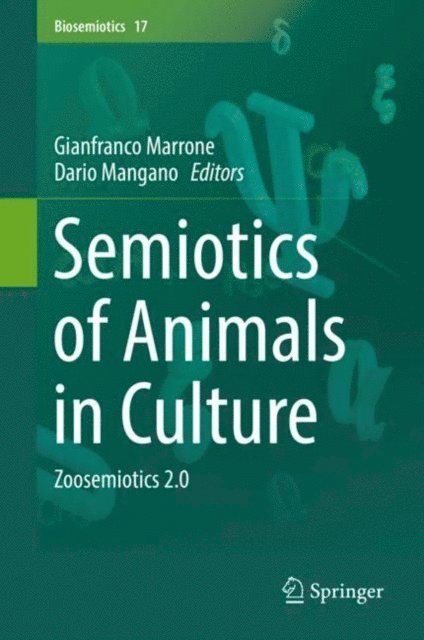
    Semiotics of Animals in Culture

    Zoosemiotics 2.0

    AvGianfranco Marrone,Dario Mangano

    Häftad, Engelska, 2018

    Del 17 i serien Biosemiotics

    1 086 kr

    Beställningsvara. Skickas inom 10-15 vardagar. Fri frakt över 249 kr.

    Beskrivning

    To place animals within the realm of nature, means inserting them among the articulations of culture and the social. Semiotics has never avoided this chiasmus, choosing to deal from the outset with the problem of the languages of animals following the old admonition of Montaigne: it is not that animals do not talk, it is us who do not understand them.Recent research in the field of the anthropology of nature and sociology of sciences and techniques allow to think about the Zoosemiotic issue in a different way. Instead of transplanting the language structures – gestures, LIS, etc. – for a semiotic study of the forms of the human and social meaning, it seems more apt to look at their discourse, and as such, the actual interactions, communicative and scientific as well as practical and functional, between humans and non-humans. This book aims to investigate precisely this hypothesis, known here as Zoosemiotics 2.0, working on several fronts and levels:· Anthropology· Languages of the image and visual representations, from art history to cinema· Old and new media. From literature to comics, from cartoons to TV documentaries but also advertising, music, Web and social networks. All those cultural products that talk about the role of human and non-human in society implicitly proposing (and in some way imposing) a form of articulation of such a relationship.· Food and feeding rites· Animalist, vegetarian and vegan movements · Philosophy: metaphysics, ethics, aesthetics

    Produktinformation

    • Utgivningsdatum:2018-12-28
    • Mått:155 x 235 x 12 mm
    • Vikt:401 g
    • Format:Häftad
    • Språk:Engelska
    • Serie:Biosemiotics
    • Antal sidor:221
    • Förlag:Springer Nature Switzerland AG
    • ISBN:9783030102975

    Utforska kategorier

    • Referensverk och tvärvetenskap inom Samhälle och politik
    • Biovetenskap inom Naturvetenskap och teknik
    • Naturvetenskapens filosofi inom Naturvetenskap och teknik

    Mer om författaren

    Dario Mangano is Associate Professor of Semiotics and Semiotics of Advertising in the University of Palermo (Italy), Department of Cultures & Society. He also teaches Semiotics of Food and a Laboratory in Food Advertising in the University of Gastronomic Sciences of Pollenzo. His research interests include Semiotics of Design and Food Design, Semiotics of Advertising and Branding. Among his books: Che cos’è il food design (What food design is) (Carocci, 2014), Ikea (Doppiozero, 2014), Archeologia del contemporaneo (Archaeology of contemporary) (Nuova Cultura, 2010) and Semiotica e design (Semiotics and design) (Carocci, 2008). Gianfranco Marrone is full Professor of Semiotics in the University of Palermo (Italy), Department of Cultures & Society. He also teaches Communication and languages of gastronomy in the University of Gastronomic Sciences of Pollenzo, and Semiotics atIULM (Milan). His research interests include Mass-Media Studies, Aesthetics and Literary Theory from a Semiotic perspective. His research in the field of Semio-Aesthetics primarily deals with the nexus between signification and perception. His most recent works have made an innovative contribution to the fields of socio-semiotics applied to food, brand, cities, journalism, space, politics, advertisement, fashion, and TV.  Selected publications in English: The Invention of the Text, London, Mimesis international 2014; Ludovico's Cure. On Body and Music in A Clockwork Orange, Toronto, Legas 2009.

    Innehållsförteckning

    • Introduction: Towards Zoosemiotica 2.0.- Part1: Animal as Food, Food for Animals. Chapter1. When To Eat Meat? Towards A Diet Of Caring.- Chapter2. Anti-Speciesist Rhetoric.- Chapter3. Aesthetics of Nutrition, Ethics of Animality: the Packaging of Vegan and Vegetarian Products in the Italian Organised Distribution Market.- Chapter4. Forms of Animality: The Dog.- Chapter5.Pet Food Communication: Notes on the Crisis of Naturalism.- Chapter6. Cat Cafés and Dog Restaurants.- Chapter7. The Birth of a Pet? The Rabbit.- Part 2: Animals in the Texts, Texts as Animals. Chapter8. Bestiality: Animal Cultures.- Chapter9. On the Logic of Animal Umwelten:The Animal Subjective Present, or Zoosemiotics of Choice and Learning.- Chapter10  Of Men, Dogs and Bears. Communication in the Wilderness.- Chapter11. The Mixted Category Human-Animal in New Anthropology and in the Arts.- chapter12. The “Morally Abandoned Child” and the“Inner Savage”.- Chapter13. Frank and Johnny and Evie. Ontological shifts in a J.R. Ackerley novel.- Chapter14. The human-animal relationship and the musical metaphor in The Great Animal Orchestra by Bernie Krause.