• Fri frakt över 249 kr
  • •
  • Snabba leveranser
  • •
  • Billiga böcker
Kundservice

Du är på sajten för privatpersoner.

Företag, bibliotek eller offentlig verksamhet?

Du handlar på classic.bokus.com, där alla dina funktioner finns intakta.
Till classic.bokus.com
Bokus logotyp. Gå till startsidan.
  • Erbjudanden
  • Nyheter
  • Student
  • Topplistor
  • Barn & ungdom
  • Bokus Play
  • E-böcker
  • Pocketböcker
  • Spel & pussel

10% rabatt på allt med kod: NYSTART10 →

Sidfot

Mina sidor

    Hjälp

    • Kundservice
    • Vanliga frågor och svar
    • Frakt och leverans
    • Retur vid ångerrätt
    • Reklamera vara
    • Betalning
    • Köpvillkor
    • Allmänna villkor
    • Information om webbplatsens tillgänglighet

    Om Bokus

    • Om oss
    • Pressrum
    • För studenter
    • För företag
    • För bibliotek och offentlig verksamhet
    • För leverantörer
    • Hållbarhet

    Populärt

    • Aktuella erbjudanden
    • Presentkort
    • Studentlitteratur
    • Nya böcker
    • Topplistor
    • Signerade böcker
    • Engelska böcker

    Inspiration

    • Boktips
    • BookTok
    • Populära bokserier
    • Barnbokskaraktärer
    • Populära författare
    Logotyp för Bokus
    Följ oss på Facebook (extern länk)Följ oss på Instagram (extern länk)Följ oss på YouTube (extern länk)Följ oss på TikTok (extern länk)
    bokus @ CookiesAnpassa cookiesIntegritetspolicyKöpvillkor
    Till Citymail hemsida (extern länk)Till Budbee hemsida (extern länk)Till Postnord hemsida (extern länk)Till Schenker hemsida (extern länk)Till Early Bird hemsida (extern länk)Till Walleys hemsida (extern länk)
    1. Djur och Natur
    2. Naturböcker
    3. Växtböcker

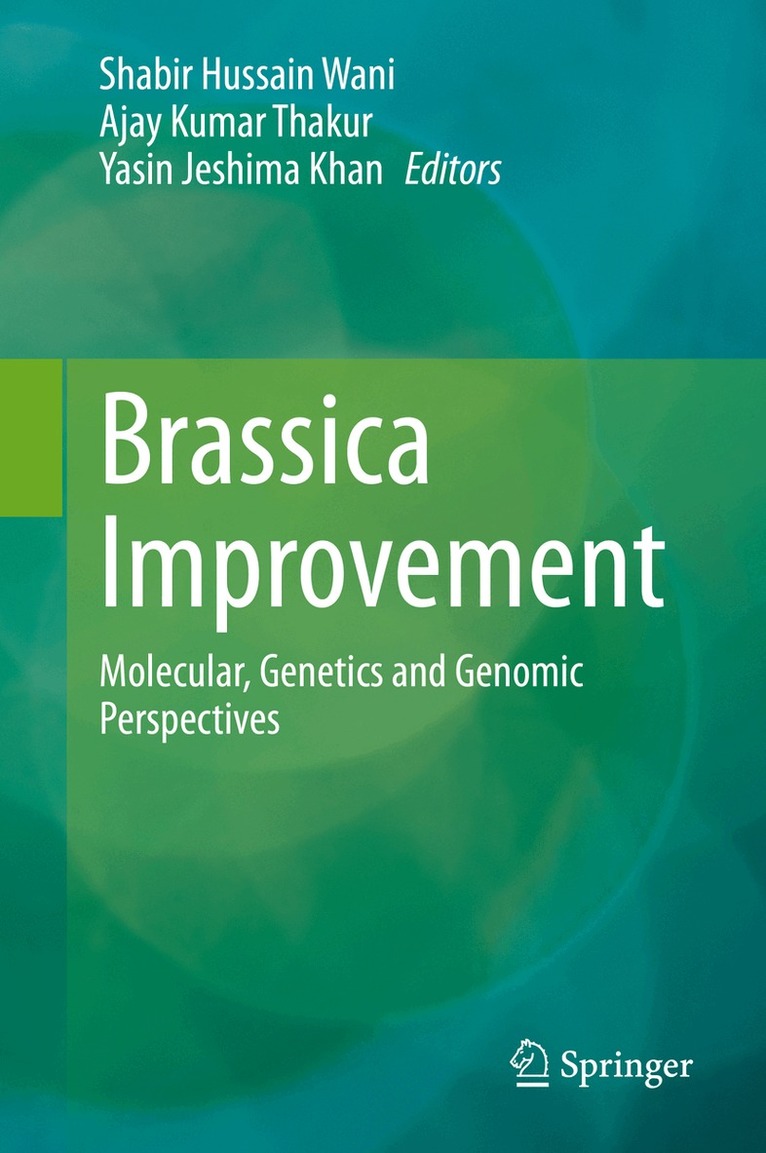
    Brassica Improvement

    Molecular, Genetics and Genomic Perspectives

    AvShabir Hussain Wani,Ajay Kumar Thakur

    Inbunden, Engelska, 2020

    1 626 kr

    Beställningsvara. Skickas inom 10-15 vardagar. Fri frakt över 249 kr.

    Beskrivning

    Global population is mounting at an alarming stride to surpass 9.3 billion by 2050, whereas simultaneously the agricultural productivity is gravely affected by climate changes resulting in increased biotic and abiotic stresses. The genus Brassica belongs to the mustard family whose members are known as cruciferous vegetables, cabbages or mustard plants. Rapeseed-mustard is world’s third most important source of edible oil after soybean and oil palm. It has worldwide acceptance owing to its rare combination of health promoting factors. It has very low levels of saturated fatty acids which make it the healthiest edible oil that is commonly available. Apart from this, it is rich in antioxidants by virtue of tocopherols and phytosterols presence in the oil. The high omega 3 content reduces the risk of atherosclerosis/heart attack. Conventional breeding methods have met with limited success in Brassica because yield and stress resilience are polygenic traits and are greatly influenced byenvironment. Therefore, it is imperative to accelerate the efforts to unravel the biochemical, physiological and molecular mechanisms underlying yield, quality and tolerance towards biotic and abiotic stresses in Brassica. To exploit its fullest potential, systematic efforts are needed to unlock the genetic information for new germplasms that tolerate initial and terminal state heat coupled with moisture stress. For instance, wild relatives may be exploited in developing introgressed and resynthesized lines with desirable attributes. Exploitation of heterosis is another important area which can be achieved by introducing transgenics to raise stable CMS lines. Doubled haploid breeding and marker assisted selection should be employed along with conventional breeding. Breeding programmes aim at enhancing resource use efficiency, especially nutrient and water as well as adoption to aberrant environmental changes should also be considered. Biotechnological interventions are essential for altering the biosynthetic pathways for developing high oleic and low linolenic lines. Accordingly, tools such as microspore and ovule culture, embryo rescue, isolation of trait specific genes especially for aphid, Sclerotinia and alternaria blight resistance, etc. along with identification of potential lines based on genetic diversity can assist ongoing breeding programmes. In this book, we highlight the recent molecular, genetic and genomic interventions made to achieve crop improvement in terms of yield increase, quality and stress tolerance in Brassica, with a special emphasis in Rapeseed-mustard.

    Produktinformation

    • Utgivningsdatum:2020-03-14
    • Mått:155 x 235 x 21 mm
    • Vikt:571 g
    • Format:Inbunden
    • Språk:Engelska
    • Antal sidor:253
    • Upplaga:20001
    • Förlag:Springer Nature Switzerland AG
    • ISBN:9783030346935

    Utforska kategorier

    • Växtböcker inom Djur och Natur
    • Botanik inom Naturvetenskap och teknik
    • Biokemisk teknik inom Naturvetenskap och teknik

    Mer om författaren

    Dr. Shabir Hussain Wani is senior assistant professor at Mountain Research Centre for Field Crops, Khudwani –192101, Sher-e-Kashmir University  of Agricultural Sciences and Technology of Kashmir, J&K, India . He received Ph.D.  degree in plant breeding and genetics on “transgenic rice for abiotic stress tolerance” from the Punjab Agricultural University Ludhiana, India. After obtaining his Ph.D. he worked as research associate in the Biotechnology Laboratory, Central Institute of Temperate Horticulture (ICAR), Srinagar, India. He then joined the Krishi Vigyan Kendra (Farm Science Centre) as program coordinator at Senapati, Manipur, India. He teaches courses related to plant breeding, seed science and technology, and stress breeding and has published more than 100 papers/chapters in journals and books of international and national repute. He served as guest editor and reviews editor for journal Frontier in Plant Science (2015-2018). He has also edited several books on current topics in crop improvement for abiotic stress tolerance published by Springer Nature and CRC press USA. His Ph.D. research won first prize in the North Zone Competition, at national level, in India. He was awarded a Young Scientist Award from the Society for Promotion of Plant Sciences, Jaipur, India, in 2009. He is a fellow of the Society for Plant Research, India. Recently he also received Young Scientist Award (Agriculture) 2015 from Society for Plant Research, Meerut, India. He also served as visiting Scientist at Department of Plant Soil and Microbial Sciences, Michigan State University, USA under the UGC Raman Post Doctoral Fellowship programme. His post doc research results on genetic dissection of pythium resistance in soybean using SNP markers was published in G3, published by Genetics Society of America.Dr Ajay Kumar Thakur is a senior scientist at the Indian Council of Agricultural Research (ICAR), India. Dr JeshimaYasin is a scientist at the Indian Council of Agricultural Research (ICAR) and the Indian Agricultural Research Institute (IARI).

    Innehållsförteckning

    • 1 Utilization of rapeseed-mustard genetic resources for Brassica improvement.- 2 Recent advances in cytoplasmic male sterility (CMS) in crop Brassicas.- 3 Ancient and recent Polyploid evolution in Brassicas.- 4 Production and application of doubled haploid in Brassica improvement.-5 Tissue culture-mediated biotechnological advancements in genus Brassica.- 6 Genomics for Brassica quality improvement.- 7 Biofortification of Brassica for quality improvement.-8 Genetics and Genomic Approaches for Disease Resistance in Brassicas.-9 Arsenic toxicity and molecular mechanism of arsenic tolerance in different members of Brassicaceae.-10 Transgenic approaches for Brassica improvement.-11 Genetic diversity studies in Indian mustard using molecular markers