• Fri frakt över 249 kr
  • •
  • Snabba leveranser
  • •
  • Billiga böcker
Kundservice

Du är på sajten för privatpersoner.

Företag, bibliotek eller offentlig verksamhet?

Du handlar på classic.bokus.com, där alla dina funktioner finns intakta.
Till classic.bokus.com
Bokus logotyp. Gå till startsidan.
  • Erbjudanden
  • Student
  • Topplistor
  • Barn & ungdom
  • Bokus Play
  • E-böcker
  • Ljudböcker
  • Pocketböcker
  • Spel och pussel

Pocketfynda! Hundratals böcker för 49 kr/st →

Sidfot

Mina sidor

    Hjälp

    • Kundservice
    • Vanliga frågor och svar
    • Frakt och leverans
    • Retur vid ångerrätt
    • Reklamera vara
    • Betalning
    • Köpvillkor
    • Allmänna villkor
    • Information om webbplatsens tillgänglighet

    Om Bokus

    • Om oss
    • Pressrum
    • För studenter
    • För företag
    • För bibliotek och offentlig verksamhet
    • För leverantörer
    • Hållbarhet

    Populärt

    • Aktuella erbjudanden
    • Presentkort
    • Studentlitteratur
    • Nya böcker
    • Topplistor
    • Signerade böcker
    • Engelska böcker

    Inspiration

    • Boktips
    • BookTok
    • Barnbokskaraktärer
    • Populära författare
    Logotyp för Bokus
    Följ oss på Facebook (extern länk)Följ oss på Instagram (extern länk)Följ oss på YouTube (extern länk)Följ oss på TikTok (extern länk)
    bokus @ CookiesAnpassa cookiesIntegritetspolicyKöpvillkor
    Till Citymail hemsida (extern länk)Till Budbee hemsida (extern länk)Till Postnord hemsida (extern länk)Till Schenker hemsida (extern länk)Till Early Bird hemsida (extern länk)Till Walleys hemsida (extern länk)
    1. Naturvetenskap och teknik
    2. Geovetenskap
    3. Miljövetenskap och miljöpolitik

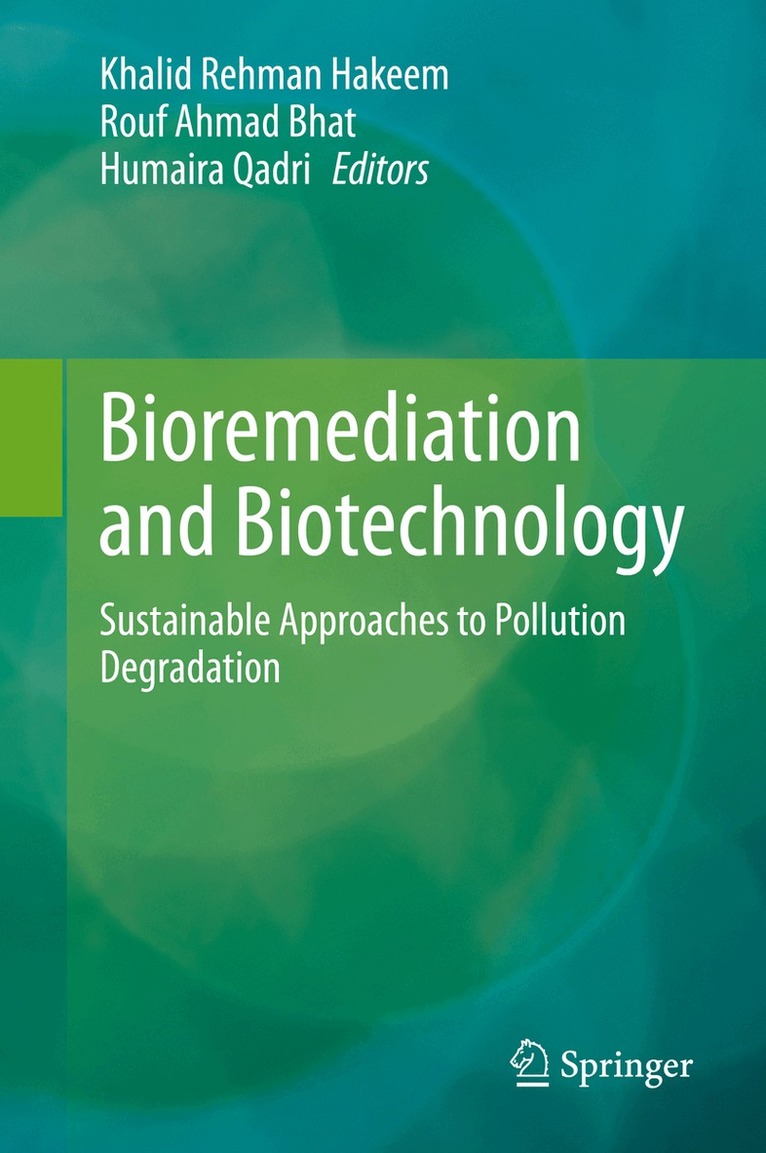
    Bioremediation and Biotechnology

    Sustainable Approaches to Pollution Degradation

    AvKhalid Rehman Hakeem,Rouf Ahmad Bhat

    Inbunden, Engelska, 2020

    1 613 kr

    Beställningsvara. Skickas inom 10-15 vardagar. Fri frakt över 249 kr.

    Beskrivning

    Toxic substances threatens aquatic and terrestrial ecosystems and ultimately human health. The book is a thoughtful effort in bringing forth the role of biotechnology for bioremediation and restoration of the ecosystems degraded by toxic and heavy metal pollution. The introductory chapters of the book deal with the understanding of the issues concerned with the pollution caused by toxic elements and heavy metals and their impacts on the different ecosystems followed by the techniques involved in monitoring of the pollution. These techniques include use of bio-indicators as well as modern techniques for the assessment and monitoring of toxicants in the environment. Detailed chapters discussing the role of microbial biota, aquatic plants, terrestrial plants to enhance the accumulation efficiency of these toxic and heavy metals are followed by remediation techniques involving myco-remediation, bio-pesticides, bio-fertilizers, phyto-remediation and rhizo-filtration. A sizable portion ofthe book has been dedicated to the advanced bio-remediation techniques which are finding their way from the laboratory to the field for revival of the degraded ecosystems. These involve bio-films, micro-algae, genetically modified plants and filter feeders. Furthermore, the book is a detailed comprehensive account for the treatment technologies from unsustainable to sustainable. We believe academicians, researchers and students will find this book informative as a complete reference for biotechnological intervention for sustainable treatment of pollution.

    Produktinformation

    • Utgivningsdatum:2020-01-27
    • Mått:155 x 235 x 25 mm
    • Vikt:688 g
    • Format:Inbunden
    • Språk:Engelska
    • Antal sidor:327
    • Förlag:Springer Nature Switzerland AG
    • ISBN:9783030356903

    Utforska kategorier

    • Miljövetenskap och miljöpolitik inom Naturvetenskap och teknik
    • Biovetenskap inom Naturvetenskap och teknik
    • Miljöteknik inom Naturvetenskap och teknik

    Mer om författaren

    Khalid Rehman Hakeem (Ph.D.) is Professor at King Abdulaziz University, Jeddah, Saudi Arabia. After completing his doctorate (Botany; specialization in Plant Eco-physiology and Molecular Biology) from Jamia Hamdard, New Delhi, India, in 2011, he worked as a lecturer at the University of Kashmir, Srinagar, for a short period. Later, he joined Universiti Putra Malaysia, Selangor, Malaysia, and worked there as Postdoctorate Fellow in 2012 and Fellow Researcher (Associate Professor) from 2013 to 2016. Dr. Hakeem has more than 10 years of teaching and research experience in plant eco-physiology, biotechnology and molecular biology, medicinal plant research, plant-microbe-soil interactions as well as in environmental studies. He is the recipient of several fellowships at both national and international levels; also, he has served as the visiting scientist at Jinan University, Guangzhou, China. Currently, he is involved with a number of international research projects with differentgovernment organizations. So far, Dr. Hakeem has authored and edited more than 35 books with international publishers, including Springer Nature, Academic Press (Elsevier), and CRC Press. He also has to his credit more than 85 research publications in peer-reviewed international journals and 60 book chapters in edited volumes with international publishers. At present, Dr. Hakeem serves as an editorial board member and reviewer of several high-impact international scientific journals from Elsevier, Springer Nature, Taylor and Francis, Cambridge, and John Wiley Publishers. He is included in the advisory board of Cambridge Scholars Publishing, UK. He is also a fellow of Plantae group of the American Society of Plant Biologists, member of the World Academy of Sciences, member of the International Society for Development and Sustainability, Japan, and member of Asian Federation of Biotechnology, Korea. Dr. Hakeem has been listed in Marquis Who’s Who in the World, since 2014–2019. Currently, Dr. Hakeem is engaged in studying the plant processes at eco-physiological as well as molecular levels.Dr. Rouf Ahmad Bhat (Ph.D) is working in Cluster University Srinagar (J&K), India on the capacity of Assistant Professor and has his specialisation in Limnology, Toxicology, Phytochemistry and Phytoremediation. Dr. Bhat has been teaching graduate and post graduate students of Environmental Sciences for the past two years. He is an author of more than 50 scientific articles and 15 book chapters, and has published 10 books with international publishers. He has presented and participated in numerous State, National and International conferences, seminars, workshops and symposium. Dr. Bhat has worked as an associate Environmental Expert in World Bank funded Flood Recovery Project and also Environmental Support Staff in Asian Development Bank (ADB) funded development projects. He has received many awards, appreciations and recognitions for his services to the science of water testing, air and noise analysis. He has served as editorial board member and reviewer of reputed international journals. Dr. Bhat is still writing and experimenting with diverse capacities of plants for use in aquatic pollution. Dr. Humaira Qadri (Ph.D) is actively involved in teaching the post-graduate students of Environmental Science for the past ten years in Sri Pratap College Campus, Cluster University Srinagar, J&K, India.  She is also heading the Department of Environment and Water Management. A gold medallist at her master’s level, she has bagged a number of awards and certificates of merit. Her specialisation is in Limnology, Nutrient Dynamics and Phytoremediation. She has published scores of papers in international journals and has more than ten books withnational and international publishers. She is also the reviewer of various international journals and is the principal investigator of some major projects on phytoremediation. She is guiding a number of research students for PhD programme and has supervised more than 60 master’s dissertations. She also has been on the scientific board of various international conferences and holds life memberships of various international organisations. With a number of national scientific events to her credit, she is an active participant in national and international scientific events and has organised a number of national conferences on science.

    Innehållsförteckning

    • Preface.- Foreword.- 1. Concerns and Threats of Contamination on Aquatic Ecosystems.- 2. Effect of Pesticides on Fish Fauna: Threats, Challenges and Possible Remedies.- 3. Impact of Invasive Plants in Aquatic Ecosystems.- 4. Role of Modern Innovative Techniques for Assessing and Monitoring Environmental Pollution.- 5. Global Scenario of Remediation Techniques to Combat Environmental Pollution.- 6. Biopesticides: clean and viable technology for healthy environment.- 7. Inoculum addition in the presence of plant rhizosphere for petroleum polluted soil remediation.- 8. Vermicomposting: An Eco-friendly Approach for Recycling /Management of Organic Wastes.- 9. Bio-Fertilizers: Ecofriendly Approach for Plant and Soil Environment.- 10. Phytoremediation of heavy metals: an ecofriendly and sustainable approach.- 11. Credibility of in situ Phytoremediation for Restoration of Disturbed Environments.- 12. Role of White Willow (Salix alba L.) for Cleaning up the Toxic Metal Pollution.- 13. Mycoremediation: a Sustainable Tool for Abating Environmental Pollution.- 14. Microbial Biofilm Cell Systems for Remediation of Wastewaters.- 15. Pollution remediation by way of using genetically modified plants (GMP).- Index.