• Fri frakt över 249 kr
  • •
  • Snabba leveranser
  • •
  • Billiga böcker
Kundservice

Du är på sajten för privatpersoner.

Företag, bibliotek eller offentlig verksamhet?

Du handlar på classic.bokus.com, där alla dina funktioner finns intakta.
Till classic.bokus.com
Bokus logotyp. Gå till startsidan.
  • Erbjudanden
  • Student
  • Topplistor
  • Barn & ungdom
  • Bokus Play
  • E-böcker
  • Ljudböcker
  • Pocketböcker
  • Spel & pussel

10% rabatt på allt med kod NYSTART10 →

Sidfot

Mina sidor

    Hjälp

    • Kundservice
    • Vanliga frågor och svar
    • Frakt och leverans
    • Retur vid ångerrätt
    • Reklamera vara
    • Betalning
    • Köpvillkor
    • Allmänna villkor
    • Information om webbplatsens tillgänglighet

    Om Bokus

    • Om oss
    • Pressrum
    • För studenter
    • För företag
    • För bibliotek och offentlig verksamhet
    • För leverantörer
    • Hållbarhet

    Populärt

    • Aktuella erbjudanden
    • Presentkort
    • Studentlitteratur
    • Nya böcker
    • Topplistor
    • Signerade böcker
    • Engelska böcker

    Inspiration

    • Boktips
    • BookTok
    • Populära bokserier
    • Barnbokskaraktärer
    • Populära författare
    Logotyp för Bokus
    Följ oss på Facebook (extern länk)Följ oss på Instagram (extern länk)Följ oss på YouTube (extern länk)Följ oss på TikTok (extern länk)
    bokus @ CookiesAnpassa cookiesIntegritetspolicyKöpvillkor
    Till Citymail hemsida (extern länk)Till Budbee hemsida (extern länk)Till Postnord hemsida (extern länk)Till Schenker hemsida (extern länk)Till Early Bird hemsida (extern länk)Till Walleys hemsida (extern länk)
    1. Medicin
    2. Medicin: icke kliniska discipliner
    3. Fysiologi

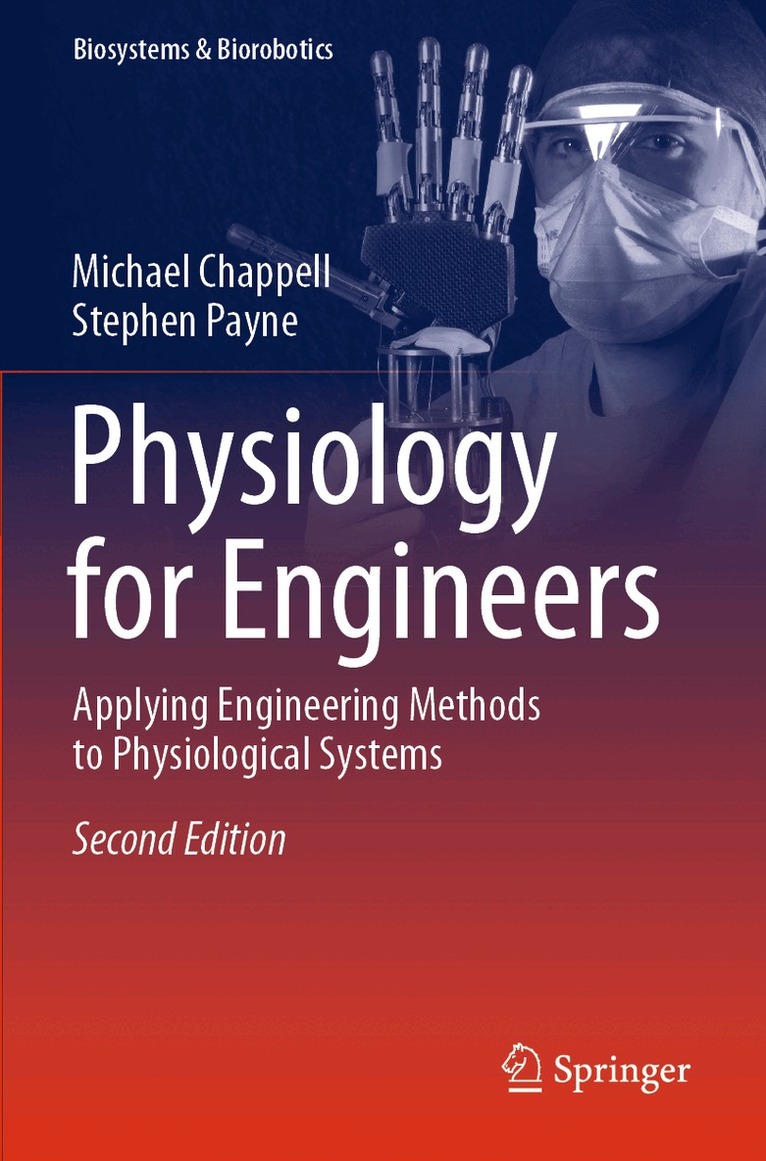
    Physiology for Engineers

    Applying Engineering Methods to Physiological Systems

    AvMichael Chappell,Stephen Payne

    Häftad, Engelska, 2021

    Del i serien Biosystems & Biorobotics

    909 kr

    Beställningsvara. Skickas inom 5-8 vardagar. Fri frakt över 249 kr.

    Fler format och utgåvor

    Inbunden

    1 006 kr

    Häftad

    728 kr

    Beskrivning

    This book provides an introduction to qualitative and quantitative aspects of human physiology. It examines biological and physiological processes and phenomena, including a selection of mathematical models, showing how physiological problems can be mathematically formulated and studied. It also illustrates how a wide range of engineering and physics topics, such as electronics, fluid dynamics, solid mechanics and control theory can be used to describe and understand physiological processes and systems. Throughout the text, there are introductions to measuring and quantifying physiological processes using both signaling and imaging technologies. This new edition includes updated material on pathophysiology, metabolism and the TCA cycle, as well as more advanced worked examples. This book describes the basic structure and models of cellular systems, the structure and function of the cardiovascular system, and the electrical and mechanical activity of the heart, and provides an overview of the structure and function of the respiratory and nervous systems. It also includes an introduction to the basic concepts and applications of reaction kinetics, pharmacokinetic modelling and tracer kinetics. It appeals to final year biomedical engineering undergraduates and graduates alike, as well as to practising engineers new to the fields of bioengineering or medical physics.

    Produktinformation

    • Utgivningsdatum:2021-04-29
    • Mått:155 x 235 x 15 mm
    • Vikt:300 g
    • Format:Häftad
    • Språk:Engelska
    • Serie:Biosystems & Biorobotics
    • Antal sidor:176
    • Upplaga:2
    • Förlag:Springer Nature Switzerland AG
    • ISBN:9783030397074

    Utforska kategorier

    • Fysiologi inom Medicin
    • Biovetenskap inom Naturvetenskap och teknik
    • Biomedicinsk teknik inom Medicin

    Mer om författaren

    Michael Chappell is an Associate Professor of Engineering Science at the Institute of Biomedical Engineering (IBME), Department of Engineering Science, University of Oxford. Michael also heads the Quantitative Biomedical Inference group, which combines together inference techniques from information engineering with mathematical models from physics and physiology to estimate quantitative information for biomedical, and especially clinical applications. His main interest is medical imaging of metabolism and haemodynamics. Michael read Engineering Science in Oxford at undergraduate level, specialising in information engineering topics and completing a project on the detection of landmines. He then completed a doctorate on SCUBA diving, primarily using mathematical models to explore the development of bubbles from dissolved gases under decompression in the body – the resulting sickness is commonly referred to as 'the bends'. Finally, he found his way into magnetic resonance imaging and now develops ways to measure blood flow and pH in the body with applications in stroke, cancer and dementia. Michael is the co-author of one book, and is a series editor for the Oxford Neuroimaging Primers and an author of two of the primers: Introduction to Neuroimaging Analysis, and Introduction to Perfusion Quantification using Arterial Spin Labelling.   Stephen Payne is an Professor of Engineering Science at the Institute of Biomedical Engineering (IBME), Department of Engineering Science, University of Oxford. Stephen heads the Cerebral Haemodynamics Group, focusing on modelling blood flow and metabolism in the brain, which is particularly important in the context of diseases such as stroke and dementia. Another of the group’s key areas is cerebral autoregulation – the mechanism that maintains blood flow almost constantly in response to changes in blood pressure. Stephen has worked in physiological modelling for over 15 years.Having entered the field of biomedical engineering before it was available even as an undergraduate option course, he has seen first-hand how difficult it can be to learn about physiology in a way that makes it amenable to mathematical treatment, such as mathematical modelling, without good introductory guides. Stephen is also the author of two related books on cerebral autoregulation and cerebral blood flow and metabolism.

    Innehållsförteckning

    • Cell Structure and Biochemical Reactions.- Cellular Homeostasis and Membrane Potential.- The Action Potential.- Cellular Transport and Communication.- Pharmacokinetics.- Tissue Mechanics.- Cardiovascular System I: The Heart.- Cardiovascular System II: The Vasculature.- Respiratory System.- Nervous System.