• Fri frakt över 249 kr
  • •
  • Snabba leveranser
  • •
  • Billiga böcker
Kundservice

Du är på sajten för privatpersoner.

Företag, bibliotek eller offentlig verksamhet?

Du handlar på classic.bokus.com, där alla dina funktioner finns intakta.
Till classic.bokus.com
Bokus logotyp. Gå till startsidan.
  • Erbjudanden
  • Nyheter
  • Student
  • Topplistor
  • Barn & ungdom
  • Bokus Play
  • E-böcker
  • Pocketböcker
  • Spel & pussel

10% rabatt på allt med kod: NYSTART10 →

Sidfot

Mina sidor

    Hjälp

    • Kundservice
    • Vanliga frågor och svar
    • Frakt och leverans
    • Retur vid ångerrätt
    • Reklamera vara
    • Betalning
    • Köpvillkor
    • Allmänna villkor
    • Information om webbplatsens tillgänglighet

    Om Bokus

    • Om oss
    • Pressrum
    • För studenter
    • För företag
    • För bibliotek och offentlig verksamhet
    • För leverantörer
    • Hållbarhet

    Populärt

    • Aktuella erbjudanden
    • Presentkort
    • Studentlitteratur
    • Nya böcker
    • Topplistor
    • Signerade böcker
    • Engelska böcker

    Inspiration

    • Boktips
    • BookTok
    • Populära bokserier
    • Barnbokskaraktärer
    • Populära författare
    Logotyp för Bokus
    Följ oss på Facebook (extern länk)Följ oss på Instagram (extern länk)Följ oss på YouTube (extern länk)Följ oss på TikTok (extern länk)
    bokus @ CookiesAnpassa cookiesIntegritetspolicyKöpvillkor
    Till Citymail hemsida (extern länk)Till Budbee hemsida (extern länk)Till Postnord hemsida (extern länk)Till Schenker hemsida (extern länk)Till Early Bird hemsida (extern länk)Till Walleys hemsida (extern länk)
    1. Naturvetenskap och teknik
    2. Geovetenskap
    3. Miljövetenskap och miljöpolitik

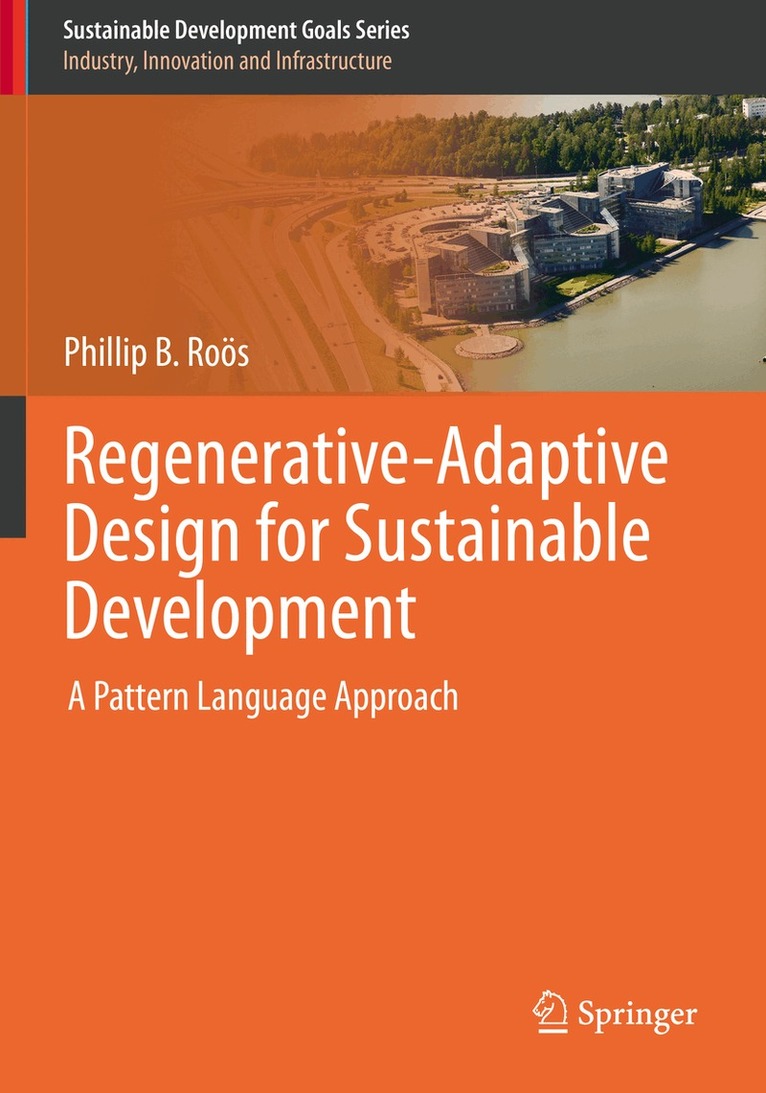
    Regenerative-Adaptive Design for Sustainable Development

    A Pattern Language Approach

    AvPhillip B. Roös

    Häftad, Engelska, 2021

    Del i serien Sustainable Development Goals Series

    1 409 kr

    Beställningsvara. Skickas inom 10-15 vardagar. Fri frakt över 249 kr.

    Fler format och utgåvor

    Inbunden

    1 409 kr

    Beskrivning

    In this book, the author tests a regenerative-adaptive pattern language theory towards investigating the possibilities of a holistic, integrated design and planning method for sustainable development that incorporates the principles of regenerative design, as well as an adaptive pattern language that re-establishes our wholeness with nature, and considers the vulnerabilities of a changing landscape. The book examines an integral approach to contemporary theories of planning and design that explores the human-nature relationship patterns in social and spatial interconnections, between people and their natural environments. The interconnectedness of human and natural systems is used to scaffold possible solutions to address key environmental and sustainability issues that specifically address the need for patterns of behaviour that acknowledge the duality of ‘man and nature’. In 12 chapters, the book presents a holistic, regenerative-adaptive pattern language that encapsulates how communities can better appreciate landscape change under future climate effects, and acknowledges the importance to adapt to patterns of change of place and the environment and therefore inform the communities’ responses for sustainable development. The application of the regenerative-adaptive pattern language was tested along the Great Ocean Road region of the Victorian coast in Australia. The concluding chapters argues that for human settlements and cities to be resilient and sustainable, we must understand the interconnected patterns of human-built environments and natural systems, and how we function in a social-spatial dimension with these. The book is intended for practitioners and academic scholars with interest in sustainable development, regenerative design, pattern languages, biophilia, settlement planning, and climate change adaptation.

    Produktinformation

    • Utgivningsdatum:2021-09-17
    • Mått:178 x 254 x 15 mm
    • Vikt:596 g
    • Format:Häftad
    • Språk:Engelska
    • Serie:Sustainable Development Goals Series
    • Antal sidor:247
    • Förlag:Springer Nature Switzerland AG
    • ISBN:9783030532369

    Utforska kategorier

    • Miljövetenskap och miljöpolitik inom Naturvetenskap och teknik
    • Biovetenskap inom Naturvetenskap och teknik
    • Regional planering inom Naturvetenskap och teknik

    Mer om författaren

    Dr. Phillip B. Roös is known internationally as a leader in Environmental Design. He is an ecological systems inspired architect, designer, planner and strategist for regenerative architecture, sustainable urban developments, infrastructure and landscapes. He is currently the director of the Live+Smart Research Laboratory at the School of Architecture and Built Environment, Deakin University. His research interests are centred on the human-nature relationship and the identification of optimised design processes based on a regenerative-adaptive design and pattern language system. Consequently, he has developed an integral based theory towards investigating the possibilities of a holistic integrated design and planning method that re-establishes our wholeness with nature, and considers the vulnerabilities of a changing landscape.In professional practice he has been working as a design professional for over 30 years on an extensive range of small to large-scale projects in Europe, Africa and Australasia. His work is influenced by whole systems thinking and his application of environmental design is closely related to the ordering of the large-scale aspects of the environment by means of architecture, engineering, landscape architecture, biophilic design, urban design and ecological planning.

    Innehållsförteckning

    • Chapter1: State of the planet.- Chapter2: The challenge of a changing environment.- Chapter3: The importance of a sustainable future.- Chapter4: Sustainability, ecological systems, and climate change.- Chapter5: Beyond sustainable development: regenerative-adaptive futures.- Chapter6: Origins of advanced knowledge.- Chapter7: Interconnections between people and their natural environments.- Chapter8: A regenerative pattern language.- Chapter 9: Case study: application of the regenerative pattern language.- Chapter10: Conclusion.