• Fri frakt över 249 kr
  • •
  • Snabba leveranser
  • •
  • Billiga böcker
Kundservice

Du är på sajten för privatpersoner.

Företag, bibliotek eller offentlig verksamhet?

Du handlar på classic.bokus.com, där alla dina funktioner finns intakta.
Till classic.bokus.com
Bokus logotyp. Gå till startsidan.
  • Erbjudanden
  • Nyheter
  • Student
  • Topplistor
  • Barn & ungdom
  • Bokus Play
  • E-böcker
  • Pocketböcker
  • Spel & pussel

10% rabatt på allt med kod: NYSTART10 →

Sidfot

Mina sidor

    Hjälp

    • Kundservice
    • Vanliga frågor och svar
    • Frakt och leverans
    • Retur vid ångerrätt
    • Reklamera vara
    • Betalning
    • Köpvillkor
    • Allmänna villkor
    • Information om webbplatsens tillgänglighet

    Om Bokus

    • Om oss
    • Pressrum
    • För studenter
    • För företag
    • För bibliotek och offentlig verksamhet
    • För leverantörer
    • Hållbarhet

    Populärt

    • Aktuella erbjudanden
    • Presentkort
    • Studentlitteratur
    • Nya böcker
    • Topplistor
    • Signerade böcker
    • Engelska böcker

    Inspiration

    • Boktips
    • BookTok
    • Populära bokserier
    • Barnbokskaraktärer
    • Populära författare
    Logotyp för Bokus
    Följ oss på Facebook (extern länk)Följ oss på Instagram (extern länk)Följ oss på YouTube (extern länk)Följ oss på TikTok (extern länk)
    bokus @ CookiesAnpassa cookiesIntegritetspolicyKöpvillkor
    Till Citymail hemsida (extern länk)Till Budbee hemsida (extern länk)Till Postnord hemsida (extern länk)Till Schenker hemsida (extern länk)Till Early Bird hemsida (extern länk)Till Walleys hemsida (extern länk)
    1. Naturvetenskap och teknik
    2. Matematik och naturvetenskap
    3. Biologi
    4. Biovetenskap

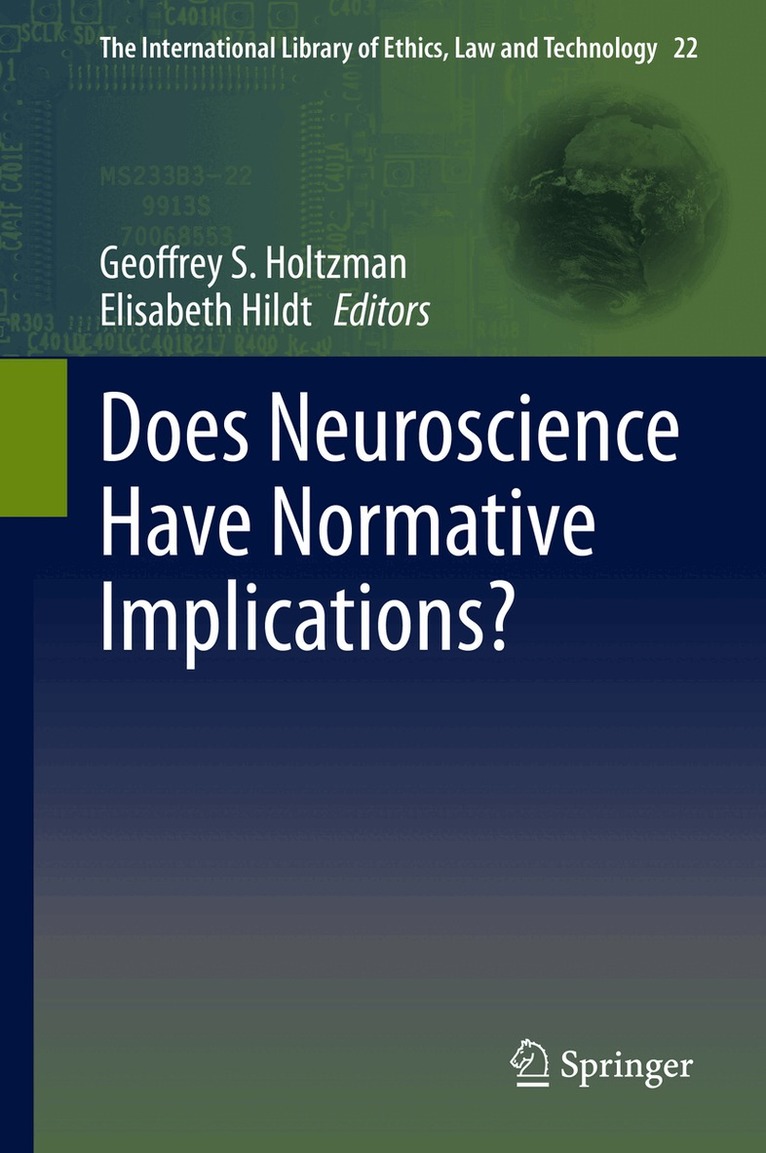
    Does Neuroscience Have Normative Implications?

    AvGeoffrey S. Holtzman,Elisabeth Hildt

    Inbunden, Engelska, 2020

    Del 22 i serien International Library of Ethics, Law and Technology

    1 194 kr

    Beställningsvara. Skickas inom 10-15 vardagar. Fri frakt över 249 kr.

    Beskrivning

    This book brings together a number of essays that are optimistic about the ways certain neuroscientific insights might advance philosophical ethics, and other essays that are more circumspect about the relevance of neuroscience to philosophical ethics. As a whole, the essays form a self-reflective body of work that simultaneously seeks to derive normative ethical implications from neuroscience, and to question whether and how that may be possible at all. In doing so, the collection brings together psychology, neuroscience, philosophy of mind, ethics, and philosophy of science. Neuroscience seeks to understand the biological systems that guide human behavior and cognition. Normative ethics, on the other hand, seeks to understand the system of abstract moral principles dictating how people ought to behave. By studying how the human brain makes moral judgments, can philosophers learn anything about the nature of morality itself? A growing number of researchers believe that neurosciencecan, indeed, provide insights into the questions of philosophical ethics. However, even these advocates acknowledge that the path from neuroscientific is to normative ethical ought can be quite fraught.

    Produktinformation

    • Utgivningsdatum:2020-11-01
    • Mått:155 x 235 x 18 mm
    • Vikt:512 g
    • Format:Inbunden
    • Språk:Engelska
    • Serie:International Library of Ethics, Law and Technology
    • Antal sidor:211
    • Förlag:Springer Nature Switzerland AG
    • ISBN:9783030561338

    Utforska kategorier

    • Biovetenskap inom Naturvetenskap och teknik
    • Filosofiska discipliner inom Filosofi och religion
    • Kognitiv psykologi inom Psykologi och pedagogik

    Mer om författaren

    Geoffrey S. Holtzman received his BA in Cognitive Science from Vassar College in 2007 and his PhD in Philosophy from CUNY Graduate Center in 2014. After completing his dissertation on the experimental philosophy of faultless disagreement, he undertook a fellowship in neuroethics at the Illinois Institute of Technology, followed by a fellowship in moral psychology at Geisinger Health System. He most recently taught courses in neuroethics and moral psychology as a faculty member at Franklin & Marshall College.Elisabeth Hildt is Professor of Philosophy and Director of the Center for the Study of Ethics in the Professions at Illinois Institute of Technology, Chicago. Her research focus is on neuroethics, ethics of technology, and Science and Technology Studies. Before moving to Chicago, she was the head of the Research Group on Neuroethics/Neurophilosophy at the University of Mainz, Germany.

    Innehållsförteckning

    • 1. The Neuroscience of Human Morality: Three Levels of Normative Implications (Jon Leefmann).- 2. Moral Responsibility and Perceived Threats from Neuroscience (Myrto Mylopoulos).- 3. Lessons for Ethics from the Science of Pain (Jennifer Corns and Robert Cowan).- 4. Two Theories of Moral Cognition (Julia Haas).- 5. Rethinking Moral Motivation: How Neuroscience Supports an Alternative to Motivation Internalism (Chris Zarpentine).- 6. The Reactive Roots of Retribution: Normative Implications of the Neuroscience of Punishment (Isaac Wiegman).- 7. Normative Implications of Neuroscience and Sociobiology – Intended and Perceived (Ullica Segerstrale).- 8. Nervous Norms (Matthew Ruble).- 9. Neuromodulation of the “Moral Brain” – Evaluating Bridges Between Neural Foundations of Moral Capacities and Normative Aims of the Intervention (Christian Ineichen and Markus Christen).- 10. Autistic Moral Agency and Integrative Neuroethics (Bongrae Seok).