• Fri frakt över 249 kr
  • •
  • Snabba leveranser
  • •
  • Billiga böcker
Kundservice

Du är på sajten för privatpersoner.

Företag, bibliotek eller offentlig verksamhet?

Du handlar på classic.bokus.com, där alla dina funktioner finns intakta.
Till classic.bokus.com
Bokus logotyp. Gå till startsidan.
  • Erbjudanden
  • Nyheter
  • Student
  • Topplistor
  • Barn & ungdom
  • Bokus Play
  • E-böcker
  • Pocketböcker
  • Spel & pussel

10% rabatt på allt med kod NYSTART10 →

Sidfot

Mina sidor

    Hjälp

    • Kundservice
    • Vanliga frågor och svar
    • Frakt och leverans
    • Retur vid ångerrätt
    • Reklamera vara
    • Betalning
    • Köpvillkor
    • Allmänna villkor
    • Information om webbplatsens tillgänglighet

    Om Bokus

    • Om oss
    • Pressrum
    • För studenter
    • För företag
    • För bibliotek och offentlig verksamhet
    • För leverantörer
    • Hållbarhet

    Populärt

    • Aktuella erbjudanden
    • Presentkort
    • Studentlitteratur
    • Nya böcker
    • Topplistor
    • Signerade böcker
    • Engelska böcker

    Inspiration

    • Boktips
    • BookTok
    • Populära bokserier
    • Barnbokskaraktärer
    • Populära författare
    Logotyp för Bokus
    Följ oss på Facebook (extern länk)Följ oss på Instagram (extern länk)Följ oss på YouTube (extern länk)Följ oss på TikTok (extern länk)
    bokus @ CookiesAnpassa cookiesIntegritetspolicyKöpvillkor
    Till Citymail hemsida (extern länk)Till Budbee hemsida (extern länk)Till Postnord hemsida (extern länk)Till Schenker hemsida (extern länk)Till Early Bird hemsida (extern länk)Till Walleys hemsida (extern länk)
    1. Naturvetenskap och teknik
    2. Matematik och naturvetenskap
    3. Matematik
    4. Matematisk statistik

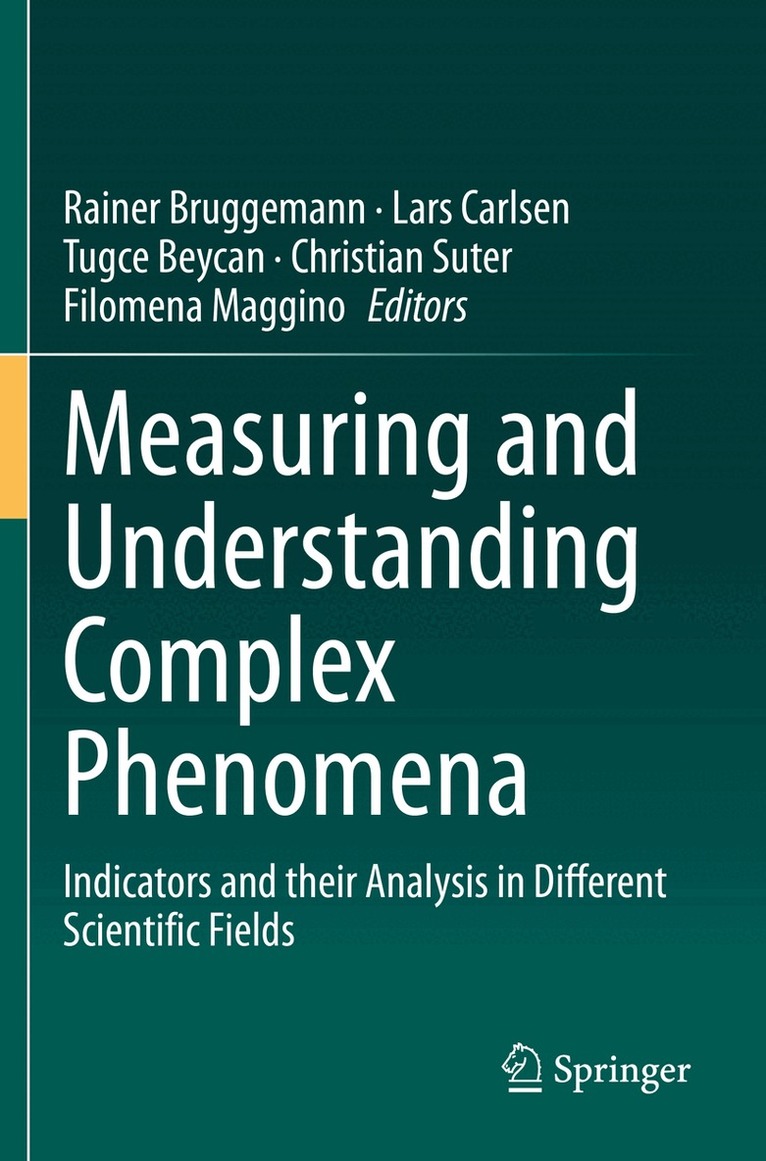
    Measuring and Understanding Complex Phenomena

    Indicators and their Analysis in Different Scientific Fields

    AvRainer Bruggemann,Lars Carlsen

    Häftad, Engelska, 2022

    1 085 kr

    Beställningsvara. Skickas inom 10-15 vardagar. Fri frakt över 249 kr.

    Beskrivning

    Indicators are more and more applied to describe and analyze complex systems. Typical examples: Innovation potential of nations, child-well being, Environmental health, poverty, chemical pollution, corruption of nations. The task is: How can a system of indicators be defined in order to fulfill the above expectations. One possibility is the application of the mathematical theory of partial order, especially when the indicator system shall be used for ranking purposes.

    Produktinformation

    • Utgivningsdatum:2022-03-03
    • Mått:155 x 235 x 19 mm
    • Vikt:517 g
    • Format:Häftad
    • Språk:Engelska
    • Antal sidor:316
    • Förlag:Springer Nature Switzerland AG
    • ISBN:9783030596859

    Utforska kategorier

    • Matematisk statistik inom Naturvetenskap och teknik
    • Tillämpad matematik inom Naturvetenskap och teknik
    • Miljövetenskap och miljöpolitik inom Naturvetenskap och teknik

    Mer om författaren

    Rainer Bruggemann studied chemistry with a focus on theoretical and mathematical concepts. He was working at several research institutes and was teaching mathematical modelling in Environmental Chemistry at several universities. His interest also focuses on indicators and their analysis.Lars Carlsen has more than 35 years of experience in R&D, technical support and training activities within the environmental field.  His current research interests include areas like sustainable development, model tools, such as structure-activity relationships and ranking techniques as decision support tools and development and application of multi-criteria data analysis tools within environmental - and social science.Tugce Beycan is currently finalizing her dissertation on multidimensional poverty in upper-middle-income countries at the department of sociology of University of Neuchâtel. She formerly worked at IPEC and department of statistics of ILO. Her research interests are poverty, quality of life, social bonds, capabilities, and child labour. Christian Suter is Professor at the Department of Sociology of the University of Neuchâtel, Switzerland. His research has focused on social and economic inequalities, social indicators and quality of life, as well as on globalization and world society.Filomena Maggino is Professor of Social Statistics at the Sapienza University of Rome. President and co-founder of the Italian Association for Quality-of-Life Studies (AIQUAV). Editor-in-Chief of Social Indicators Research journal (Springer) and Encyclopedia of Quality-of-Life and Well-being Research (Springer). She is one of the main worldwide experts in the field of indicators construction, analysis and synthesis and wellbeing and quality of life research. Advisor of several governmental organizations and member of institutional ad-hoc committees.

    Innehållsförteckning

    • Chapter 1. Some basic considerations on the design and the interpretation of indicators in the context of modelling and simulation.- Chapter 2. Indicators in the framework of partial order.- Chapter 3. ASSESSING INHOMOGENEOUS INDICATOR-RELATED TYPOLOGIES.- Chapter 4. Uncertainty in weights for composite indicators generated by weighted sums.- Chapter 5. A study to generate a weak order from a partially ordered set, taken  biomonitoring measurements.- Chapter 6. Problem orientable evaluations as L-subsets.- Chapter 7. Evaluations as Sets over Lattices - Application point of view.- Chapter 8. Indicators for Sustainability Assessment in the Procurement of Civil Engineering Services.- Chapter 9. DEPENDENT INDICATORS FOR ENVIRONMENTAL EVALUATIONS OF DESALINATION PLANTS.- Chapter 10. Introduction into Sampling Theory, Applying.- Chapter 11. Looking for alternatives? Split shots as an exemplary case.- Chapter 12. Comparison of selected procedures for generating activated carbon with special focus on Miscanthus straw as a sustainable raw material.- Chapter 13. Uranium trappers, a partial order study.- Chapter 14. There is no such thing as a free lunch! Who is paying for our happiness?.- Chapter 15. Posetic tools in the social sciences: a tutorial exposition.- Chapter 16. Assessing Subjective Well-being in Wide Populations. A Posetic Approach to Micro-data Analysis.- Chapter 17. Deep Ranking Analysis by Power Eigenvectors (DRAPE): a study on the human, environmental and economic wellbeing of 154 countries.- Chapter 18. PyHasse, a software package for applicational studies of partial orderings