• Fri frakt över 249 kr
  • •
  • Snabba leveranser
  • •
  • Billiga böcker
Kundservice

Du är på sajten för privatpersoner.

Företag, bibliotek eller offentlig verksamhet?

Du handlar på classic.bokus.com, där alla dina funktioner finns intakta.
Till classic.bokus.com
Bokus logotyp. Gå till startsidan.
  • Erbjudanden
  • Nyheter
  • Student
  • Topplistor
  • Barn & ungdom
  • Bokus Play
  • E-böcker
  • Pocketböcker
  • Spel & pussel

10% rabatt på allt med kod: NYSTART10 →

Sidfot

Mina sidor

    Hjälp

    • Kundservice
    • Vanliga frågor och svar
    • Frakt och leverans
    • Retur vid ångerrätt
    • Reklamera vara
    • Betalning
    • Köpvillkor
    • Allmänna villkor
    • Information om webbplatsens tillgänglighet

    Om Bokus

    • Om oss
    • Pressrum
    • För studenter
    • För företag
    • För bibliotek och offentlig verksamhet
    • För leverantörer
    • Hållbarhet

    Populärt

    • Aktuella erbjudanden
    • Presentkort
    • Studentlitteratur
    • Nya böcker
    • Topplistor
    • Signerade böcker
    • Engelska böcker

    Inspiration

    • Boktips
    • BookTok
    • Populära bokserier
    • Barnbokskaraktärer
    • Populära författare
    Logotyp för Bokus
    Följ oss på Facebook (extern länk)Följ oss på Instagram (extern länk)Följ oss på YouTube (extern länk)Följ oss på TikTok (extern länk)
    bokus @ CookiesAnpassa cookiesIntegritetspolicyKöpvillkor
    Till Citymail hemsida (extern länk)Till Budbee hemsida (extern länk)Till Postnord hemsida (extern länk)Till Schenker hemsida (extern länk)Till Early Bird hemsida (extern länk)Till Walleys hemsida (extern länk)
    1. Naturvetenskap och teknik
    2. Geovetenskap
    3. Miljövetenskap och miljöpolitik

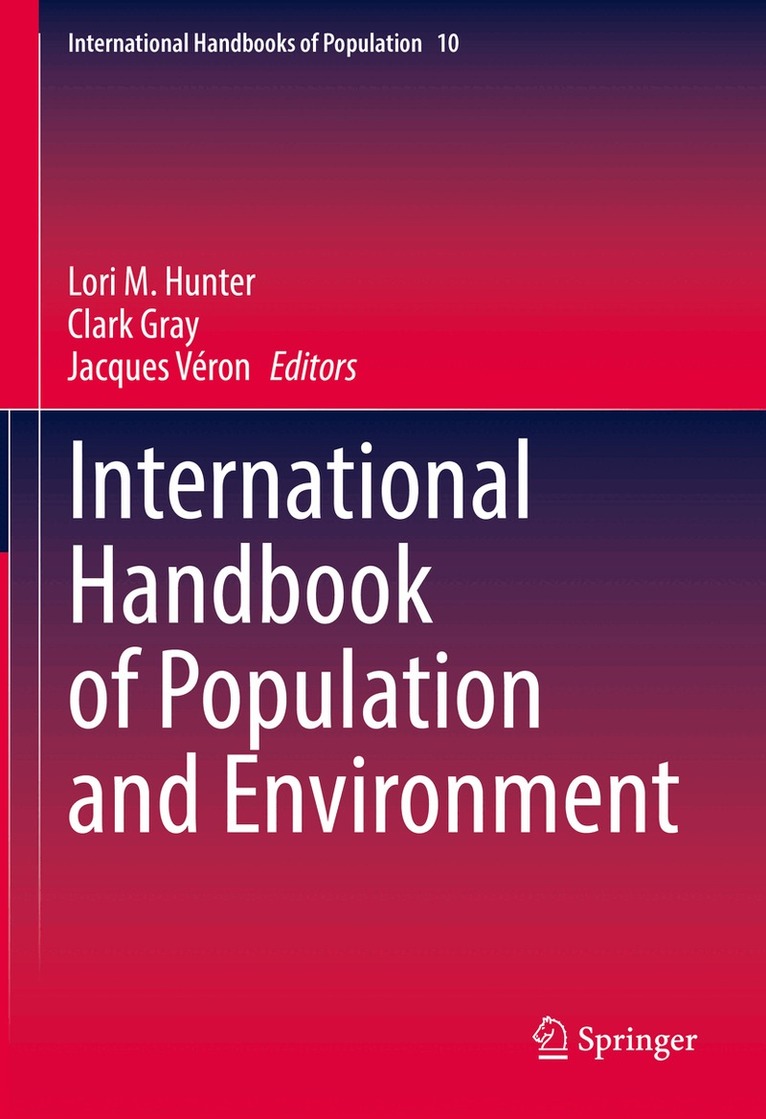
    International Handbook of Population and Environment

    AvLori M. Hunter,Clark Gray

    Inbunden, Engelska, 2022

    Del i serien International Handbooks of Population

    1 949 kr

    Beställningsvara. Skickas inom 10-15 vardagar. Fri frakt över 249 kr.

    Beskrivning

    This handbook presents a timely and comprehensive overview of theory, data, methods and research findings that connect human population dynamics and environmental context. It presents regional summaries of empirical findings on migration and environmental connections and summarizes environmental impacts of migration – such as urbanization and deforestation. It also offers background on the health implications of environmental conditions such as climate change, natural disasters, scarcity of natural resources, as well as on resource scarcity and fertility, gender considerations in population and environment, and the connections between population size, growth, composition and carbon emissions. This handbook helps readers to better understand the complexities within population-environment connections, in addition to some of the opportunities and challenges within environmental demography. As such this collection is an invaluable resource for students, researchers, and policy analysts inthe areas of demography, migration, fertility, health and mortality, as well as environmental, global and development studies.

    Produktinformation

    • Utgivningsdatum:2022-02-08
    • Mått:178 x 254 x 32 mm
    • Vikt:1 298 g
    • Format:Inbunden
    • Språk:Engelska
    • Serie:International Handbooks of Population
    • Antal sidor:518
    • Förlag:Springer Nature Switzerland AG
    • ISBN:9783030764326

    Utforska kategorier

    • Miljövetenskap och miljöpolitik inom Naturvetenskap och teknik
    • Sociologi inom Samhälle och politik
    • Biovetenskap inom Naturvetenskap och teknik

    Mer om författaren

    Lori Hunter is Professor of Sociology at the University of Colorado Boulder. She is also Director of the CU Population Center within in the Institute of Behavioral Science. Dr. Hunter’s research focuses on population dynamics as related to environmental context with a primary emphasis on migration as a livelihood strategy among natural resource-dependent communities in rural South Africa. She also works on issues of data confidentiality in population-environment research. Clark Gray is Associate Professor of Geography at the University of North Carolina at Chapel Hill. His research integrates data and methods from the population and spatial sciences to investigate the consequences of environmental change for vulnerable households in the developing world. A primary contribution has been to quantify environmental influences on human migration  in more than twenty developing countries. Jacques Véron is demographer and emeritus research director at the French Institute for Demographic Studies (INED). He has been deputy director of INED. His research focus on population dynamics, environmental change and development. He has conducted surveys in India, in particular on international migration.  He has also an interest for the demography of extreme events.

    Innehållsförteckning

    • Chapter 1.  It’s About Time: Integrating the Environment into Population Research (Lori M. Hunter, Clark Gray, and Jacques Veron).- Part I : Theoretical Perspectives.- Chapter 2.  Population and Environment Interactions: Macro Perspectives (Jacques Véron).- Chapter 3.  A Micro Perspective: Elaborating Demographic Contributions to the Livelihoods Framework (Sara Curran).- Chapter 4. Vulnerability to Climate Change and Adaptive capacity from a demographic perspective (Raya Muttarak).- Part II: Data & Methods.- Chapter 5.  Household-scale Data and Analytical Approaches (Brian Thiede).- Chapter 6.  Spatial Data and Analytical Approaches (Rachel A. Rosenfeld and KatherineJ. Curtis).- Chapter 7.  Qualitative Data and Approaches to Population-Environment Inquiry (Sabine Henry, Sebastien Dujardin, Elisabeth Henriet, and Sofia Costa Santos Baltazar).- Part III: Migration & Environment.- Chapter 8.  Building a Policy-Relevant Research Agenda on EnvironmentalMigration in Africa (Valerie Mueller).- Chapter 9.  Water Stress and Migration in Asia (David J. Wrathall and Jamon Van Den Hoek).- Chapter 10.  Environmentally Informed Migration in North America (Elizabeth Fussell and Brianna Castro).- Chapter 11.  Environmental Migration in Latin America (Daniel H. Simon and Fernando Riosmena).- Part IV: Health and Mortality.- Chapter 12.  Air Pollution, Health, and Mortality (Melissa LoPalo and Dean Spears).- Chapter 13.  Population and Water Issues: Going Beyond Scarcity (Stéphanie Dos Santos, Bénédicte Gastineau and Valérie Golaz).- Chapter 14.  Heat, Mortality, and Health (Heather Randell).- Chapter 15.  Land Use Change and Health (William Pan and Gabrielle Bonnet).- Chapter 16.  Health and Mortality Consequences of Natural Disasters (Mark VanLandingham, Bonnie Bui, David Abramson, Sarah Friedman, and Rhae Cisneros).- Part V: The Influence of Demographic Dynamics on the Environment.- Chapter 17.  Cities and Their Environments (Mark R. Montgomery, Jessie Pinchoff, and Erica K. Chuang).- Chapter 18.  Population and Agricultural Change (Richard Bilsborrow).- Chapter 19.  Population and Energy Consumption/Carbon Emissions: What We Know, What We Should Focus on Next (Brantley Liddle and Gregory Casey).- Part VI: Other arenas.- Chapter 20.  Environment and Fertility (Samuel Sellers).- Chapter 21.  Gender, Population and the Environment (Jessica Marter-Kenyon, Samuel Sellers, and Maia Call).- Chapter 22.  Socio-Demographic Inequalities in Environmental Exposures (James R. Elliott and Kevin T. Smiley).- Part VI: Conclusion & Reflections.- Chapter 23. Reflections on the Past, Present, and Future of Population-Environment Research (Barbara Entwisle).- Chapter 24. Environmental migration scholarship and policy: recent progress, future challenges (Robert McLeman).