• Fri frakt över 249 kr
  • •
  • Snabba leveranser
  • •
  • Billiga böcker
Kundservice

Du är på sajten för privatpersoner.

Företag, bibliotek eller offentlig verksamhet?

Du handlar på classic.bokus.com, där alla dina funktioner finns intakta.
Till classic.bokus.com
Bokus logotyp. Gå till startsidan.
  • Erbjudanden
  • Nyheter
  • Student
  • Topplistor
  • Barn & ungdom
  • Bokus Play
  • E-böcker
  • Pocketböcker
  • Spel & pussel

10% rabatt på allt med kod: NYSTART10 →

Sidfot

Mina sidor

    Hjälp

    • Kundservice
    • Vanliga frågor och svar
    • Frakt och leverans
    • Retur vid ångerrätt
    • Reklamera vara
    • Betalning
    • Köpvillkor
    • Allmänna villkor
    • Information om webbplatsens tillgänglighet

    Om Bokus

    • Om oss
    • Pressrum
    • För studenter
    • För företag
    • För bibliotek och offentlig verksamhet
    • För leverantörer
    • Hållbarhet

    Populärt

    • Aktuella erbjudanden
    • Presentkort
    • Studentlitteratur
    • Nya böcker
    • Topplistor
    • Signerade böcker
    • Engelska böcker

    Inspiration

    • Boktips
    • BookTok
    • Populära bokserier
    • Barnbokskaraktärer
    • Populära författare
    Logotyp för Bokus
    Följ oss på Facebook (extern länk)Följ oss på Instagram (extern länk)Följ oss på YouTube (extern länk)Följ oss på TikTok (extern länk)
    bokus @ CookiesAnpassa cookiesIntegritetspolicyKöpvillkor
    Till Citymail hemsida (extern länk)Till Budbee hemsida (extern länk)Till Postnord hemsida (extern länk)Till Schenker hemsida (extern länk)Till Early Bird hemsida (extern länk)Till Walleys hemsida (extern länk)
    1. Naturvetenskap och teknik
    2. Matematik och naturvetenskap
    3. Matematik

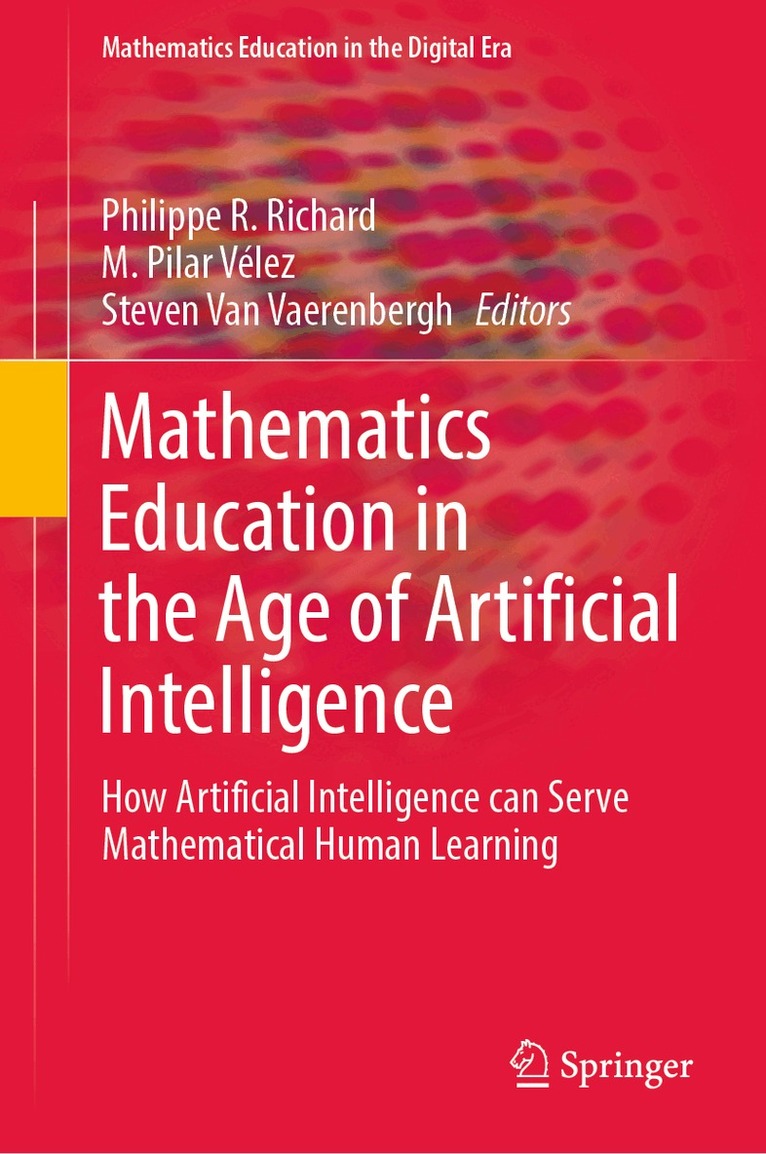
    Mathematics Education in the Age of Artificial Intelligence

    How Artificial Intelligence can Serve Mathematical Human Learning

    AvPhilippe R. Richard,M. Pilar Vélez

    Inbunden, Engelska, 2022

    Del 17 i serien Mathematics Education in the Digital Era

    1 842 kr

    Beställningsvara. Skickas inom 10-15 vardagar. Fri frakt över 249 kr.

    Beskrivning

    This book highlights the contribution of artificial intelligence for mathematics education. It provides concrete ideas supported by mathematical work obtained through dynamic international collaboration, and discusses the flourishing of new mathematics in the contemporary world from a sustainable development perspective. Over the past thirty years, artificial intelligence has gradually infiltrated all facets of society. When it is deployed in interaction with the human designer or user, AI certainly raises new ethical questions. But as soon as it aims to augment intelligence in a kind of human-machine partnership, it goes to the heart of knowledge development and the very performance of work. The proposed themes and the sections of the book address original issues relating to the creation of AI milieus to work on mathematics, to the AI-supported learning of mathematics and to the coordination of « usual »  paper/pencil techniquesand « new » AI-aided educational working spaces. The authors of the book and the coordinators of each section are all established specialists in mathematics didactics, mathematics and computer science. In summary, this book is a must-read for everyone interested in the teaching and learning of mathematics, and it concerns the interaction between the human and the machine in both directions. It contains ideas, questions and inspiration that invite to take up the challenge of Artificial Intelligence contributing to Mathematical Human Learning.

    Produktinformation

    • Utgivningsdatum:2022-03-10
    • Mått:155 x 235 x 31 mm
    • Vikt:875 g
    • Format:Inbunden
    • Språk:Engelska
    • Serie:Mathematics Education in the Digital Era
    • Antal sidor:450
    • Förlag:Springer Nature Switzerland AG
    • ISBN:9783030869083

    Utforska kategorier

    • Matematik inom Naturvetenskap och teknik
    • Artificiell intelligens inom Data och IT
    • Lärarutbildning inom Psykologi och pedagogik

    Mer om författaren

    Philippe R. Richard is professeur titulaire (full professor) in the Département de didactique at the Université de Montréal. He is a specialist in didactics of mathematics and computer science. He has participated in and has led several major programs concerning didactics, mathematics and computer science. His current research activity extends the recent technological achievements of his research team in artificial intelligence. He is regularly invited to chair thematic groups (CERME, ICME) and to preside over symposia on mathematical work (ETM). He also gives research seminars and participates in the writing of synthesis texts and as editors for books. He has been a visiting professor at the Universitat Autònoma de Barcelona, the Université de Paris and the École Polytechnique de Montréal, and he is currently editor-in-chief of the journal Annales de didactique et de sciences cognitives (IREM, Université de Strasbourg).M. Pilar Vélez is professor of applied mathematics at the Universidad Antonio de Nebrija (Madrid, Spain). She is member of the research group PID2020-113192GB-I00 (Mathematical Visualization: Foundations, Algorithms and Applications) from the Spanish MICINN.  She has been Rector of Universidad Antonio de Nebrija from 2010 to 2014. She authorship several scientific papers in different indexed journals and many scientific communications and conferences on topics as Real Algebraic Geometry, Computer Algebra, Automatic Reasoning in Dynamic Geometry and Mathematics Education. Now her research interest is focused in automatic reasoning in geometry, as well as algorithms, implementation and its applications to other fields as math education, linkages visualization and augmented reality. She has been organizer of international workshops, special sessions and conferences, as well as program committe (ACA,  CAGDME, ATCM, Maple Conference, Bienal RSME, RAAG). She has been a guest researcher at Università di Pisa, Louisiana State University,  Johannes Kepler University and at the University of Montreal. She has been invited to deliver lectures at the IHP of Paris, the University of Trento, the Eindhoven University of Technology, the Louisiana State University or the University of Pisa.Steven Van Vaerenbergh is assistant professor in the Department of Mathematics, Statistics and Computing at Universidad de Cantabria (Spain). He has conducted research in artificial intelligence, co-authoring scientific publications on machine learning theory and multivariate statistics. Drawing upon this experience, his current research activity focuses on the applications of artificial intelligence in mathematics education, in particular on novel technological learning environments and automated systems to provide individualized learning experiences. He has co-authored several scientific papers on these topics, as well as publications on related subjects such as dynamic geometry systems. He hasparticipated in the organizing committees of international conferences and, in particular, he recently co-organized the Symposium on Artificial Intelligence for Mathematics Education (AI4ME).

    Innehållsförteckning

    • Part I: Creation of AI milieus to work on mathematics.- Chapter 1. Evolution of automatic proving and reasoning technologies and dynamics in geometry.- Chapter 2. Exploring dynamic geometry through immersive virtual reality.- Chapter 3. Computing power and automated reasoning tools for performing mathematical work.- Chapter 4. Designing atutorial system for learning mathematics.- Chapter 5. Technological innovations in math education to foster creativities in schools in the era of artificial intelligence.- Part II: AI-supported learning of mathematics.- Chapter 6. Classroom Implementation of STEAM Education through IA and other technology.- Chapter 7. Understanding and creating to better understand instrumented reasoning using tools and IA devices.- Chapter 8. Automated exploration in mathematics.- Chapter 9. Artificial intelligence and mathematics working over monuments and other realities.- Chapter 10. Emerging technologies and emerging types of learning in mathematics education.- Part III: Coordinating “usual” paper/pencil techniques and “new” AI-aided educational working spaces.- Chapter 11. Digital technology and its various uses from the instrumental perspective.- Chapter 12. Innovative CAS technology use in mathematics teaching and assessment.- Chapter 13. Learning itineraries in pre-service teachereducation.- Chapter 14. One method of trisecting an angle and its interpretation for teaching purposes using a dynamic geometry and computer algebra system.- Chapter 15. Rearrangement method for area of a circle: complex paths from historical roots to modern visual and dynamic models in discovery-based teaching approach.- Chapter 16. Teaching Programming to Mathematical Scientists.- Conclusion.