• Fri frakt över 249 kr
  • •
  • Snabba leveranser
  • •
  • Billiga böcker
Kundservice

Du är på sajten för privatpersoner.

Företag, bibliotek eller offentlig verksamhet?

Du handlar på classic.bokus.com, där alla dina funktioner finns intakta.
Till classic.bokus.com
Bokus logotyp. Gå till startsidan.
  • Erbjudanden
  • Nyheter
  • Student
  • Topplistor
  • Barn & ungdom
  • Bokus Play
  • E-böcker
  • Pocketböcker
  • Spel & pussel

10% rabatt på allt med kod NYSTART10 →

Sidfot

Mina sidor

    Hjälp

    • Kundservice
    • Vanliga frågor och svar
    • Frakt och leverans
    • Retur vid ångerrätt
    • Reklamera vara
    • Betalning
    • Köpvillkor
    • Allmänna villkor
    • Information om webbplatsens tillgänglighet

    Om Bokus

    • Om oss
    • Pressrum
    • För studenter
    • För företag
    • För bibliotek och offentlig verksamhet
    • För leverantörer
    • Hållbarhet

    Populärt

    • Aktuella erbjudanden
    • Presentkort
    • Studentlitteratur
    • Nya böcker
    • Topplistor
    • Signerade böcker
    • Engelska böcker

    Inspiration

    • Boktips
    • BookTok
    • Populära bokserier
    • Barnbokskaraktärer
    • Populära författare
    Logotyp för Bokus
    Följ oss på Facebook (extern länk)Följ oss på Instagram (extern länk)Följ oss på YouTube (extern länk)Följ oss på TikTok (extern länk)
    bokus @ CookiesAnpassa cookiesIntegritetspolicyKöpvillkor
    Till Citymail hemsida (extern länk)Till Budbee hemsida (extern länk)Till Postnord hemsida (extern länk)Till Schenker hemsida (extern länk)Till Early Bird hemsida (extern länk)Till Walleys hemsida (extern länk)
    1. Naturvetenskap och teknik
    2. Matematik och naturvetenskap
    3. Matematik
    4. Tillämpad matematik

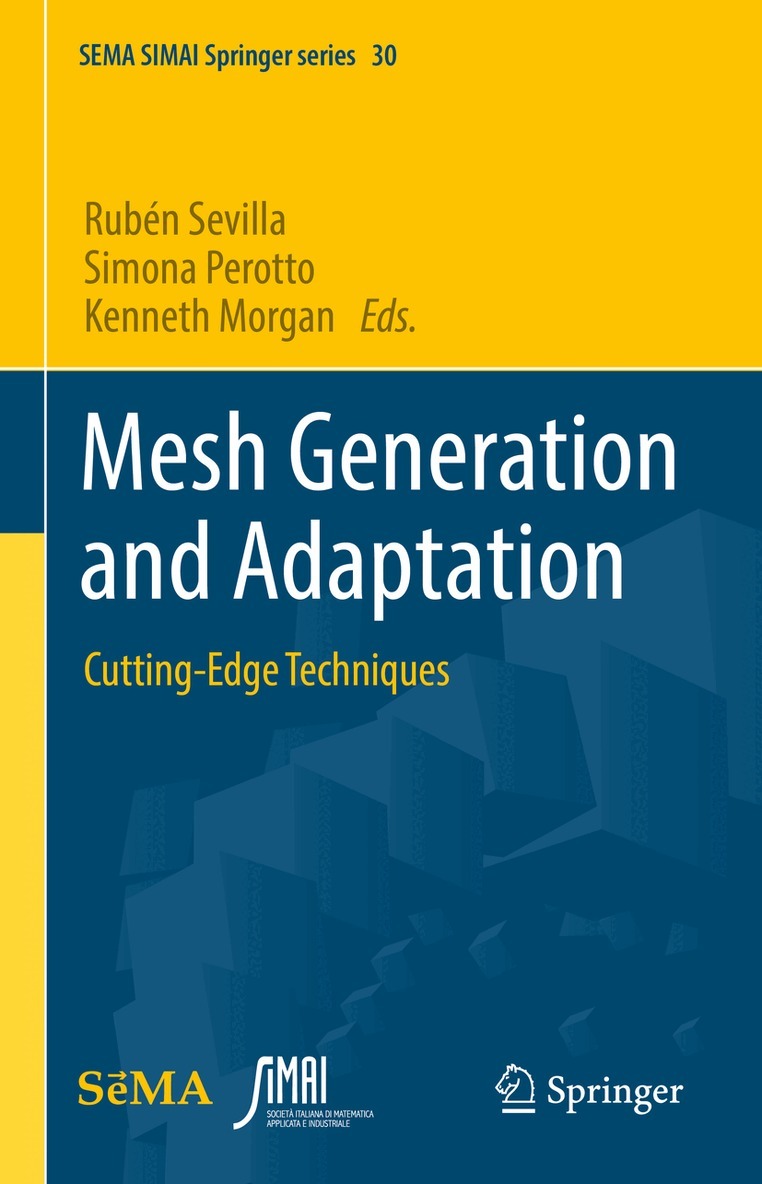
    Mesh Generation and Adaptation

    Cutting-Edge Techniques

    AvRubén Sevilla,Simona Perotto

    Inbunden, Engelska, 2022

    Del 30 i serien SEMA SIMAI Springer Series

    1 623 kr

    Beställningsvara. Skickas inom 10-15 vardagar. Fri frakt över 249 kr.

    Beskrivning

    The developments in mesh generation are usually driven by the needs of new applications and/or novel algorithms. The last decade has seen a renewed interest in mesh generation and adaptation by the computational engineering community, due to the challenges introduced by complex industrial problems.Another common challenge is the need to handle complex geometries. Nowadays, it is becoming obvious that geometry should be persistent throughout the whole simulation process. Several methodologies that can carry the geometric information throughout the simulation stage are available, but due to the novelty of these methods, the generation of suitable meshes for these techniques is still the main obstacle for the industrial uptake of this technology.This book will cover different aspects of mesh generation and adaptation, with particular emphasis on cutting-edge mesh generation techniques for advanced discretisation methods and complex geometries.

    Produktinformation

    • Utgivningsdatum:2022-05-19
    • Mått:155 x 235 x 24 mm
    • Vikt:676 g
    • Format:Inbunden
    • Språk:Engelska
    • Serie:SEMA SIMAI Springer Series
    • Antal sidor:327
    • Förlag:Springer Nature Switzerland AG
    • ISBN:9783030925390

    Utforska kategorier

    • Tillämpad matematik inom Naturvetenskap och teknik
    • Teknik: allmänt inom Naturvetenskap och teknik
    • Hårdvara inom Data och IT

    Mer om författaren

    Rubén Sevilla is a Professor at the Zienkiewicz Centre for Computational Engineering at Swansea University, Wales, UK. His research interest is the development, analysis and application of high-order methods. He is particularly interested in methods that are able to account for the exact boundary representation given by a CAD model. He is the current President of the UK Association for Computational Mechanics.Simona Perotto is an Associate Professor of Numerical Analysis at the Department of Mathematics, Politecnico di Milano, Italy. Her research interests are focused on the numerical approximation of partial differential equations, in particular on mesh generation and adaptation and on adaptive reduced order modelling, with application to computational fluid dynamics, topology optimization, materials, crack detection, aerospace engineering, images, rendering of 3D graphical objects.Kenneth Morgan is a Professor at the Zienkiewicz Centre for Computational Engineering at Swansea University, Wales, UK. His research interests are the development and use of numerical techniques for the solution of problems in aerospace engineering. He was elected a Fellow of the Royal Academy of Engineering in 1997 and an Inaugural Fellow of the Learned Society of Wales in 2012.

    Innehållsförteckning

    • 1 Carolyn Woeber, Advances in H-P Mesh Adaptation for Finite Element Methods.- 2 Chiara Nardoni, Remeshing techniques in shape and topology optimization.- 3 Dimitrios Papadimitrakis, Building direction fields on the medial object to generate 3D domain decompositions for hexahedral meshing.- 4 Franck Ledoux, Interecode hexahedral meshing from Eulerian to Lagrangian simulations.- 5 Jean-Francois Remacle, A robust approach for mesh generation of surfaces with irregular/singular parametrizations.6 Jens Lang, Sample Adaptive Multilevel Stochastic Collocation Schemes in Uncertainty Quantification of Gas Transport in Networks.- 7 Jessica Zhang, Hexahedral dominant mesh generation and spline modeling for isogeometric analysis.- 8 Juan José Ródenas, Mesh adaptivity in the framework of the Cartesian grid finite element method, cgFEM.- 9 Mario Ricchiuto, h- and r-adaptation on simplicial meshes: implementation and applications.- 10 Onkar Sahni, Geometry and Adaptive Mesh Update Procedures for Ballistics Simulations.- 11 Per-Olof Persson, HOIST: High-Order Implicit Shock Tracking using an optimization-based discontinuous Galerkin method.- 12 Rainald Lohner, Breakthrough ‘workarounds’ in unstructured mesh generation.- 13 Simone Appella, An adaptive moving mesh method with conservative interpolation based on local projection.- 14 Suzanne Shontz, Global optimization strategies for automated edge grid generation.