• Fri frakt över 249 kr
  • •
  • Snabba leveranser
  • •
  • Billiga böcker
Kundservice

Du är på sajten för privatpersoner.

Företag, bibliotek eller offentlig verksamhet?

Du handlar på classic.bokus.com, där alla dina funktioner finns intakta.
Till classic.bokus.com
Bokus logotyp. Gå till startsidan.
  • Erbjudanden
  • Nyheter
  • Student
  • Topplistor
  • Barn & ungdom
  • Bokus Play
  • E-böcker
  • Pocketböcker
  • Spel & pussel

10% rabatt på allt med kod: NYSTART10 →

Sidfot

Mina sidor

    Hjälp

    • Kundservice
    • Vanliga frågor och svar
    • Frakt och leverans
    • Retur vid ångerrätt
    • Reklamera vara
    • Betalning
    • Köpvillkor
    • Allmänna villkor
    • Information om webbplatsens tillgänglighet

    Om Bokus

    • Om oss
    • Pressrum
    • För studenter
    • För företag
    • För bibliotek och offentlig verksamhet
    • För leverantörer
    • Hållbarhet

    Populärt

    • Aktuella erbjudanden
    • Presentkort
    • Studentlitteratur
    • Nya böcker
    • Topplistor
    • Signerade böcker
    • Engelska böcker

    Inspiration

    • Boktips
    • BookTok
    • Populära bokserier
    • Barnbokskaraktärer
    • Populära författare
    Logotyp för Bokus
    Följ oss på Facebook (extern länk)Följ oss på Instagram (extern länk)Följ oss på YouTube (extern länk)Följ oss på TikTok (extern länk)
    bokus @ CookiesAnpassa cookiesIntegritetspolicyKöpvillkor
    Till Citymail hemsida (extern länk)Till Budbee hemsida (extern länk)Till Postnord hemsida (extern länk)Till Schenker hemsida (extern länk)Till Early Bird hemsida (extern länk)Till Walleys hemsida (extern länk)
    1. Naturvetenskap och teknik
    2. Teknik och industri
    3. Teknik: allmänt

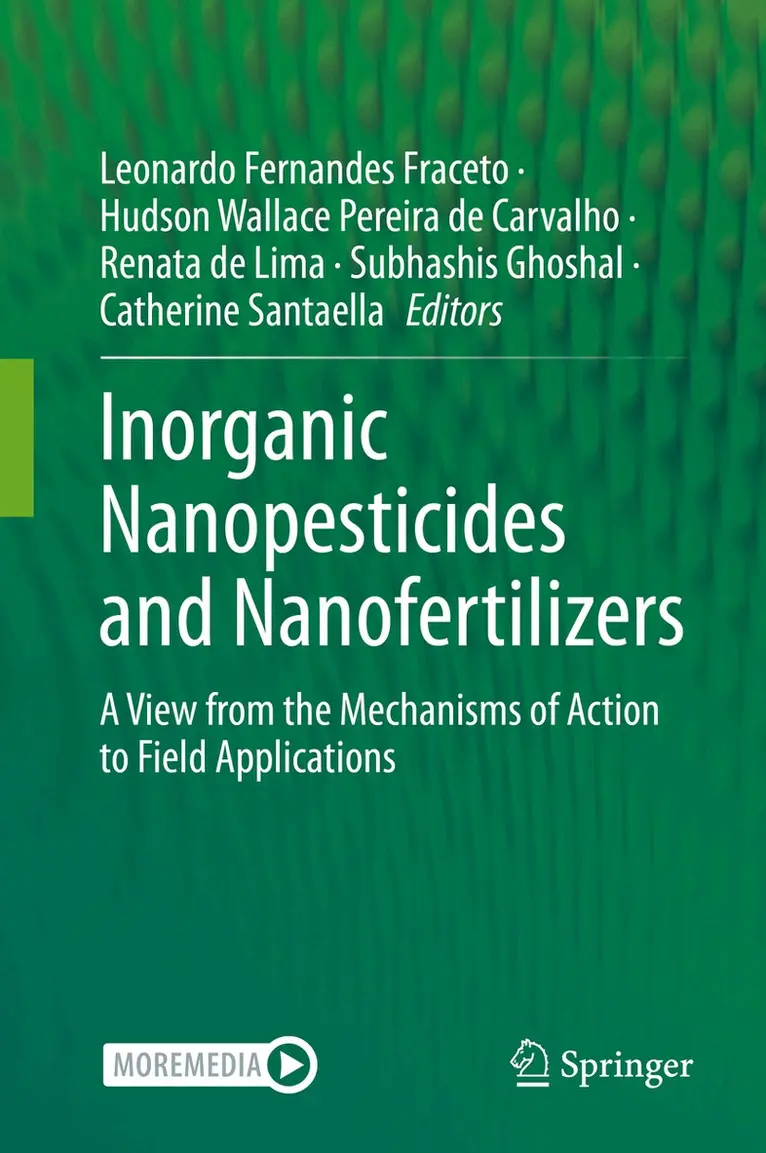
    Inorganic Nanopesticides and Nanofertilizers

    A View from the Mechanisms of Action to Field Applications

    AvLeonardo Fernandes Fraceto,Hudson Wallace Pereira de Carvalho

    Inbunden, Engelska, 2022

    1 949 kr

    Beställningsvara. Skickas inom 10-15 vardagar. Fri frakt över 249 kr.

    Beskrivning

    This book discusses inorganic/metallic nanopesticides and fertilizers. Rather than providing a general review of the topic, it offers a critical assessment of what has been achieved and highlights future measures to allow agriculture to profit from the properties of inorganic nanoparticles. It covers a variety of topics, including strategies for preparing cost-effective nanoparticles, their chemistry both within and outside the plant, the effects of nanoparticles in the field and whether the current strategies were successful in increasing crop yields. This book will appeal to readers in academia and industry, as well as stakeholders and anyone who has an interest in the applications of inorganic nanopesticides and nanofertilizers as well as the potential use of these technologies in agriculture.

    Produktinformation

    • Utgivningsdatum:2022-05-28
    • Mått:155 x 235 x 28 mm
    • Vikt:781 g
    • Format:Inbunden
    • Språk:Engelska
    • Antal sidor:390
    • Förlag:Springer Nature Switzerland AG
    • ISBN:9783030941543

    Utforska kategorier

    • Teknik: allmänt inom Naturvetenskap och teknik
    • Biokemisk teknik inom Naturvetenskap och teknik
    • Naturvetenskap:allmänt inom Naturvetenskap och teknik

    Mer om författaren

    Dr. Leonardo Fernandes Fraceto is a Professor at São Paulo State University. After completing Ph.D., he conducted research on systems based on cyclodextrins and their applications in health and has developed carrier systems for herbicides and other compounds of interest for pest control in agriculture. His research has with respected collaborators has contributed to scientific and technological development at national and international levels.Dr. Hudson Wallace Pereira de Carvalho holds a bachelor’s degree in Chemistry and doctoral degree in Physical Chemistry from São Paulo State University and the University of Paris-Sud XI. An expert on the application of X-ray spectrometry to characterize nano and biosystems, he has an extensive track record on the use of nanomaterials in environmental remediation and catalytic reactions. His research focuses on the use of nanomaterials to increase crop productivity and reduce the use of pesticides and fertilizers. Dr. Renata de Lima holds a bachelor’s degree in Biological Sciences and M.Sc. in Genetics and Evolution from the Federal University of São Carlos (UFSCar) and a Ph.D. in Medical Sciences from Unicamp. She was the coordinator of the Biotechnology undergraduate course of the University of Sorocaba from 2006 to 2014 and of the Engineering of Biotechnology and Bioprocesses undergraduate course from 2014 to 2016. She is a professor in two graduate programs at Uniso. Her interests include genetics, particularly molecular biology, cytogenetics, and mutagenesis. Dr. Subhasis Ghoshal is a Professor of Civil Engineering at McGill University and Director of McGill’s Trottier Institute for Sustainability in Engineering and Design. He joined McGill after completing his Ph.D. at Carnegie Mellon University and a postdoctoral fellowship at the University of Michigan at Ann Arbor. He has led several inter-university research projects and international collaborations on the use of biotechnology and nanotechnology for the environmental remediation of soils and groundwater contaminated with industrial wastes.  Dr. Catherine Santaellas holds a bachelor’s degree, a Master of Engineering degree in Industrial Organic Synthesis and Process Engineering from the University of Aix-Marseille, as well as a Ph.D. in Chemistry and a postdoctorate degree (habilitation). She is a Research Scientist at the CNRS, where she focuses on molecular, cellular, and functional responses in the rhizosphere induced by environmental stresses, such as nanomaterials and metals, and the adaptation of the soil-plant-microorganism system under biotic and abiotic stress. She has coordinated various national and international programs, including a number on safer-by-design approaches for nanomaterials and nanotoxicology.

    Innehållsförteckning

    • Chapter 1 - Properties of inorganic nanoparticles that can be applied to agriculture.- Chapter 2 - Strategies to produce cost-effective fertilizer-based nanoparticles.- Chapter 3 - Physicochemical properties of inorganic nanoparticles in aqueous media and agricultural tank mixtures.- Chapter 4 - Mechanisms of root and leaf uptake, transport, storage, metabolism, and detoxication of inorganic nanoparticles.- Chapter 5 - Nanoparticles for seed treatment.- Chapter 6 - Pesticide effects of inorganic nanoparticles.- Chapter 7 - Nanoparticles in soils: transport, fate and capacity to enhance soil properties.- Chapter 8 - Nanoparticles for remediation of agricultural contaminated soils.- Chapter 9 - Implications of nanoparticles on the dynamics of the rhizosphere and microbial community.- Chapter 10 - Nanoparticles as bio stimulantsChapter 11 - Nanoparticles in plant diagnosis.- Chapter 12 - Nanoparticles used as biosensors in the agri-sector.- Chapter 13 - A comparison of the performance of inorganic and organic nanocarriers in agriculture.- Chapter 14 - Balancing the benefits to agriculture and adverse ecotoxicological impacts of inorganic nanoparticles.- Chapter 15 - Efficacy of nanoparticles on crops: lab versus field trials.- Chapter 16 - Porous inorganic nanoparticles as pesticide or nutrient carriers.- Chapter 17 - Uptake and translocation of nanomaterials by plants and their possible inclusion in the trophic chain.