• Fri frakt över 249 kr
  • •
  • Snabba leveranser
  • •
  • Billiga böcker
Kundservice

Du är på sajten för privatpersoner.

Företag, bibliotek eller offentlig verksamhet?

Du handlar på classic.bokus.com, där alla dina funktioner finns intakta.
Till classic.bokus.com
Bokus logotyp. Gå till startsidan.
  • Erbjudanden
  • Nyheter
  • Student
  • Topplistor
  • Barn & ungdom
  • Bokus Play
  • E-böcker
  • Pocketböcker
  • Spel & pussel

10% rabatt på allt med kod NYSTART10 →

Sidfot

Mina sidor

    Hjälp

    • Kundservice
    • Vanliga frågor och svar
    • Frakt och leverans
    • Retur vid ångerrätt
    • Reklamera vara
    • Betalning
    • Köpvillkor
    • Allmänna villkor
    • Information om webbplatsens tillgänglighet

    Om Bokus

    • Om oss
    • Pressrum
    • För studenter
    • För företag
    • För bibliotek och offentlig verksamhet
    • För leverantörer
    • Hållbarhet

    Populärt

    • Aktuella erbjudanden
    • Presentkort
    • Studentlitteratur
    • Nya böcker
    • Topplistor
    • Signerade böcker
    • Engelska böcker

    Inspiration

    • Boktips
    • BookTok
    • Populära bokserier
    • Barnbokskaraktärer
    • Populära författare
    Logotyp för Bokus
    Följ oss på Facebook (extern länk)Följ oss på Instagram (extern länk)Följ oss på YouTube (extern länk)Följ oss på TikTok (extern länk)
    bokus @ CookiesAnpassa cookiesIntegritetspolicyKöpvillkor
    Till Citymail hemsida (extern länk)Till Budbee hemsida (extern länk)Till Postnord hemsida (extern länk)Till Schenker hemsida (extern länk)Till Early Bird hemsida (extern länk)Till Walleys hemsida (extern länk)
    1. Samhälle och politik
    2. Samhälle och kultur
    3. Sociala och etiska frågor
    4. Migration

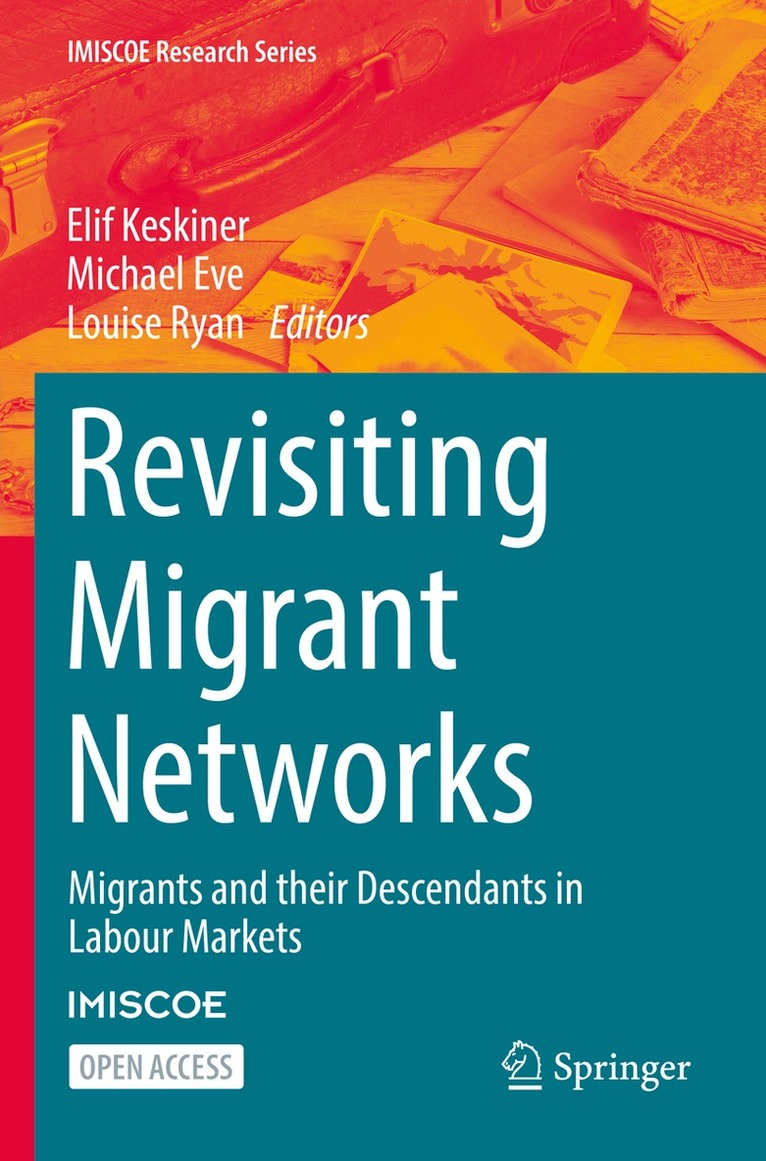
    Revisiting Migrant Networks

    Migrants and their Descendants in Labour Markets

    AvElif Keskiner,Michael Eve

    Häftad, Engelska, 2022

    Del i serien IMISCOE Research Series

    438 kr

    Beställningsvara. Skickas inom 10-15 vardagar. Fri frakt över 249 kr.

    Beskrivning

    This open access book provides new conceptualisations on the networks of migrants and their descendants in accessing the labour market. Although references to social networks are common in discussions of migration, simplified ideas of co-ethnic networks often obscure the reality, for example confounding ties with co-ethnics and ‘strong ties’. This open access book addresses key questions about the role of networks in migration contexts, particularly in relation to how migrants and their descendants, access the labour market and develop their employment trajectories over time. Rather than adopting a narrow essentializing ethnic lens, the research presented in this book explores intersectional identities of class, generation and gender. By focusing on the kinds of capital circulating between ties, including the dark side of social capital, the book offers insights into power dynamics and the potentially exclusionary dimension of networks. Taking a long term view, acrossgenerations, the research in this book shows how migrants and their descendants mobilize resources to tackle discrimination and enhance their position within particular labour markets. Drawing on robust quantitative and rich qualitative data, this book provides a primary source to students, scholars and policy-makers focusing on issues of migration, social networks, social mobility as well as labour market inequalities.

    Produktinformation

    • Utgivningsdatum:2022-03-17
    • Mått:155 x 235 x 14 mm
    • Vikt:376 g
    • Format:Häftad
    • Språk:Engelska
    • Serie:IMISCOE Research Series
    • Antal sidor:236
    • Förlag:Springer Nature Switzerland AG
    • ISBN:9783030949747

    Utforska kategorier

    • Migration inom Samhälle och politik
    • Sociologi inom Samhälle och politik
    • Offentlig förvaltning inom Samhälle och politik

    Mer om författaren

    Elif Keskiner is an Assistant Professor at the Vrije University Amsterdam, The Netherlands. She has conducted her PhD at the University of Amsterdam on youth transitions among descendants of migrants in the Netherlands and France. Later she worked as a Post-doc researcher in the ELITES project studying capital development among upwardly mobile descendants of Turkish migrants who have achieved leading positions. She was also involved in Reducing Early School Leavers in EU project as a coordinator. As a sociologist she is trained both in quantitative and qualitative methods and she has significant experience in mixed methods studies. She has also worked in various cross-country research projects and achieved a strong competence in comparative research. Her research interests cover a wide range of subjects in sociology such as youth transitions, descendants of Turkish migrants, social mobility patterns and elite formation, social capital formation and development of various forms of capital among minority youth, transnationalism and educational inequality. She published numerous articles and book chapters on these topics. In 2017 she co-edited a special issue with Maurice Crul in Ethnic and Racial Studies called “The Upcoming New Elite among Children of Immigrants”. In 2019 her book Youth Transitions among Descendants of Turkish Immigrants in Amsterdam and Strasbourg: A Generation in Transition came out with Springer.Michael Eve is Associate Professor and director of the Migration and Inequality Laboratory at the University of Eastern Piedmont, Alessandria, Italy. Much of his research has focused on the role of networks and social capital in the shaping of social processes. In recent years, his work has been mainly on migration, on integration into the workforce, and on educational results of children of migrants, often with a comparative focus. His work has been published in international and Italian journals including Ethnic and Racial Studies, Archives Européennes de Sociologie, Polis, Mondi Migranti, Rassegna italiana di sociologia. His work has been funded by the European Research Council, EU funds (FAMI), Italian foundations and the Italian National Research Council. He is currently working on “neighbourhood effects” and the way growing up in a particular neighbourhood affects educational attainment of children of migrants, and (in another project) on the difficulties of entering into the workforce of migrants arriving in Italy as asylum seekers.Louise Ryan, is Senior Professor of Sociology and  Director of the Global Diversities and Inequalities Research Centre, London Metropolitan University.She is an expert on migration with a particular focus on social networks. She has written many highly cited journal articles on migrant networks and is a leading thinker in the field of qualitative social network analysis. She has recently guest edited special issues of Global Networks (with Janine Dahinden, 2021) and Social Networks (with Paola Tubaro, Alessio D'Angelo and Antonio Casilli, 2021). Louise has published several books including Gendering Migration (with Wendy Webster, 2008) and Migrant Capital (with Umut Erel and Alessio D'Angelo, 2015).Louise a Fellow of the Academy of Social Sciences and chair of trustees at the British Sociological Association. Louise’s work has been funded by the Economic and Social Research Council (ESRC), FP7 and Horizon2020.

    Innehållsförteckning

    • Chapter 1. Introduction: Revisiting Networks: setting the conceptual and methodological scene.- Chapter 2. The direct and indirect role of migrants’ networks in accessing diverse labour market sectors: an analysis of the weak/ strong ties continuum.- Chapter 3. Are “weak ties” really weak? Social capital reliance among second generation Turkish lawyers in Paris.- Chapter 4. Context matters: the varying roles of social ties for professional careers of immigrants’ descendants.- Chapter 5. Access to employment of the second generations in France: unequal role of family and personal networks by Origins and Gender.- Chapter 6. Social capital, immigrants and their descendants - the case of Sweden.- Chapter 7.Activating Social Capital: Steep mobility of descendants of immigrants at the top of the corporate business sector.- Chapter 8. Reciprocity within Migrant Networks: The Role of Social Support for Employment.- Chapter 9. Networks in Migration Processes.- Chapter 10.  Early-career academics’ transnational moves: The gendered role of vertical social ties in obtaining academic positions abroad.- Chapter 11: Epilogue. Where Did Weak and Strong Ties Go Wrong?.