• Fri frakt över 249 kr
  • •
  • Snabba leveranser
  • •
  • Billiga böcker
Kundservice

Du är på sajten för privatpersoner.

Företag, bibliotek eller offentlig verksamhet?

Du handlar på classic.bokus.com, där alla dina funktioner finns intakta.
Till classic.bokus.com
Bokus logotyp. Gå till startsidan.
  • Erbjudanden
  • Nyheter
  • Student
  • Topplistor
  • Barn & ungdom
  • Bokus Play
  • E-böcker
  • Pocketböcker
  • Spel & pussel

10% rabatt på allt med kod: NYSTART10 →

Sidfot

Mina sidor

    Hjälp

    • Kundservice
    • Vanliga frågor och svar
    • Frakt och leverans
    • Retur vid ångerrätt
    • Reklamera vara
    • Betalning
    • Köpvillkor
    • Allmänna villkor
    • Information om webbplatsens tillgänglighet

    Om Bokus

    • Om oss
    • Pressrum
    • För studenter
    • För företag
    • För bibliotek och offentlig verksamhet
    • För leverantörer
    • Hållbarhet

    Populärt

    • Aktuella erbjudanden
    • Presentkort
    • Studentlitteratur
    • Nya böcker
    • Topplistor
    • Signerade böcker
    • Engelska böcker

    Inspiration

    • Boktips
    • BookTok
    • Populära bokserier
    • Barnbokskaraktärer
    • Populära författare
    Logotyp för Bokus
    Följ oss på Facebook (extern länk)Följ oss på Instagram (extern länk)Följ oss på YouTube (extern länk)Följ oss på TikTok (extern länk)
    bokus @ CookiesAnpassa cookiesIntegritetspolicyKöpvillkor
    Till Citymail hemsida (extern länk)Till Budbee hemsida (extern länk)Till Postnord hemsida (extern länk)Till Schenker hemsida (extern länk)Till Early Bird hemsida (extern länk)Till Walleys hemsida (extern länk)
    1. Historia och arkeologi
    2. Historia
    3. Asiens historia

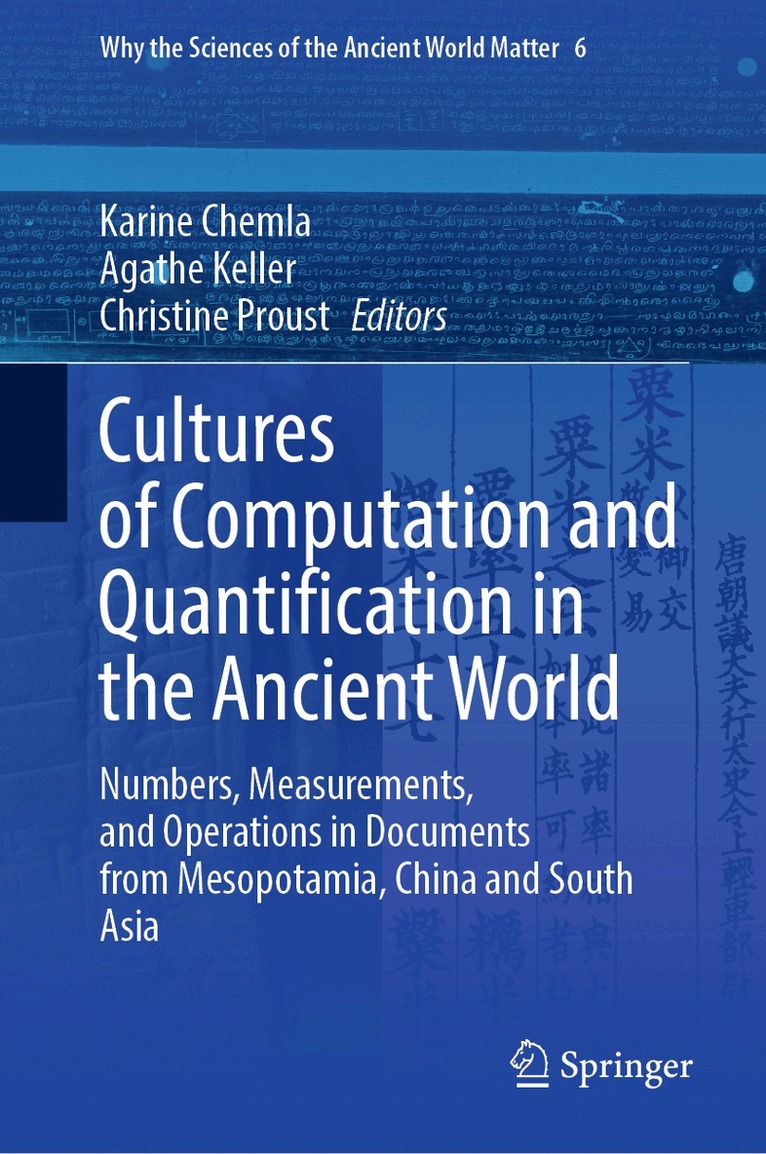
    Cultures of Computation and Quantification in the Ancient World

    Numbers, Measurements, and Operations in Documents from Mesopotamia, China and South Asia

    AvKarine Chemla,Agathe Keller

    Inbunden, Engelska, 2023

    Del i serien Why the Sciences of the Ancient World Matter

    1 842 kr

    Beställningsvara. Skickas inom 10-15 vardagar. Fri frakt över 249 kr.

    Beskrivning

    This book sheds light on the variety of mathematical cultures in general. To do so, it concentrates on cultures of computation and quantification in the ancient world, mainly in ancient China, South Asia, and the Ancient Near East and offers case studies focused on numbers, quantities, and operations, in particular in relation to mathematics as well as administrative and economic activities. The various chapters focus on the different ways and contexts of shaping numbers and quantities, and on the procedures applied to them. The book places special emphasis on the processes of emergence of place-value number systems, evidenced in the three geographical areas under study All these features yield essential elements that will enable historians of mathematics to further capture the diversity of computation practices in their contexts, whereas previous historical approaches have tended to emphasize elements that displayed uniformity within “civilizational” blocks. The book includes editions and translations of texts, some of them published here for the first time, maps, and conventions for editions of ancient texts. It thereby offers primary sources and methodological tools for teaching and learning. The volume is aimed at historians and philosophers of science and mathematics, historians of the ancient worlds, historians of economics, sinologists, indologists, assyriologists, as well as undergraduate, graduate students and teachers in mathematics, the history and philosophy of science and mathematics, and in the history of ancient worlds.

    Produktinformation

    • Utgivningsdatum:2023-01-02
    • Mått:155 x 235 x 47 mm
    • Vikt:1 314 g
    • Format:Inbunden
    • Språk:Engelska
    • Serie:Why the Sciences of the Ancient World Matter
    • Antal sidor:765
    • Förlag:Springer Nature Switzerland AG
    • ISBN:9783030983604

    Utforska kategorier

    • Asiens historia inom Historia och arkeologi
    • Filosofiska discipliner inom Filosofi och religion
    • Matematikens historia inom Naturvetenskap och teknik

    Mer om författaren

    Karine Chemla studied mathematics at the Ecole Normale Supérieure de Jeunes Filles (1976-1982) and the history of mathematics at the Institute for the History of Natural Sciences (Beijing, China, 1981). She is a Senior Researcher at the French National Center for Scientific Research (CNRS), in the laboratory SPHERE (CNRS & Université de Paris), and from 2011 to 2016, Chemla was Principal Investigator of the ERC Advanced Research Grant “Mathematical Sciences in the Ancient Worlds,” with co-directors A. Keller and C. Proust (SAW).Agathe Keller is Senior Researcher with the CNRS and Member of the SPHERE lab in Paris. She works on medieval Sanskrit mathematical commentaries (5th-12th centuries) and on the historiography of mathematics in and on India from the 19th century until today. She has published Expounding the mathematical Seed, Bhāskara’s commentary on the mathematical chapter of the Āryabhaṭīya(Birkhaüser, 2006). Christine Proust is Senior Researcher Emerita at the French Centre National de la Recherche Scientifique (Paris). She works on the history of mathematics in the Ancient Near East, more specifically on mathematical cuneiform texts from different periods, including the end of the third millennium BCE, the Old Babylonian period (early second millennium), and Late Babylonian periods (last centuries of the first millennium BCE).

    Innehållsförteckning

    • Chapter 1. Cultures of computation and quantification in the ancient world: An introduction (Karine Chemla, in dialogue with Agathe Keller and Christine Proust).- Part 1: Shaping quantities and relating them to numbers.- Chapter 2. Carrying bricks and bundling reed in theory and practice (Wolfgang Heimpel).- Chapter 3. Measuring grain in early Bronze Age Mesopotamia: Form, use, and control of the bariga container in the Twenty-First Century BCE (Walther Sallaberger).- Chapter 4. Volume, brickage and capacity in old Babylonian mathematical texts from Southern Mesopotamia (Christine Proust).- Part 2: Interpreting numbers and quantities in texts.- Place value notations in the Ur III period: Marginal numbers in administrative texts (Ouyang Xiaoli and Christine Proust).- Chapter 6. The Nazbalum in old Babylonian Mesopotamia (Robert Middeke-Conlin).- Part 3. Working with operations and algorithms.- Chapter 7. Computing tools and representations of arithmetic (Baptiste Mélès).- Chapter 8. Working on and with division in early China, Third Century BCE—Seventh Century CE (Karine Chemla).- Chapter 9. Multiplying integers: On the diverse practices of medieval Sanskrit authors (Agathe Keller and Catherine Morice-Singh).- Part 4. Different cultures of computation and quantification.- Chapter 10. Another culture of computation from 7th century China (Zhu Yiwen).- Chapter 11. The characteristics of mathematical methods in the Wu Cao Suanjing and its social background (Zou Dahai and Chen Wei).- Chapter 12. Weighing units and weights in the context of trade between upper Mesopotamia and Anatolia (Nineteenth and Eighteenth Centuries BCE) (Cécile Michel).- Chapter 13. Quantification and computation in the mathematical texts of old Babylonian Diyala (Carlos Gonçalves).- Index.