• Fri frakt över 249 kr
  • •
  • Snabba leveranser
  • •
  • Billiga böcker
Kundservice

Du är på sajten för privatpersoner.

Företag, bibliotek eller offentlig verksamhet?

Du handlar på classic.bokus.com, där alla dina funktioner finns intakta.
Till classic.bokus.com
Bokus logotyp. Gå till startsidan.
  • Erbjudanden
  • Nyheter
  • Student
  • Topplistor
  • Barn & ungdom
  • Bokus Play
  • E-böcker
  • Pocketböcker
  • Spel & pussel

10% rabatt på allt med kod NYSTART10 →

Sidfot

Mina sidor

    Hjälp

    • Kundservice
    • Vanliga frågor och svar
    • Frakt och leverans
    • Retur vid ångerrätt
    • Reklamera vara
    • Betalning
    • Köpvillkor
    • Allmänna villkor
    • Information om webbplatsens tillgänglighet

    Om Bokus

    • Om oss
    • Pressrum
    • För studenter
    • För företag
    • För bibliotek och offentlig verksamhet
    • För leverantörer
    • Hållbarhet

    Populärt

    • Aktuella erbjudanden
    • Presentkort
    • Studentlitteratur
    • Nya böcker
    • Topplistor
    • Signerade böcker
    • Engelska böcker

    Inspiration

    • Boktips
    • BookTok
    • Populära bokserier
    • Barnbokskaraktärer
    • Populära författare
    Logotyp för Bokus
    Följ oss på Facebook (extern länk)Följ oss på Instagram (extern länk)Följ oss på YouTube (extern länk)Följ oss på TikTok (extern länk)
    bokus @ CookiesAnpassa cookiesIntegritetspolicyKöpvillkor
    Till Citymail hemsida (extern länk)Till Budbee hemsida (extern länk)Till Postnord hemsida (extern länk)Till Schenker hemsida (extern länk)Till Early Bird hemsida (extern länk)Till Walleys hemsida (extern länk)
    1. Samhälle och politik
    2. Samhälle och kultur
    3. Kultur och medier
    4. Referensverk och tvärvetenskap

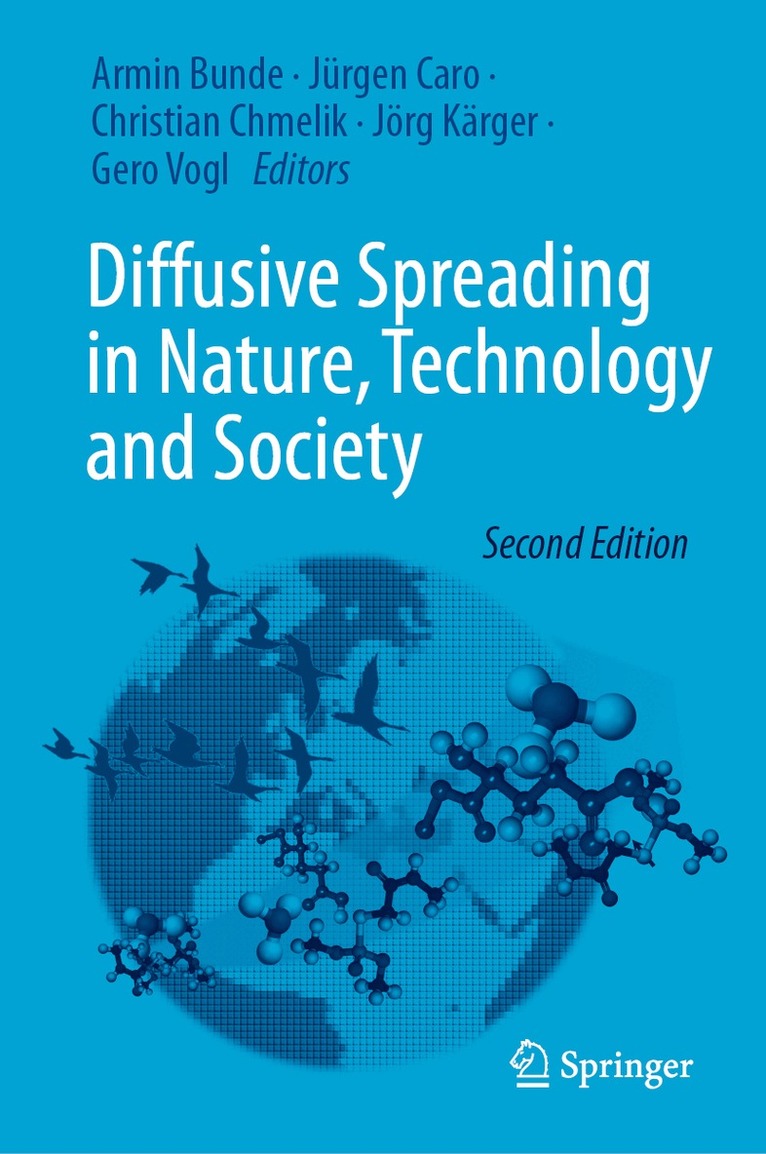
    Diffusive Spreading in Nature, Technology and Society

    AvArmin Bunde,Jürgen Caro

    Inbunden, Engelska, 2023

    2 007 kr

    Beställningsvara. Skickas inom 10-15 vardagar. Fri frakt över 249 kr.

    Beskrivning

    What do the movements of molecules and the migration of humans have in common? How does the functionality of our brain tissue resemble the flow of traffic in New York City? How can understanding the spread of ideas, rumors, and languages help us tackle the spread a pandemic? This book provides an illuminating look into these seemingly disparate topics by exploring and expertly communicating the fundamental laws that govern the spreading and diffusion of objects. A collection of leading scientists in disciplines as diverse as epidemiology, linguistics, mathematics, and physics discuss various spreading phenomena relevant to their own fields, revealing astonishing similarities and correlations between the objects of study—be they people, particles, or pandemics.This updated and expanded second edition of an award-winning book introduces timely coverage of a subject with the greatest societal impact in recent memory—the global fight against COVID-19. Winner of the 2019Literature Prize of the German Chemical Industry Fund and brainchild of the international and long-running Diffusion Fundamentals conference series, this book targets an interdisciplinary readership, featuring an introductory chapter that sets the stage for the topics discussed throughout. Each chapter provides ample opportunity to whet the appetite of those readers seeking a more in-depth treatment, making the book also useful as supplementary reading in appropriate courses dealing with complex systems, mass transfer, and network theory.Chapter “Neolithic Transitions: Diffusion of People or Diffusion of Culture?” is available open access under a Creative Commons Attribution 4.0 International License via link.springer.com.

    Produktinformation

    • Utgivningsdatum:2023-05-09
    • Mått:155 x 235 x 33 mm
    • Vikt:1 073 g
    • Format:Inbunden
    • Språk:Engelska
    • Antal sidor:517
    • Upplaga:2
    • Förlag:Springer International Publishing AG
    • ISBN:9783031059452

    Utforska kategorier

    • Referensverk och tvärvetenskap inom Samhälle och politik
    • Biovetenskap inom Naturvetenskap och teknik
    • Epidemiologi och medicinsk statistik inom Medicin

    Mer om författaren

    Armin Bunde studied Physics at the universities in Giessen and Stuttgart (PhD 1974). After postdoc periods in Saarbrücken, Antwerp, and Konstanz he was awarded a Heisenberg fellowship in 1983. In 1984 he received the Carl-Wagner prize.  After extended research stays in Boston, Paris, and Ramat-Gan he became professor for Theoretical Physics at Hamburg University in 1987 and full chair of Theoretical  Physics  at Giessen University in 1993. His research activities have been dedicated to many facets of  interdisciplinary research, including diffusion in disordered materials, long-range correlations in nature, extremes in financial markets, and climate variability, and he co-authored several books on these topics.Jürgen Caro graduated in Chemistry at Leipzig University (PhD 1977, supervised by Jörg Kärger, Habilitation 1992). After PhD he joined the Academy of Sciences of GDR in Berlin-Adlershof. In 2001 he became professor of PhysicalChemistry at Leibniz University Hannover working in porous materials as membrane, catalyst and adsorbent. He is author of about 400 publications and 43 patents. In 2013 he got together with M. Tsapatsis the Donald W. Breck Award, in the same year the Ostwald Medal of the Saxon Academy of Sciences and in 2020 the Eni Award for “Advanced Environmental Solutions” together with J. Kärger. In 2016 Caro became Corresponding Member of the Saxon Academy of Sciences.Christian Chmelik graduated in Physics at Leipzig University (PhD 2008, supervised by Jörg Kärger). As part of his dissertation, he established IR micro-imaging as a new method for diffusion measurement in nanoporous materials. As postdoc he continued to chair the development of microimaging methods for diffusion measurements. He is an editor of the online journal ‘‘Diffusion Fundamentals’’ and chaired the eponymous conference in 2009 (Athens) and in 2015 (Dresden). Since 2014 he is member of the structure-related commission “Spreading in Nature, Technology and Society” of the Saxonian Academy of Sciences. He is author of more than 80 publications, two edited books and several book chapters.Jörg Kärger is emeritus professor of physics at Leipzig University. His research focuses on the development of new experimental techniques for studying diffusion in nanoporous materials. He has (co)-authored several books on the topics of diffusion and nanoporous materials and, together with Paul Heitjans, established the online journal and conference series Diffusion Fundamentals. His work has been widely recognized via e.g. the Donald W. Breck Award for zeolite research, the Max Planck Research Prize, and election to the Saxon Academy of Sciences. He holds an entry in the Guinness book of records for the largest orchestra of bicycle bells, awarded during the Physics Sunday Lectures at Leipzig University.Gero Vogl received his habilitation from the Physik-Department of Technische Universität München, then moved to Freie Universität Berlin as professor of experimental physics. From 1985 till 2009 he was full professor of physics at Universität Wien and from 1999 till 2001 acted as chairman of the Department of Structural Research at the Hahn-Meitner-Institut Berlin. His scientific interests were centered on the dynamics of solid matter. He introduced several new methods based on the application of nuclear physics to materials science. After 2005 Vogl devoted much of his capacity to interdisciplinary research in the field of spread and diffusion publishing some booklets on that subject.

    Innehållsförteckning

    • What the Book Is Dealing With.- Spreading Fundamentals.- Dispersal in Plants and Animals.- Search for Food of Birds, Fish and Insects.- Epicuticular Wax Formation and Regeneration—A Remarkable Diffusion Phenomenon for Maintaining Surface Integrity and Functionality in Plant Surfaces.- Brain Interstitial Structure Revealed Through Diffusive Spread of Molecules.- Turbulent Diffusion in the Atmosphere.- Hot Brownian Motion.- On Phase Transitions in Biased Diffusion of Interacting Particles.