• Fri frakt över 249 kr
  • •
  • Snabba leveranser
  • •
  • Billiga böcker
Kundservice

Du är på sajten för privatpersoner.

Företag, bibliotek eller offentlig verksamhet?

Du handlar på classic.bokus.com, där alla dina funktioner finns intakta.
Till classic.bokus.com
Bokus logotyp. Gå till startsidan.
  • Erbjudanden
  • Nyheter
  • Student
  • Topplistor
  • Barn & ungdom
  • Bokus Play
  • E-böcker
  • Pocketböcker
  • Spel & pussel

10% rabatt på allt med kod: NYSTART10 →

Sidfot

Mina sidor

    Hjälp

    • Kundservice
    • Vanliga frågor och svar
    • Frakt och leverans
    • Retur vid ångerrätt
    • Reklamera vara
    • Betalning
    • Köpvillkor
    • Allmänna villkor
    • Information om webbplatsens tillgänglighet

    Om Bokus

    • Om oss
    • Pressrum
    • För studenter
    • För företag
    • För bibliotek och offentlig verksamhet
    • För leverantörer
    • Hållbarhet

    Populärt

    • Aktuella erbjudanden
    • Presentkort
    • Studentlitteratur
    • Nya böcker
    • Topplistor
    • Signerade böcker
    • Engelska böcker

    Inspiration

    • Boktips
    • BookTok
    • Populära bokserier
    • Barnbokskaraktärer
    • Populära författare
    Logotyp för Bokus
    Följ oss på Facebook (extern länk)Följ oss på Instagram (extern länk)Följ oss på YouTube (extern länk)Följ oss på TikTok (extern länk)
    bokus @ CookiesAnpassa cookiesIntegritetspolicyKöpvillkor
    Till Citymail hemsida (extern länk)Till Budbee hemsida (extern länk)Till Postnord hemsida (extern länk)Till Schenker hemsida (extern länk)Till Early Bird hemsida (extern länk)Till Walleys hemsida (extern länk)
    1. Naturvetenskap och teknik
    2. Teknik och industri
    3. Elektronik och kommunikationer

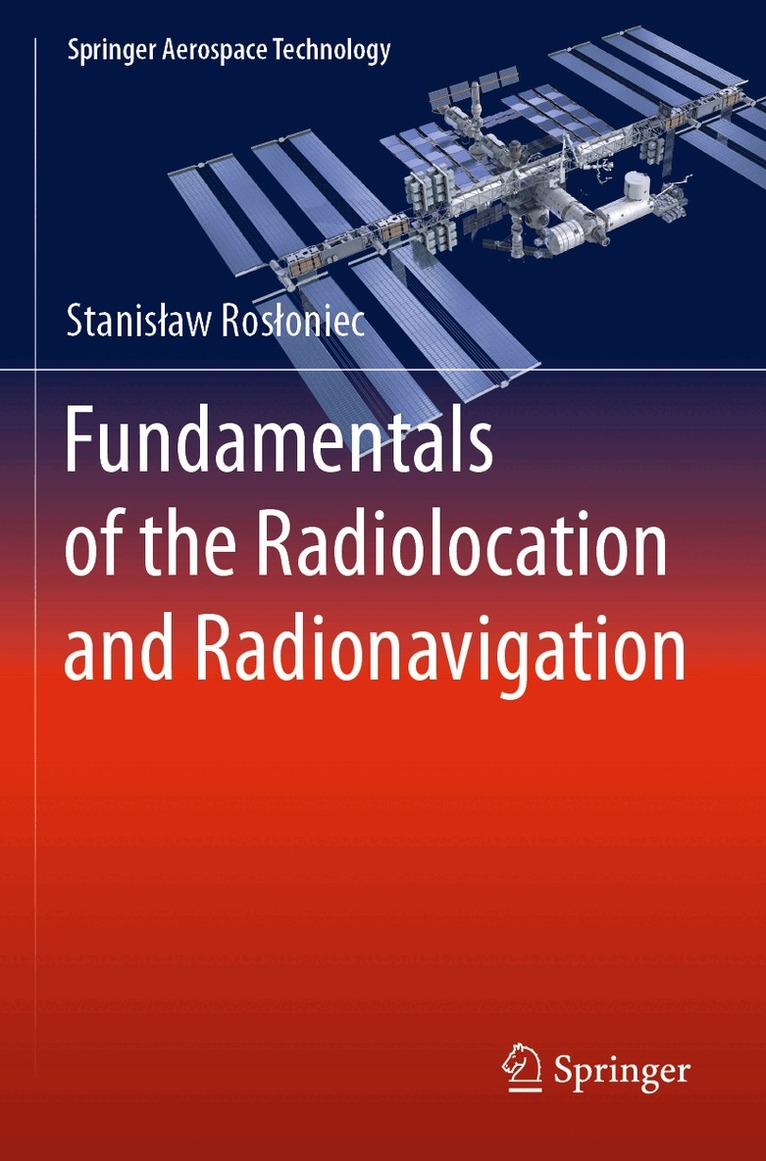
    Fundamentals of the Radiolocation and Radionavigation

    AvStanisław Rosłoniec

    Häftad, Engelska, 2024

    Del i serien Springer Aerospace Technology

    978 kr

    Beställningsvara. Skickas inom 10-15 vardagar. Fri frakt över 249 kr.

    Fler format och utgåvor

    Inbunden

    1 410 kr

    E-bok

    1 255 kr

    Övrigt

    648 kr

    Beskrivning

    The book presents principles of operation of radar and radionavigation systems. The group of radar systems includes: primary and secondary radiolocations, bistatic and multistatic systems. They are illustrated with relevant examples of calculation and applications. The issues of increasing the range of the radar systems are presented together with the matched filtering of the used signals. Other discussed issues are methods for eliminating interfering signals and researching methods of 3D space. Various methods of the monopulse radiolocation are presented in Chapter 12. In Chapters 13–18 terrestrial and satellite radionavigation systems are under discussion. The terrestrial systems are: Loran C, Decca Navigator and Omega. The TRANSIT is an example of a hyperbolic satellite system. The stadiometric systems GPS, GLONASS, GALILEO, BeiDou, IRNSS and QZSS are discussed together with differential systems augmentating of them. The ILS, MLS and TLS supporting the landing of aircrafts are discussed in Chapter 17. The prospects for replacing of them with satellite systems augmentated by appropriate reference ground-based stations (GBAS) are also analyzed. Various beacons and ranging devices used in aviation are described in the Chapter 18. This book is intended primarily for students and engineers interested in radar, radionavigation and aerospace engineering.

    Produktinformation

    • Utgivningsdatum:2024-01-06
    • Mått:155 x 235 x 25 mm
    • Vikt:835 g
    • Format:Häftad
    • Språk:Engelska
    • Serie:Springer Aerospace Technology
    • Antal sidor:453
    • Förlag:Springer International Publishing AG
    • ISBN:9783031106330

    Utforska kategorier

    • Elektronik och kommunikationer inom Naturvetenskap och teknik
    • Flyg- och rymdteknik inom Naturvetenskap och teknik
    • Rymdforskning inom Naturvetenskap och teknik

    Mer om författaren

    Stanisław Rosłoniec was born on June 25, 1948, in Ostaszewo, Poland. He received his M.Sc. degree (in electronic engineering) from Warsaw University of Technology in 1972. After graduation, he joined the Department of Electronics (Institute of Radioelectronics) of Warsaw University of Technology where in 1976, he was granted with distinction his doctor’s degree (Ph.D). He received the higher doctor’s degree (Dr Sc.) in 1991 also from Warsaw University of Technology. Finally, he obtained the degree of professor of technical sciences  from the President of the Republic of Poland in 2001.   Since 1992, he is closely cooperating with the Telecommunications Research Institute (PIT), Poland. Therefore, his didactic and research interests are mainly focused on relevant for practice problems of microwave and antenna techniques, especially on the design methods of various passive microwave devices and high-directivity radar antennas. Several array antennas designed by him operate in long-range surveillance radars of type TRD-12, RST-12M, CAR-1100 and TRS-15 fabricated by PIT for the Polish Army and foreign contractors. Stanisław Rosłoniec is the author over 80 reviewed scientific papers, 25 technical reports,  3 patents, and 10 books. A list of mentioned books includes 4 academic handbooks and 6 monographs. Two of them, viz. “Algorithms for computer-aided design of linear microwave circuits” (1990) and “Fundamental numerical methods for electrical engineering” (2008) have been published by top internationally recognized publishers, respectively, by Artech House Inc., USA, and Springer Verlag, Germany. The latest of his book entitled “Some  design problems of contemporary antenna technique” (in Polish) has been  published in 2022 by Publishing House of the Military University of Technology, Warsaw.He is a senior member of the Microwave Theory and Techniques Society (IEEE/MTT-S).

    Innehållsförteckning

    • Radiolocation and its basic principles.- Determining the objects position by radiolocation methods.- Reflective surface of the detected objects with monostatic and bistatic radar systems.- Range equations of  primary and secondary radar systems.- Bistatic radar systems.- Multistatic radar systems.- Standard methods for extending the range of radar station.- Theoretical basis of  matched signal filtration.- Filters matched to the typical radar signals.- Basic methods for eliminating  spurious signals.