• Fri frakt över 249 kr
  • •
  • Snabba leveranser
  • •
  • Billiga böcker
Kundservice

Du är på sajten för privatpersoner.

Företag, bibliotek eller offentlig verksamhet?

Du handlar på classic.bokus.com, där alla dina funktioner finns intakta.
Till classic.bokus.com
Bokus logotyp. Gå till startsidan.
  • Erbjudanden
  • Nyheter
  • Student
  • Topplistor
  • Barn & ungdom
  • Bokus Play
  • E-böcker
  • Pocketböcker
  • Spel & pussel

10% rabatt på allt med kod: NYSTART10 →

Sidfot

Mina sidor

    Hjälp

    • Kundservice
    • Vanliga frågor och svar
    • Frakt och leverans
    • Retur vid ångerrätt
    • Reklamera vara
    • Betalning
    • Köpvillkor
    • Allmänna villkor
    • Information om webbplatsens tillgänglighet

    Om Bokus

    • Om oss
    • Pressrum
    • För studenter
    • För företag
    • För bibliotek och offentlig verksamhet
    • För leverantörer
    • Hållbarhet

    Populärt

    • Aktuella erbjudanden
    • Presentkort
    • Studentlitteratur
    • Nya böcker
    • Topplistor
    • Signerade böcker
    • Engelska böcker

    Inspiration

    • Boktips
    • BookTok
    • Populära bokserier
    • Barnbokskaraktärer
    • Populära författare
    Logotyp för Bokus
    Följ oss på Facebook (extern länk)Följ oss på Instagram (extern länk)Följ oss på YouTube (extern länk)Följ oss på TikTok (extern länk)
    bokus @ CookiesAnpassa cookiesIntegritetspolicyKöpvillkor
    Till Citymail hemsida (extern länk)Till Budbee hemsida (extern länk)Till Postnord hemsida (extern länk)Till Schenker hemsida (extern länk)Till Early Bird hemsida (extern länk)Till Walleys hemsida (extern länk)
    1. Naturvetenskap och teknik
    2. Matematik och naturvetenskap
    3. Matematik

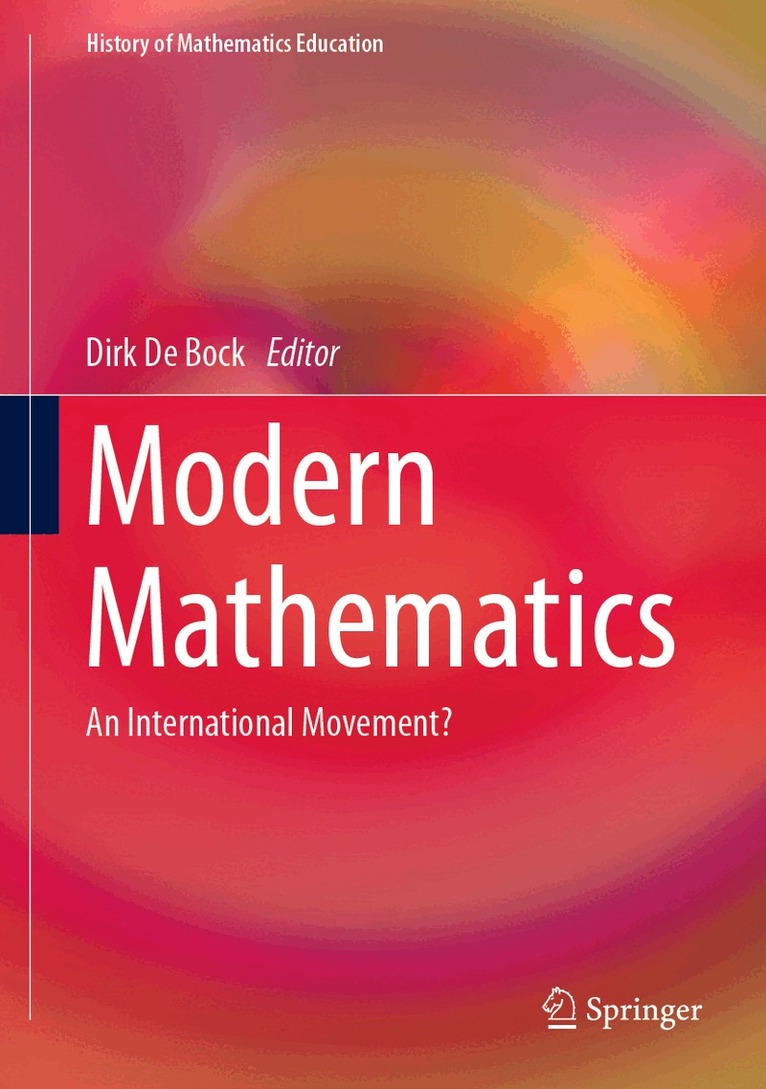
    Modern Mathematics

    An International Movement?

    AvDirk De Bock

    Inbunden, Engelska, 2023

    Del i serien History of Mathematics Education

    1 734 kr

    Beställningsvara. Skickas inom 10-15 vardagar. Fri frakt över 249 kr.

    Beskrivning

    The international New Math developments between about 1950 through 1980, are regarded by many mathematics educators and education historians as the most historically important development in curricula of the twentieth century. It attracted the attention of local and international politicians, of teachers, and of parents, and influenced the teaching and learning of mathematics at all levels—kindergarten to college graduate—in many nations. After garnering much initial support it began to attract criticism. But, as Bill Jacob and the late Jerry Becker show in Chapter 17, some of the effects became entrenched.This volume, edited by Professor Dirk De Bock, of Belgium, provides an outstanding overview of the New Math/modern mathematics movement. Chapter authors provide exceptionally high-quality analyses of the rise of the movement, and of subsequent developments, within a range of nations.The first few chapters show how the initial leadership came from mathematicians in European nations and in the United States of America. The background leaders in Europe were Caleb Gattegno and members of a mysterious group of mainly French pure mathematicians, who since the 1930s had published under the name of (a fictitious) “Nicolas Bourbaki.” In the United States, there emerged, during the 1950s various attempts to improve U.S. mathematics curricula and teaching, especially in secondary schools and colleges. This side of the story climaxed in 1957 when the Soviet Union succeeded in launching “Sputnik,” the first satellite. Undoubtedly, this is a landmark publication in education. The foreword was written by Professor Bob Moon, one of a few other scholars to have written on the New Math from an international perspective. The final “epilogue” chapter, by Professor Geert Vanpaemel, a historian, draws together the overall thrust of the volume, and makes links with the general history of curriculum development, especially in science education, including recent globalization trends.

    Produktinformation

    • Utgivningsdatum:2023-03-09
    • Mått:178 x 254 x 45 mm
    • Vikt:1 378 g
    • Format:Inbunden
    • Språk:Engelska
    • Serie:History of Mathematics Education
    • Antal sidor:596
    • Förlag:Springer International Publishing AG
    • ISBN:9783031111655

    Utforska kategorier

    • Matematik inom Naturvetenskap och teknik
    • Läroplaner och kursplaner inom Psykologi och pedagogik
    • Undervisning i specifika ämnen inom Psykologi och pedagogik

    Mer om författaren

    Dirk De Bock is a Professor of Mathematics in the Faculty of Economics and Business at the University of Leuven (Belgium). His research concerns the history of mathematics education, psychological aspects of the teaching and learning of mathematics, and the role of mathematics in economics and finance.

    Recensioner i media

    “I highly recommend De Bock’s work for anyone interested in reform and in that particular movement which gave rise, one way or another, to so much of the mathematics education we still think about today.” (Michael N. Fried, Mathematical Thinking and Learning, Vol. 27 (1), 2025)  “The book is adaptable to personal preference, one can read it front to back, or stroll in it.” (Wendy Goemans, BMS-NCM Newsletter, November 15, 2024)  “The book will be of interest to researchers and all those interested in the history of mathematics education as an academic field, mathematics teachers interested in how the curriculum changed in the post-Second World War era and curriculum developers interested in the factors affecting large-scale curriculum reform in an international context.” (Bert Zwaneveld, History of Education, Vol. 53 (4), 2024)  “Professor Dirk De Bock, the editor of this volume, Modern Mathematics. An International Movement? … has been one of the most active players contributing to this ‘golden age’ of research about the Modern Mathematics movement. … The book has a clear and simple structure. … the set of countries included in the book is geographically diverse. We find examples from the five continents and from both hemispheres.” (Antonio M. Oller‑Marcén, Educational Studies in Mathematics, Vol. 115 (2), 2024)

    Innehållsförteckning

    • Preface.- Part I: The Rise of Modern Mathematics on Both Sides of the Atlantic.- 1. The Early Roots of the European Modern Mathematics Movement.- 2. The Rise of the American New Math Movement.-3. The Constituent Meetings of the Modern Mathematics Movement.-Part II: Various Faces of Modern Mathematics Around the World.- 4. Belgium.- 5. France.- 6. United Kingdom.- 7. The Netherlands.- 8. Nordic Countries.- 9. Portugal.- 10. Italy.- 11. Former Yugoslavia.- 12. Hungary.- 13. Poland.- 14. The United States.- 15. Canada.- 16. Brazil.- 17. Australia and New Zealand.- 18. Southeast Asia.- 19. Africa.- Epilogue. Chapter 1. Modern Mathematics: An International Movement Diversely Shaped in National Contexts.- Part I. Preparing the Reform on Both Sides of the Atlantic.- Chapter 2. The Rise of the American New Math Movement: How National Security Anxiety and Mathematical Modernism Disrupted the School Curriculum.- Chapter 3. The Early Roots of the European Modern Mathematics Movement: How a Modelfor the Science of Mathematics Became a Model for Mathematics Education.- Chapter 4. The Royaumont Seminar as a Booster of Communication and Internationalization in the World of Mathematics Education.- Part II. Implementation of the Reform Around the World.- Chapter 5. The Modern Mathematics Movement in France: Reforming to What Ends? The Contribution of a Cross-over Approach to Modernity.- Chapter 6. West German Neue Mathematik and Some of Its Protagonists.- Chapter 7. New Mathematics in the United Kingdom: Projects and Textbooks as Driving Forces of Curriculum Reform.- Chapter 8. Modern Mathematics in Italy: A Difficult Challenge Between Rooted Tradition and Need for Innovation.- Chapter 9. The Distinct Facets of Modern Mathematics in Portugal.- Chapter 10. Papy’s Reform of Mathematics Education in Belgium: Development, Implementation, and Controversy.-  Chapter 11. A Tale of Two Systems: A History of New Math in The Netherlands, 1945–1980.- Chapter 12. Nordic Cooperation on Modernizing Mathematics Teaching, 1960–1967.- Chapter 13. Reforms Inspired by Mathématique Moderne in Poland, 1967–1980.- Chapter 14. The New Math in Hungary: Tamás Varga’s Complex Mathematics Education Reform.- Chapter 15. New Math and the South Slavs.- Chapter 16. The Kolmogorov Reform of Mathematics Education in the USSR.- Chapter 17. The Influence of Royaumont on Mathematics Education in the USA.- Chapter 18. Aspects of Canadian Versions of So-Called “Modern” Mathematics and Its Teaching: Another Visit to the Old “New” Math(s) .- Chapter 19. New Math in Latin America (and a Glimpse at Costa Rica).- Chapter 20. Modernizing Mathematics Teaching: International Dialogues from Brazil.- Chapter 21. Australian School Mathematics and “Colonial Echo” Influences, 1901–1975. Chapter 22. What Did the “New Math Movement” Bring to Hong Kong in the 1960s and the 1970s (and Beyond)? .- Chapter 23. An International Movement, the Experience of Morocco.- Chapter 24. Modern Mathematics Curriculum Reformsin Ghana: UK and USA Influences.