• Fri frakt över 249 kr
  • •
  • Snabba leveranser
  • •
  • Billiga böcker
Kundservice

Du är på sajten för privatpersoner.

Företag, bibliotek eller offentlig verksamhet?

Du handlar på classic.bokus.com, där alla dina funktioner finns intakta.
Till classic.bokus.com
Bokus logotyp. Gå till startsidan.
  • Erbjudanden
  • Nyheter
  • Student
  • Topplistor
  • Barn & ungdom
  • Bokus Play
  • E-böcker
  • Pocketböcker
  • Spel & pussel

10% rabatt på allt med kod: NYSTART10 →

Sidfot

Mina sidor

    Hjälp

    • Kundservice
    • Vanliga frågor och svar
    • Frakt och leverans
    • Retur vid ångerrätt
    • Reklamera vara
    • Betalning
    • Köpvillkor
    • Allmänna villkor
    • Information om webbplatsens tillgänglighet

    Om Bokus

    • Om oss
    • Pressrum
    • För studenter
    • För företag
    • För bibliotek och offentlig verksamhet
    • För leverantörer
    • Hållbarhet

    Populärt

    • Aktuella erbjudanden
    • Presentkort
    • Studentlitteratur
    • Nya böcker
    • Topplistor
    • Signerade böcker
    • Engelska böcker

    Inspiration

    • Boktips
    • BookTok
    • Populära bokserier
    • Barnbokskaraktärer
    • Populära författare
    Logotyp för Bokus
    Följ oss på Facebook (extern länk)Följ oss på Instagram (extern länk)Följ oss på YouTube (extern länk)Följ oss på TikTok (extern länk)
    bokus @ CookiesAnpassa cookiesIntegritetspolicyKöpvillkor
    Till Citymail hemsida (extern länk)Till Budbee hemsida (extern länk)Till Postnord hemsida (extern länk)Till Schenker hemsida (extern länk)Till Early Bird hemsida (extern länk)Till Walleys hemsida (extern länk)
    1. Naturvetenskap och teknik
    2. Matematik och naturvetenskap
    3. Naturvetenskap:allmänt
    4. Naturvetenskapens historia

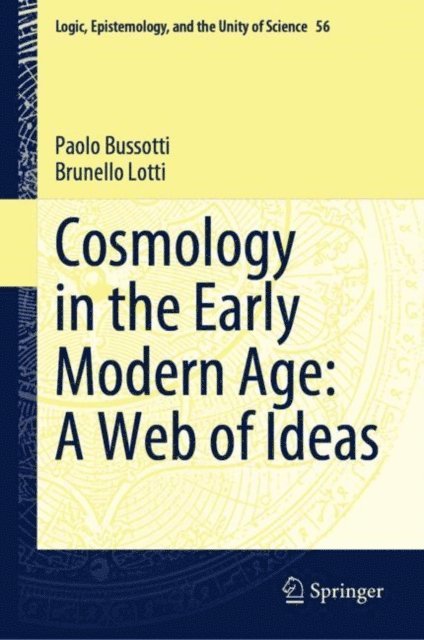
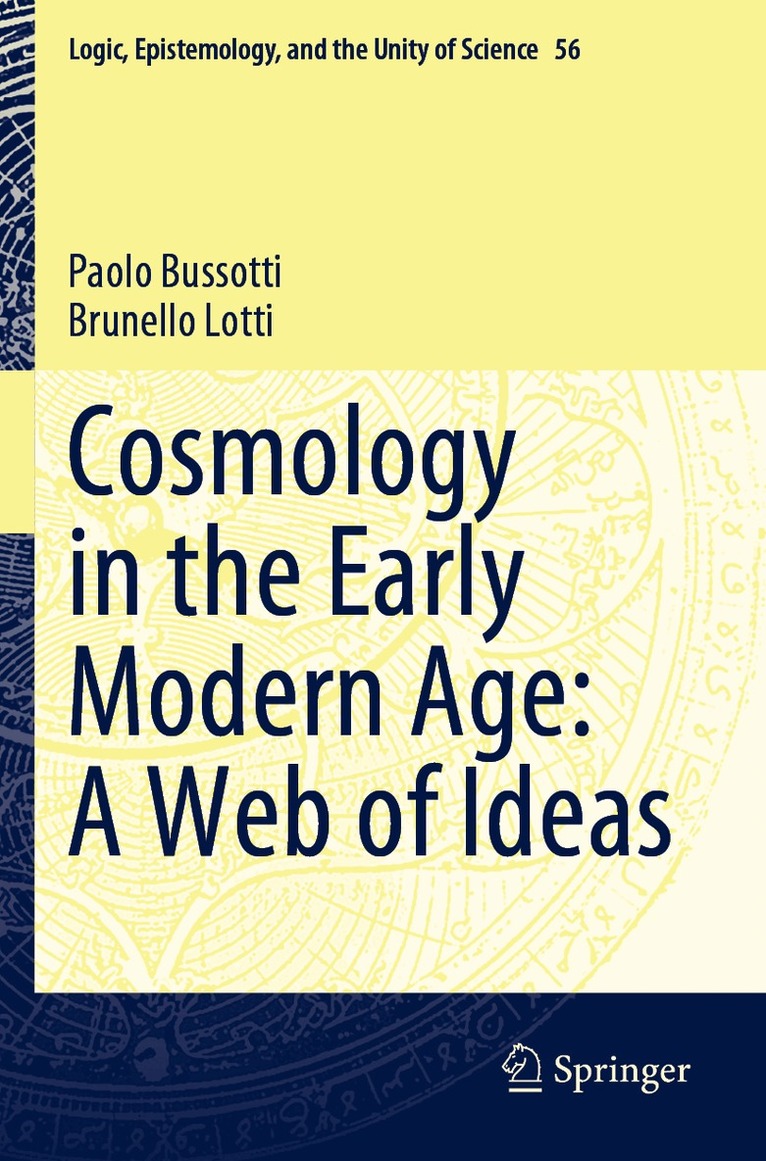
    Cosmology in the Early Modern Age: A Web of Ideas

    AvPaolo Bussotti,Brunello Lotti

    Inbunden, Engelska, 2023

    Del 56 i serien Logic, Epistemology, and the Unity of Science

    1 302 kr

    Beställningsvara. Skickas inom 10-15 vardagar. Fri frakt över 249 kr.

    Fler format och utgåvor

    Övrigt

    646 kr

    Häftad

    1 302 kr

    Beskrivning

    This volume addresses the history and epistemology of early modern cosmology. The authors reconstruct the development of cosmological ideas in the age of ‘scientific revolution’ from Copernicus to Leibniz, taking into account the growth of a unified celestial-and-terrestrial mechanics. The volume investigates how, in the rise of the new science, cosmology displayed deep and multifaceted interrelations between scientific notions (stemming from mechanics, mathematics, geometry, astronomy) and philosophical concepts. These were employed to frame a general picture of the universe, as well as to criticize and interpret scientific notions and observational data.This interdisciplinary work reconstructs a conceptual web pervaded by various intellectual attitudes and drives. It presents an historical–epistemological unified itinerary which includes Copernicus, Kepler, Galileo, Descartes, Huygens, Newton and Leibniz. For each of the scientists and philosophers, a presentation and commentary is made of their cosmological views, and where relevant, outlines of their most relevant physical concepts are given. Furthermore, the authors highlight the philosophical and epistemological implications of their scientific works. This work is helpful both as a synthetic overview of early modern cosmology, and an analytical exposition of the elements that were intertwined in early-modern cosmology. This book addresses historians, philosophers, and scientists and can also be used as a research source book by post-graduate students in epistemology, history of science and history of philosophy.

    Produktinformation

    • Utgivningsdatum:2023-01-06
    • Mått:155 x 235 x 25 mm
    • Vikt:694 g
    • Format:Inbunden
    • Språk:Engelska
    • Serie:Logic, Epistemology, and the Unity of Science
    • Antal sidor:328
    • Förlag:Springer International Publishing AG
    • ISBN:9783031121944

    Utforska kategorier

    • Naturvetenskapens historia inom Naturvetenskap och teknik
    • Astronomi inom Naturvetenskap och teknik
    • Filosofiska discipliner inom Filosofi och religion

    Mer om författaren

    Paolo Bussotti is Associate Professor in History of Science and Techniques at the University of Udine (Italy). His research areas are history of science and mathematics, in particular history of geometry and number theory between the 17th and the 19th centuries, and history of physics and astronomy in the 17th century. He is the author of more than 100 scientific publications, among which a monograph on the history of the method of infinite descent (number theory), From Fermat to Gauss.  Indefinite descent and methods of reduction in Number Theory (2006) and one on Leibniz’s planetary theory, The complex itinerary of Leibniz’s planetary theory (2015). He is the co-author (jointly with prof. R. Pisano) of many papers on the Geneva Edition of Newton’s Principia published in important journals dedicated to the history of science.  He is reviewer for leading scientific journals as the Zentralblatt für Mathematik.Brunello Lotti is Associate Professor of History of Philosophy at the University of Udine (Italy). His research interests on early modern British philosophy focus on the relations between natural philosophy, metaphysics and theology, including the history of platonism, the reception of Cartesian scepticism and mechanicism, and the issue of the origin of motion. He is author of the monographs Ralph Cudworth e l’idea di natura plastica (2004), L’iperbole del dubbio. Lo scetticismo cartesiano nella filosofia inglese tra Sei e Settecento (2010), “Spiritus intus alit”. La ricezione di un luogo filosofico virgiliano nel pensiero moderno (2021). He coedited Scienza e teologia fra Seicento e Ottocento. Studi in memoria di Maurizio Mamiani (2006), and Eredità cartesiane nella cultura britannica (2011). His articles and essays cover several authors in early modern British philosophy, from the Cambridge Platonists to Locke and Berkeley.

    Innehållsförteckning

    • Foreword.- Preface.- Introduction.- Chapter 1. The elements of a cosmological model.- Chapter 2. Copernicus’ astronomical revolution.- Chapter 3. Kepler: the cosmographer par excellence.- Chapter 4.Galileo and the spread of the Copernican system.- Chapter 5. Descartes and the new mechanistic paradigm.- Chapter 6. Huygens: the greatest Cartesian scientist.- Chapter 7. Newton and his system of the world.- Chapter 8. Leibniz: the philosopher-scientist.- Conclusion.- Bibliography.- Glossary of the Technical Terms.- Index of Subjects.- Index of Figures.- Index of Names.​