• Fri frakt över 249 kr
  • •
  • Snabba leveranser
  • •
  • Billiga böcker
Kundservice

Du är på sajten för privatpersoner.

Företag, bibliotek eller offentlig verksamhet?

Du handlar på classic.bokus.com, där alla dina funktioner finns intakta.
Till classic.bokus.com
Bokus logotyp. Gå till startsidan.
  • Erbjudanden
  • Nyheter
  • Student
  • Topplistor
  • Barn & ungdom
  • Bokus Play
  • E-böcker
  • Pocketböcker
  • Spel & pussel

10% studentrabatt med kod TERM26

Sidfot

Mina sidor

    Hjälp

    • Kundservice
    • Vanliga frågor och svar
    • Frakt och leverans
    • Retur vid ångerrätt
    • Reklamera vara
    • Betalning
    • Köpvillkor
    • Allmänna villkor
    • Information om webbplatsens tillgänglighet

    Om Bokus

    • Om oss
    • Pressrum
    • För studenter
    • För företag
    • För bibliotek och offentlig verksamhet
    • För leverantörer
    • Hållbarhet

    Populärt

    • Aktuella erbjudanden
    • Presentkort
    • Studentlitteratur
    • Nya böcker
    • Topplistor
    • Signerade böcker
    • Engelska böcker

    Inspiration

    • Boktips
    • BookTok
    • Populära bokserier
    • Barnbokskaraktärer
    • Populära författare
    Logotyp för Bokus
    Följ oss på Facebook (extern länk)Följ oss på Instagram (extern länk)Följ oss på YouTube (extern länk)Följ oss på TikTok (extern länk)
    bokus @ CookiesAnpassa cookiesIntegritetspolicyKöpvillkor
    Till Citymail hemsida (extern länk)Till Budbee hemsida (extern länk)Till Postnord hemsida (extern länk)Till Schenker hemsida (extern länk)Till Early Bird hemsida (extern länk)Till Walleys hemsida (extern länk)
    1. Ekonomi och Ledarskap
    2. Nationalekonomi
    3. Ekonomisk politik

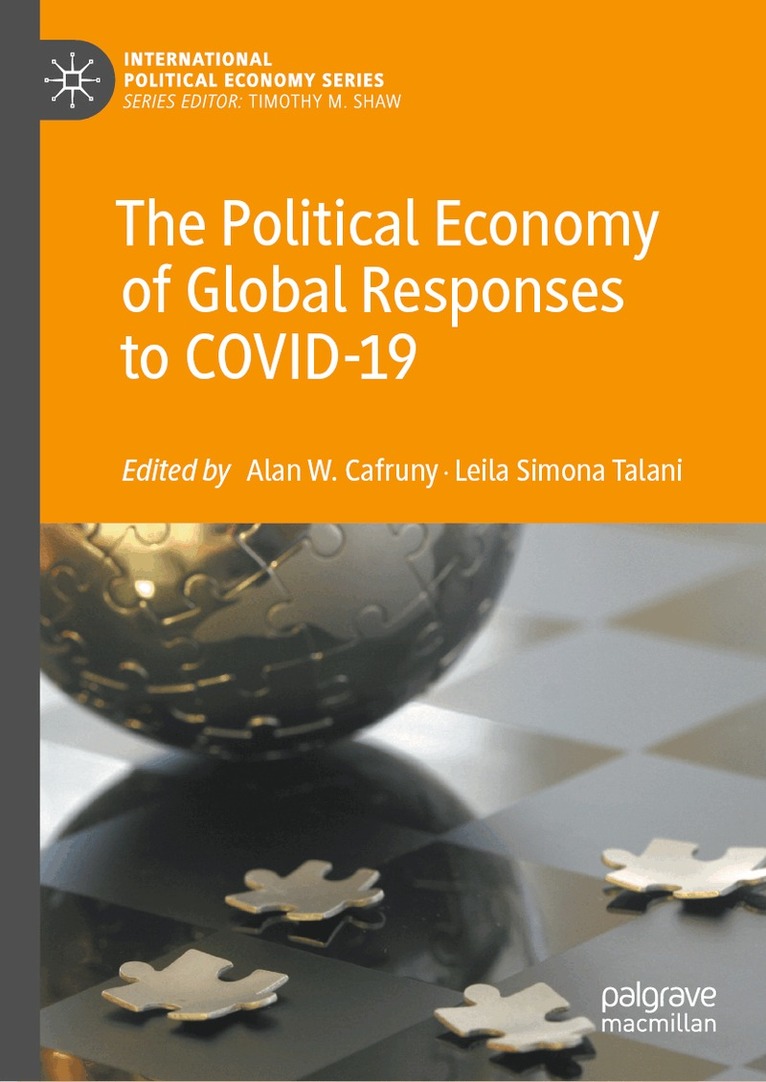
    Political Economy of Global Responses to COVID-19

    AvAlan W. Cafruny,Leila Simona Talani

    Inbunden, Engelska, 2023

    Del i serien International Political Economy Series

    1 571 kr

    Beställningsvara. Skickas inom 10-15 vardagar. Fri frakt över 249 kr.

    Beskrivning

    This book seeks to identify the reasons why some countries were more efficient and effective than others in responding to the COVID 19 pandemic, and why the global community failed to coalesce. What are the political determinants of the different state responses to the pandemic? Why was scientific advice rejected or ignored in many countries? What has been the role, respectively, of neoliberalism, populism, and authoritarianism in the making of Covid-19 policy? What role have each of these factors played in the uneven and clearly inadequate global response to the pandemic?In an effort to understand why some states failed to handle the pandemic properly, some of the literature suggests that populism is at the root of the current failure of international co-operation. The global financial crisis of 2008-10 triggered significant cooperation within the G-20, led by the combined efforts of the United States and China. These forms of cooperation have clearly disappeared in the context of the pandemic, not only with respect to economic policy but also in public health and management. The authors of this volume link the different state responses to the pandemic-- from its inception to the start of the vaccination campaign, and to the political regimes prevailing in each. In particular, the present volume focuses on a distinction between the responses of neo-liberal regimes, populist regimes and authoritarian ones.

    Produktinformation

    • Utgivningsdatum:2023-03-26
    • Mått:148 x 210 x 24 mm
    • Vikt:558 g
    • Format:Inbunden
    • Språk:Engelska
    • Serie:International Political Economy Series
    • Antal sidor:325
    • Upplaga:2023
    • Förlag:Springer International Publishing AG
    • ISBN:9783031239137

    Utforska kategorier

    • Ekonomisk politik inom Ekonomi och Ledarskap
    • Samhällsmedicin och preventiv medicin inom Medicin
    • Internationella relationer inom Samhälle och politik

    Mer om författaren

    Leila Simona Talani has been Professor of International Political Economy in the department of European and International Studies at King’s College London since 2014. She is the author, among other titles, of: The International Political Economy of Migration in the Globalisation era, (London: Palgrave 2021), The political Economy of Italy in the Euro (Palgrave 2017), The Handbook of the International Political Economy of Migration (Edward Elgar, 2014-2017); The Arab Spring in the Global Political Economy(Palgrave, 2014), Dirty Cities: towards a political economy of shadow dynamics in global cities (Palgrave, 2013), European Political Economy(Ashgate: 2013), Globalization, Migration and the future of Europe (Routledge 2011), From Egypt to Europe (I.B.Tauris, 2010).Alan Cafruny (Ph.D.) Cornell (1983) is Henry Platt Bristol Professor of International Affairs at Hamilton College. He is the author of numerous books including Ruling the Waves: The Political Economy of International Shipping (Univ. of California Press 1987; 2020); Europe at Bay (Lynne Rienner, 2008, with Magnus Ryner) The European Union and Global Capitalism: Origins, Development, Crisis (Palgrave MacMillan, with Magnus Ryner, 2017).  Most recently he has co-edited The Handbook of Critical International Political Economy (Palgrave MacMillan, Leila Talani and Gonzalo Pozo , 2017).  He is a former series editor (with Herman Schwartz) of the series:  Advances in International Political Economy, sponsored by the International Political Economy Section of the International Studies Association.

    Innehållsförteckning

    • Introduction: The Political Economy Of The Covid-19 Crisis:  Neo-Liberalism, Populism And Autocracy.- Part 1: Neo-Liberal States.- Chapter 1: Populism, Neoliberalism, And The Pandemic: The Tragedy Of U.S. Policy.- Chapter 2: Risk, Responsibilisation And The Political Economy Of The Pandemic In The Uk.- Chapter 3: The Covid-19 Crisis: Global Competitive (Geo)Politics, Labour Regimes And The Case Of Greece.- Chapter 4: An Exceptional Case: Sweden And The Pandemic.- Part 2: Populist States.- Chapter 5: The Pandemic Politics Of The Bolsonaro Government In Brazil: Covid-19 Denial, The Chloroquine Economy And High Death Rates.- Of Poverty, Salaries, And Hunger.-Chapter 6: The Political Economy Of Pandemic Management In India.- Chapter 7: A Tale Of Two Crises. The Impact Of Eu Response To The Pandemic: The Case Of Italy.- Part 3: Authoritarian States.- Chapter 8: Authoritarian Crisis Response To Covid-19 In China.- Chapter 9: Health And Vaccine Diplomacy In Russia’s Foreign Policy.- Part 4: Global Inequality.- Chapter 10: Covid-19 And Sub-Saharan Africa: Paradoxes And Very Tentative Conclusions On The Pandemic.- Chapter 11: Conversation On Precarity. The Mutation Of The Virus Into A Public Health Risk On Equity.- Chapter 12: Pandemic Co-Pathogenesis: From The Vectors To The Variants Of Neoliberal Disease.