• Fri frakt över 249 kr
  • •
  • Snabba leveranser
  • •
  • Billiga böcker
Kundservice

Du är på sajten för privatpersoner.

Företag, bibliotek eller offentlig verksamhet?

Du handlar på classic.bokus.com, där alla dina funktioner finns intakta.
Till classic.bokus.com
Bokus logotyp. Gå till startsidan.
  • Erbjudanden
  • Nyheter
  • Student
  • Topplistor
  • Barn & ungdom
  • Bokus Play
  • E-böcker
  • Pocketböcker
  • Spel & pussel

10% rabatt på allt med kod: NYSTART10 →

Sidfot

Mina sidor

    Hjälp

    • Kundservice
    • Vanliga frågor och svar
    • Frakt och leverans
    • Retur vid ångerrätt
    • Reklamera vara
    • Betalning
    • Köpvillkor
    • Allmänna villkor
    • Information om webbplatsens tillgänglighet

    Om Bokus

    • Om oss
    • Pressrum
    • För studenter
    • För företag
    • För bibliotek och offentlig verksamhet
    • För leverantörer
    • Hållbarhet

    Populärt

    • Aktuella erbjudanden
    • Presentkort
    • Studentlitteratur
    • Nya böcker
    • Topplistor
    • Signerade böcker
    • Engelska böcker

    Inspiration

    • Boktips
    • BookTok
    • Populära bokserier
    • Barnbokskaraktärer
    • Populära författare
    Logotyp för Bokus
    Följ oss på Facebook (extern länk)Följ oss på Instagram (extern länk)Följ oss på YouTube (extern länk)Följ oss på TikTok (extern länk)
    bokus @ CookiesAnpassa cookiesIntegritetspolicyKöpvillkor
    Till Citymail hemsida (extern länk)Till Budbee hemsida (extern länk)Till Postnord hemsida (extern länk)Till Schenker hemsida (extern länk)Till Early Bird hemsida (extern länk)Till Walleys hemsida (extern länk)
    1. Data och IT
    2. Systemvetenskap och AI

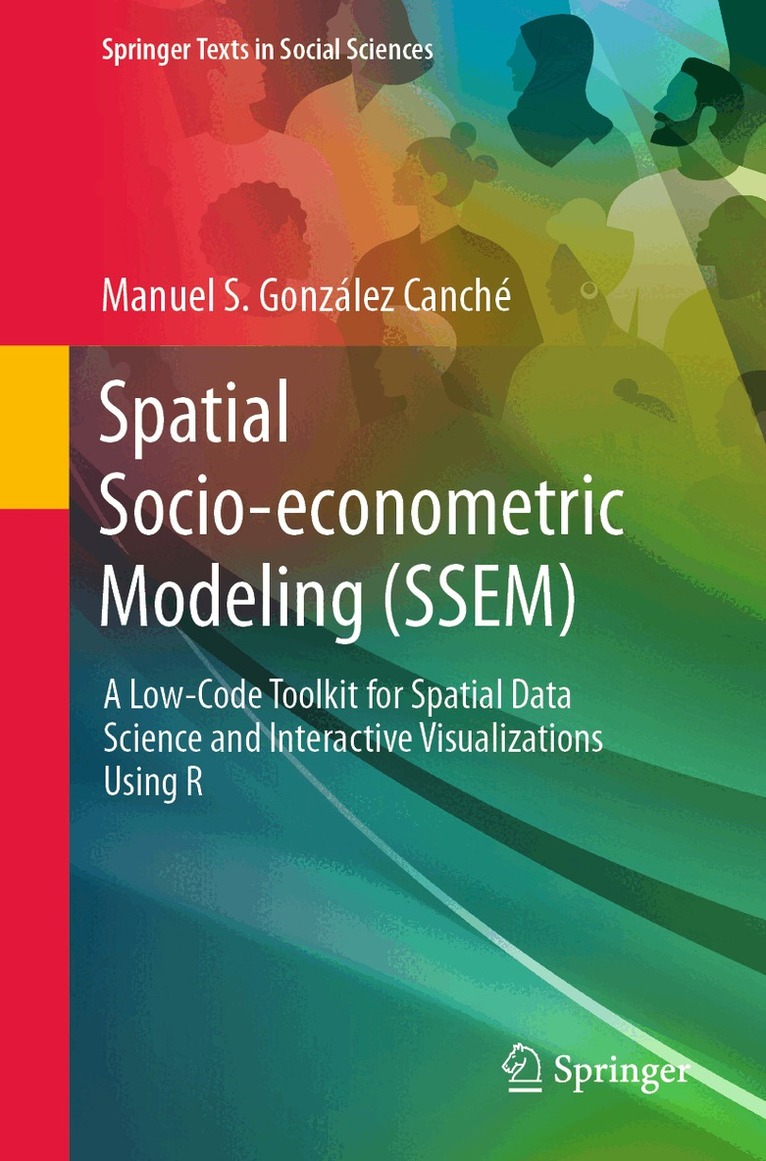
    Spatial Socio-econometric Modeling (SSEM)

    A Low-Code Toolkit for Spatial Data Science and Interactive Visualizations Using R

    AvManuel S. González Canché

    Häftad, Engelska, 2023

    Del i serien Springer Texts in Social Sciences

    978 kr

    Beställningsvara. Skickas inom 10-15 vardagar. Fri frakt över 249 kr.

    Fler format och utgåvor

    E-bok

    1 258 kr

    Beskrivning

    With the primary goal of expanding access to spatial data science tools, this book offers dozens of minimal or low-code functions and tutorials designed to ease the implementation of fully reproducible Spatial Socio-Econometric Modeling (SSEM) analyses. Designed as a University of Pennsylvania Ph.D. level course for sociologists, political scientists, urban planners, criminologists, and data scientists, this textbook equips social scientists with all concepts, explanations, and functions required to strengthen their data storytelling. It specifically provides social scientists with a comprehensive set of open-access minimal code tools to:•Identify and access place-based longitudinal and cross-sectional data sources and formats•Conduct advanced data management, including crosswalks, joining, and matching•Fully connect social network analyses with geospatial statistics•Formulate research questions designed to account for place-based factors in model specification and assess their relevance compared to individual- or unit-level indicators•Estimate distance measures across units that follow road network paths •Create sophisticated and interactive HTML data visualizations cross-sectionally or longitudinally, to strengthen research storytelling capabilities•Follow best practices for presenting spatial analyses, findings, and implications•Master theories on neighborhood effects, equality of opportunity, and geography of (dis)advantage that undergird SSEM applications and methods•Assess multicollinearity issues via machine learning that may affect coefficients' estimates and guide the identification of relevant predictors•Strategize how to address feedback loops by using SSEM as an identification framework that can be merged with standard quasi-experimental techniques like propensity score models, instrumental variables, and difference in differences•Expand the SSEM analyses to connections that emerge via social interactions, such as co-authorship and advice networks, or any form of relational dataThe applied nature of the book along with the cost-free, multi-operative R software makes the usability and applicability of this textbook worldwide.

    Produktinformation

    • Utgivningsdatum:2023-07-02
    • Mått:155 x 235 x 30 mm
    • Vikt:820 g
    • Format:Häftad
    • Språk:Engelska
    • Serie:Springer Texts in Social Sciences
    • Antal sidor:503
    • Förlag:Springer International Publishing AG
    • ISBN:9783031248566

    Utforska kategorier

    • Systemvetenskap och AI inom Data och IT
    • Matematisk statistik inom Naturvetenskap och teknik
    • Sociologi inom Samhälle och politik

    Mer om författaren

    Manuel S. González Canché holds a tenured professorship at the University of Pennsylvania. His professional training in Computer Science, Biostatistics, Economics, and Sociology has informed his eclectic view of social issues and research. His primary methodological interests are on spatial data science, complex systems, network modeling, text classification via machine learning, and quasi-experimental or quasi-causal design focused on policy-related issues. Recently, he has been working on developing low- and no-code, cost-free, and open-access software that aims to democratize access to data science tools. In addition to the dozens of low-code tools included in this book, a recent example of no-code software can be found at Expert Systems with Applications, where an open-access software is offered to help qualitative, mixed-methods, and even quantitative researchers close open-ended responses.

    Innehållsförteckning

    • Part I Conceptual and Theoretical Underpinnings.- Chapter 1. SPlaces.- Chapter 2. Operationalizing Splaces.- Chapter 3. Data Formats, Coordinate Reference Systems, and Differential Privacy Frameworks.- Part II Data Science SSEM Identification Tools: Distances, Networks, and Neighbors.- Chapter 4. Access and Management of Spatial or Geocoded Data.- Chapter 5. Distances.- Chapter 6. Geographical Networks as Identification Tools.- Part III SSEM Hypothesis Testing of Cross-sectional and Spatio-temporal Data and Interactive Visualizations.- Chapter 7. SODA: Spatial Outcome Dependence or Autocorrelation.- Chapter 8. SSEM Regression Based analyses.- Chapter 9. Visualization, Mining, and Density Analyses of Spatial and Spatio-temporal Data.- Chapter 10. Final Words.-  Glossary.- Index.