Beställningsvara. Skickas inom 10-15 vardagar. Fri frakt över 249 kr.
Beskrivning
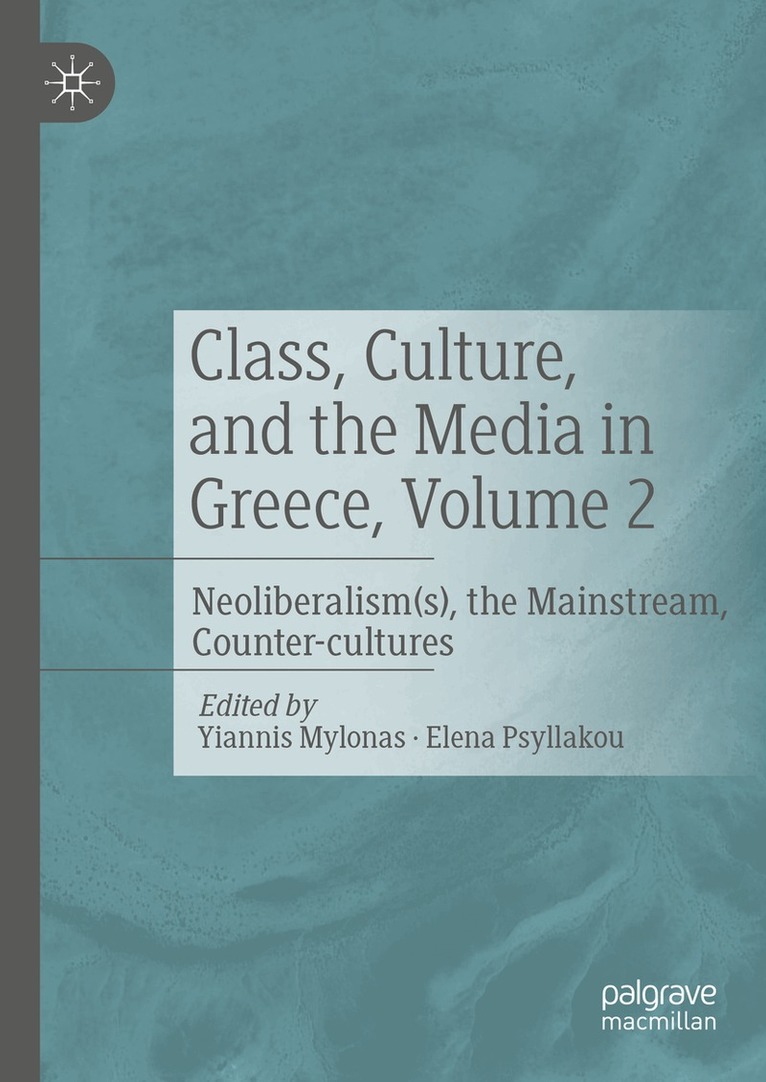
This two-volume work brings together studies focusing on the Greek realities of class as they appear in and through the Greek media realm. Critically engaging with traditions of class analysis, it brings to light various class perspectives and their explanatory power for the Greek context.
Yiannis Mylonas is Associate Professor at the Media Institute of the National Research University Higher School of Economics, in Moscow. He received a PhD in Media and Communications from Copenhagen University, and has worked at Lund University as postdoctoral researcher. He is the author of the monograph The “Greek Crisis” in Europe: Race, Class and Politics (2019), and co-editor (with Panos Kompatsiaris and Ilya Kirya) of The Industrialization of Creativity and Its Limits: Values, Politics and Lifestyles of Contemporary Cultural Economies (Springer, 2020). He has previously published in journals such as Stasis, Critical Discourse Studies, tripleC, The Journal of Language and Politics, Continuum, Subjectivity, Race and Class, The Journal of Political Ideologies, Javnost/the Public, Nordicom Review, and Journalism, among others.Elena Psyllakou holds a PhD in Discourse Studies (Department of Political Sciences, University of Athens), building on critical approaches to discourse analysis, media and communication. In her postdoctoral research for the project “Media in the limelight. A dialogic approach”, implemented in collaboration with the Greek National Center for Social Research (EKKE), she focused on the intersections of news media, politics, and journalistic identities in the Greek mediascape. She has been an active member of DiscourseNet. Currently she works as a Communications Expert and Research Associate in the NGOs/CSOs sector in Greece. In collaboration with the ENA Institute for Alternative Policies she contributes to projects and initiatives to enhance transparency and trust in media and journalism.
Innehållsförteckning
Chapter 1. Introduction: Conjunctures of class, culture, and the media in contemporary Greek studies (Yiannis Mylonas).- Chapter 2. Greek new middle class and fashion in late modernity: Between individualized “conformity” and “creative” appropriation (Dimitris Lallas).- Chapter 3. Communication practices of the social classes in contemporary Greece (George Pleios).- Chapter 4. Posh in the City: Images of social class in the television dramas of Christophoros Papakaliatis (Spyridon Chairetis).- Chapter 5. Wanna be on top? Labor pedagogies and neoliberal ethics in Greece’s Next Top Model (GNTM) (Georgia Aitaki).- Chapter 6. The Construction of Entrepreneurial Masculinity: Competition, Choice and Tech-savviness in Online Intimacy Coaching (Georgia Aitaki).- Chapter 7. The State They Live In: Lumpenproletariat, Linguistic Capital, and Minor Language in Yannis Economides’ Films (Evangelia Theodoridou).- Chapter 8. Class, negativity, and becoming; the poetic counter-archives of Samson Rakasand Antonis Antonakos (Yiannis Mylonas).- Chapter 9. From book to screen entertainment: How class issues in Alki Zei’s novel Wildcat under Glass are reportrayed in the TV-adaptation (Vladimir Cotal San Martin).- Chapter 10. On the Network Culture of Electronic Dance Music (Leandros Kyriakopoulos).- Chapter 11. Cooperative media in Greece: anti-austerity movements, class and the battle for hegemony (Vaggelis Gkagkelis).- Chapter 12. Afterword: Ghosting, imagery and reconstruction Or, what we do not talk about when we do not talk about class in Greece (Dimitris Papanikolaou).