• Fri frakt över 249 kr
  • •
  • Snabba leveranser
  • •
  • Billiga böcker
Kundservice

Du är på sajten för privatpersoner.

Företag, bibliotek eller offentlig verksamhet?

Du handlar på classic.bokus.com, där alla dina funktioner finns intakta.
Till classic.bokus.com
Bokus logotyp. Gå till startsidan.
  • Erbjudanden
  • Student
  • Topplistor
  • Barn & ungdom
  • Bokus Play
  • Bokus Play
  • E-böcker
  • Ljudböcker
  • Pocketböcker
  • Spel & pussel

10% rabatt på allt med kod NYSTART10 →

Sidfot

Mina sidor

    Hjälp

    • Kundservice
    • Vanliga frågor och svar
    • Frakt och leverans
    • Retur vid ångerrätt
    • Reklamera vara
    • Betalning
    • Köpvillkor
    • Allmänna villkor
    • Information om webbplatsens tillgänglighet

    Om Bokus

    • Om oss
    • Pressrum
    • För studenter
    • För företag
    • För bibliotek och offentlig verksamhet
    • För leverantörer
    • Hållbarhet

    Populärt

    • Aktuella erbjudanden
    • Presentkort
    • Studentlitteratur
    • Nya böcker
    • Topplistor
    • Signerade böcker
    • Engelska böcker

    Inspiration

    • Boktips
    • BookTok
    • Populära bokserier
    • Barnbokskaraktärer
    • Populära författare
    Logotyp för Bokus
    Följ oss på Facebook (extern länk)Följ oss på Instagram (extern länk)Följ oss på YouTube (extern länk)Följ oss på TikTok (extern länk)
    bokus @ CookiesAnpassa cookiesIntegritetspolicyKöpvillkor
    Till Citymail hemsida (extern länk)Till Budbee hemsida (extern länk)Till Postnord hemsida (extern länk)Till Schenker hemsida (extern länk)Till Early Bird hemsida (extern länk)Till Walleys hemsida (extern länk)
    1. Naturvetenskap och teknik
    2. Matematik och naturvetenskap
    3. Biologi
    4. Biovetenskap

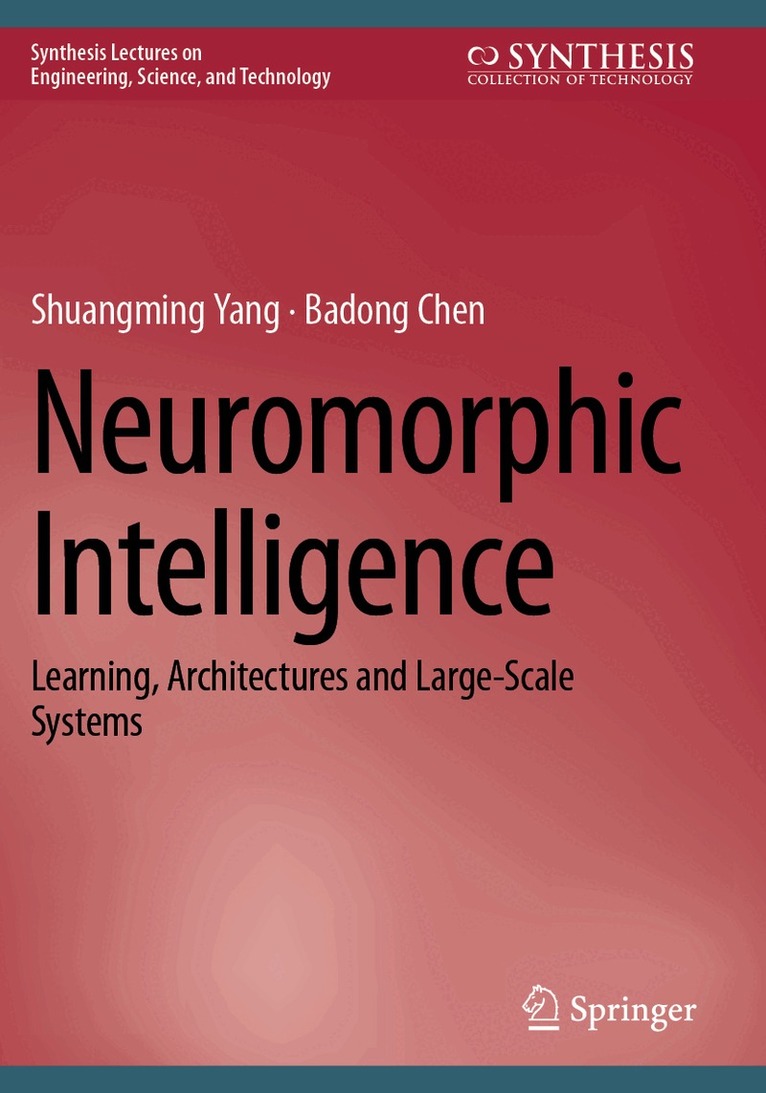
    Neuromorphic Intelligence

    Learning, Architectures and Large-Scale Systems

    AvShuangming Yang,Badong Chen

    Häftad, Engelska, 2025

    Del i serien Synthesis Lectures on Engineering, Science, and Technology

    492 kr

    Beställningsvara. Skickas inom 10-15 vardagar. Fri frakt över 249 kr.

    Fler format och utgåvor

    Inbunden

    492 kr

    Beskrivning

    This book provides a valuable resource on the design of neuromorphic intelligence, which serves as a computational foundation for building compact and low-power brain-inspired intelligent systems. The book introduces novel spiking neural network learning algorithms, including spike-based learning based on the multi-compartment model and spike-based learning with information theory. These offer important insights and academic value for readers to grasp the latest advances in neural-inspired learning. Additionally, the book presents insights and approaches to the design of scalable neuromorphic architectures, which are crucial foundations for achieving highly cognitive and energy-efficient computing systems. Furthermore, the book introduces representative large-scale neuromorphic systems and reviews several recently implemented large-scale digital neuromorphic systems by the authors, providing corresponding application scenarios.

    Produktinformation

    • Utgivningsdatum:2025-05-16
    • Mått:168 x 240 x 15 mm
    • Vikt:442 g
    • Format:Häftad
    • Språk:Engelska
    • Serie:Synthesis Lectures on Engineering, Science, and Technology
    • Antal sidor:239
    • Förlag:Springer International Publishing AG
    • ISBN:9783031578755

    Utforska kategorier

    • Biovetenskap inom Naturvetenskap och teknik
    • Artificiell intelligens inom Data och IT

    Mer om författaren

    Shuangming Yang (IEEE Member) received the B.S. degree from Hebei University of Technology in 2013, the M.S. degree and the Ph.D degree in Control Science and Engineering both from Tianjin University, Tianjin, China, in 2016 and 2020, respectively. Since January 2020, he was a lecturer and Postdoctoral Associate at the School of Electrical and Information Engineering, Tianjin University, Tianjin, China. Currently he is an associate professor at the School of Electrical and Information Engineering, Tianjin University, Tianjin, China. His current research interests include information theoretical learning, neuromorphic computing, spike-based machine learning, computer vision, and artificial general intelligence. At present, he is the author or coauthor of more than 40 international journal papers, and the owner of 4 ESI highly cited papers. Dr. Yang has served as an active reviewer for several IEEE Transactions, Frontiers in Neuroscience, and other international journals. He is currently appointed an Editorial board member of JCSC, IET CDS, Frontiers in Neuroscience, and Electronics. Badong Chen (IEEE Senior Member) received the B.S. and M.S. degrees in Control Theory and Engineering from Chongqing University, Chongqing, China, in 1997 and 2003, respectively, and the Ph.D. degree in Computer Science and Technology from Tsinghua University, Beijing, China, in 2008. He was a Postdoctoral Associate at the University of Florida Computational NeuroEngineering Laboratory (CNEL) from 2010 to 2012. He visited the Nanyang Technological University (NTU), Singapore, as a visiting research scientist in 2015. He also served as a senior research fellow with The Hong Kong Polytechnic University in 2017. Currently he is a professor at the Institute of Artificial Intelligence and Robotics (IAIR), Xi’an Jiaotong University, Xi’an, China. His research interests are in signal processing, machine learning, artificial intelligence, neural engineering and robotics. He has published 6 books and over 300 papers in various journals and conference proceedings and his papers have got over 13000 citations according to Google Scholar. Dr. Chen is an IEEE Senior Member, a Technical Committee Member of IEEE SPS Machine Learning for Signal Processing (MLSP) and IEEE CIS Cognitive and Developmental Systems (CDS), and an associate editor of IEEE Transactions on Cognitive and Developmental Systems, IEEE Transactions on Neural Networks and Learning Systems and Journal of The Franklin Institute, and has been on the editorial board of Entropy.

    Innehållsförteckning

    • Introduction.- Introduction for Neuromorphic Intelligence.- Spike-based Learning with Multi-compartment Model.- Spike-based Learning with Information Theory.- Scalable Architectures on Neuromorphic Systems.- Large-scale Digital Neuromorphic Systems.- Conclusion.