• Fri frakt över 249 kr
  • •
  • Snabba leveranser
  • •
  • Billiga böcker
Kundservice

Du är på sajten för privatpersoner.

Företag, bibliotek eller offentlig verksamhet?

Du handlar på classic.bokus.com, där alla dina funktioner finns intakta.
Till classic.bokus.com
Bokus logotyp. Gå till startsidan.
  • Erbjudanden
  • Nyheter
  • Student
  • Topplistor
  • Barn & ungdom
  • Bokus Play
  • E-böcker
  • Pocketböcker
  • Spel & pussel

10% rabatt på allt med kod NYSTART10 →

Sidfot

Mina sidor

    Hjälp

    • Kundservice
    • Vanliga frågor och svar
    • Frakt och leverans
    • Retur vid ångerrätt
    • Reklamera vara
    • Betalning
    • Köpvillkor
    • Allmänna villkor
    • Information om webbplatsens tillgänglighet

    Om Bokus

    • Om oss
    • Pressrum
    • För studenter
    • För företag
    • För bibliotek och offentlig verksamhet
    • För leverantörer
    • Hållbarhet

    Populärt

    • Aktuella erbjudanden
    • Presentkort
    • Studentlitteratur
    • Nya böcker
    • Topplistor
    • Signerade böcker
    • Engelska böcker

    Inspiration

    • Boktips
    • BookTok
    • Populära bokserier
    • Barnbokskaraktärer
    • Populära författare
    Logotyp för Bokus
    Följ oss på Facebook (extern länk)Följ oss på Instagram (extern länk)Följ oss på YouTube (extern länk)Följ oss på TikTok (extern länk)
    bokus @ CookiesAnpassa cookiesIntegritetspolicyKöpvillkor
    Till Citymail hemsida (extern länk)Till Budbee hemsida (extern länk)Till Postnord hemsida (extern länk)Till Schenker hemsida (extern länk)Till Early Bird hemsida (extern länk)Till Walleys hemsida (extern länk)
    1. Naturvetenskap och teknik
    2. Matematik och naturvetenskap
    3. Matematik

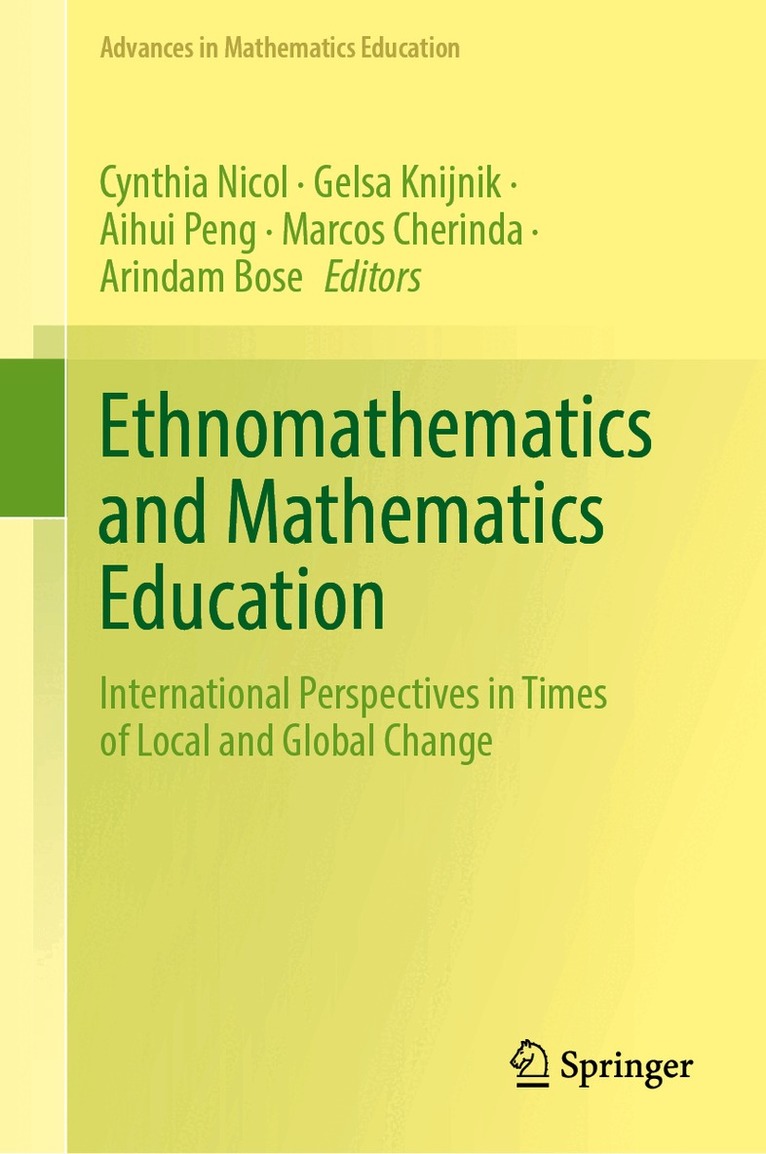
    Ethnomathematics and Mathematics Education

    International Perspectives in Times of Local and Global Change

    AvCynthia Nicol,Gelsa Knijnik

    Inbunden, Engelska, 2024

    Del i serien Advances in Mathematics Education

    1 841 kr

    Beställningsvara. Skickas inom 10-15 vardagar. Fri frakt över 249 kr.

    Beskrivning

    This edited volume examines ethnomathematics conceptions, pedagogical practices, and research from international perspectives in times of local and global challenges. The book explores connections between mathematical, cultural, political, and social practices toward more inclusive, holistic, creative, transdisciplinary and critical ways of engaging with knowledge and mathematical actions in society. In this edited book, the authors explore how ethnomathematics supports transformation of educational systems toward regaining cultural reclamation and self-confidence, challenges colonial logics for decolonizing and Indigenizing mathematics education, and engages with actions for critical and social justice issues.

    Produktinformation

    • Utgivningsdatum:2024-07-17
    • Mått:155 x 235 x 21 mm
    • Vikt:678 g
    • Format:Inbunden
    • Språk:Engelska
    • Serie:Advances in Mathematics Education
    • Antal sidor:292
    • Upplaga:2024
    • Förlag:Springer International Publishing AG
    • ISBN:9783031606793

    Utforska kategorier

    • Matematik inom Naturvetenskap och teknik
    • Utbildningsstrategier och utbildningspolitik inom Psykologi och pedagogik
    • Studieteknik och inlärningsförmåga inom Psykologi och pedagogik

    Mer om författaren

    Dr. Cynthia Nicol is a professor in mathematics education in the Department of Curriculum and Pedagogy at the University of British Columbia, Canada. She holds the David Robitaille Professorship in Mathematics and Science Education and is recognized internationally for her research in culturally responsive mathematics education with/in rural and Indigenous communities.Dr. Gelsa Knijnik is a professor in mathematics education at the Universidade Federal do Rio Grande do Sul, Brazil. She conducts research in the area of Mathematics Education from an ethnomathematical perspective, which examines culture in its intersections with the social, economic, and political. She has participated in all ICMEs since 1987. At ICME-14, she was the chair of TSG Ethnomathematics. She has published many articles and book chapters with international circulation as well as books in Brazil linked to her academic production.Dr. Aihui Peng is an associate professor in the Faculty of Education at Southwest University, China. She had been a postdoctoral researcher in Umea University and senior lecturer in Linneaus University, Sweden. Her research interests focus on mathematics curriculum and instruction from cross-cultural perspectives, under which she led international and national research projects. She served as the co-chair of TSG 24 in ICME-12 and a team member of TSG 52 in ICME-14.Dr. Marcos Cherinda is professionally trained as a Teacher of Mathematics and Physics and holds a Ph.D. in Mathematics Education. He was a Regular Lecturer at ICME-12, served as the ICMI-Mozambique Country Representative (2012–2020) and was the Chair of the Local Organizing Committee of the 5th International Congress on Ethnomathematics (ICEM-5) held in Maputo, on July 7 to 11, 2014. Currently, he is serving the United Nations Educational, Scientific and Cultural Organization (UNESCO) at the Maputo, Mozambique office as a senior officer for Science, Technology, Higher Education and TVET.Dr. Arindam Bose is an Associate Professor in TISS, Mumbai and a Collaborative Prof in UNIFESP, Brazil. His research focus is on Ethnomathematics, math cognition and language diversity. He has published on ethnomathematics of the work practices of low-income communities with rich cultural resources. In ICME-14, he was an active member of the Topic Study Group (TSG) on Ethnomathematics. In ICME-13, he co-edited a volume on TSG work on language communication and math learning which has been published by Springer.

    Innehållsförteckning

    • Chapter 1. Introduction.- Part I. Ethnomathematics and Schools: Cultural Self-confidence and Reclamation.- Chapter 2. Chinese Cultural Group Students’ Mathematical Problem Posing in Tasks with a Cultural Context and Without a Cultural Context.- Chapter 3. Foreign algorithms from the rich fund of knowledge as a starting point for mathematically productive and emancipating teaching in international classes in Germany.- Chapter 4. Mexican American woman talking about graphs: A focus on their lived experiences.- Chapter 5. Weaving Indigenous mathematics: Bringing Indigenous ways and stories into conversation with ethnomathematics.- Chapter 6. From ethnomathematics reasoning to mathematics research.- Part II. Ethnomathematics, Challenging Colonial Logics, and Indigenizing.- Chapter 7. Internalized mathematics as intuitive as breathing: An ethnomathematics study of traditional architecture in Iran.- Chapter 8. Ethnomathematics as a pedagogical and political tool in an Indigenous school curriculum.- Chapter 9. The formation of critical thinking in mathematics learning through a model of contextualization with the social, political and historical environment in Ecuadorian education.- Chapter 10. Ethnomodelling Research: Glocalizing Educational Systems from Exclusion to Inclusion at Local and Global Levels.- Chapter 11. The Dynamic Components of Janiola’s Ethnolearning Framework.- Chapter 12. Ethnomathematics from a political perspective.