• Fri frakt över 249 kr
  • •
  • Snabba leveranser
  • •
  • Billiga böcker
Kundservice

Du är på sajten för privatpersoner.

Företag, bibliotek eller offentlig verksamhet?

Du handlar på classic.bokus.com, där alla dina funktioner finns intakta.
Till classic.bokus.com
Bokus logotyp. Gå till startsidan.
  • Erbjudanden
  • Nyheter
  • Student
  • Topplistor
  • Barn & ungdom
  • Bokus Play
  • E-böcker
  • Pocketböcker
  • Spel & pussel

10% rabatt på allt med kod: NYSTART10 →

Sidfot

Mina sidor

    Hjälp

    • Kundservice
    • Vanliga frågor och svar
    • Frakt och leverans
    • Retur vid ångerrätt
    • Reklamera vara
    • Betalning
    • Köpvillkor
    • Allmänna villkor
    • Information om webbplatsens tillgänglighet

    Om Bokus

    • Om oss
    • Pressrum
    • För studenter
    • För företag
    • För bibliotek och offentlig verksamhet
    • För leverantörer
    • Hållbarhet

    Populärt

    • Aktuella erbjudanden
    • Presentkort
    • Studentlitteratur
    • Nya böcker
    • Topplistor
    • Signerade böcker
    • Engelska böcker

    Inspiration

    • Boktips
    • BookTok
    • Populära bokserier
    • Barnbokskaraktärer
    • Populära författare
    Logotyp för Bokus
    Följ oss på Facebook (extern länk)Följ oss på Instagram (extern länk)Följ oss på YouTube (extern länk)Följ oss på TikTok (extern länk)
    bokus @ CookiesAnpassa cookiesIntegritetspolicyKöpvillkor
    Till Citymail hemsida (extern länk)Till Budbee hemsida (extern länk)Till Postnord hemsida (extern länk)Till Schenker hemsida (extern länk)Till Early Bird hemsida (extern länk)Till Walleys hemsida (extern länk)
    1. Naturvetenskap och teknik
    2. Geovetenskap
    3. Miljövetenskap och miljöpolitik

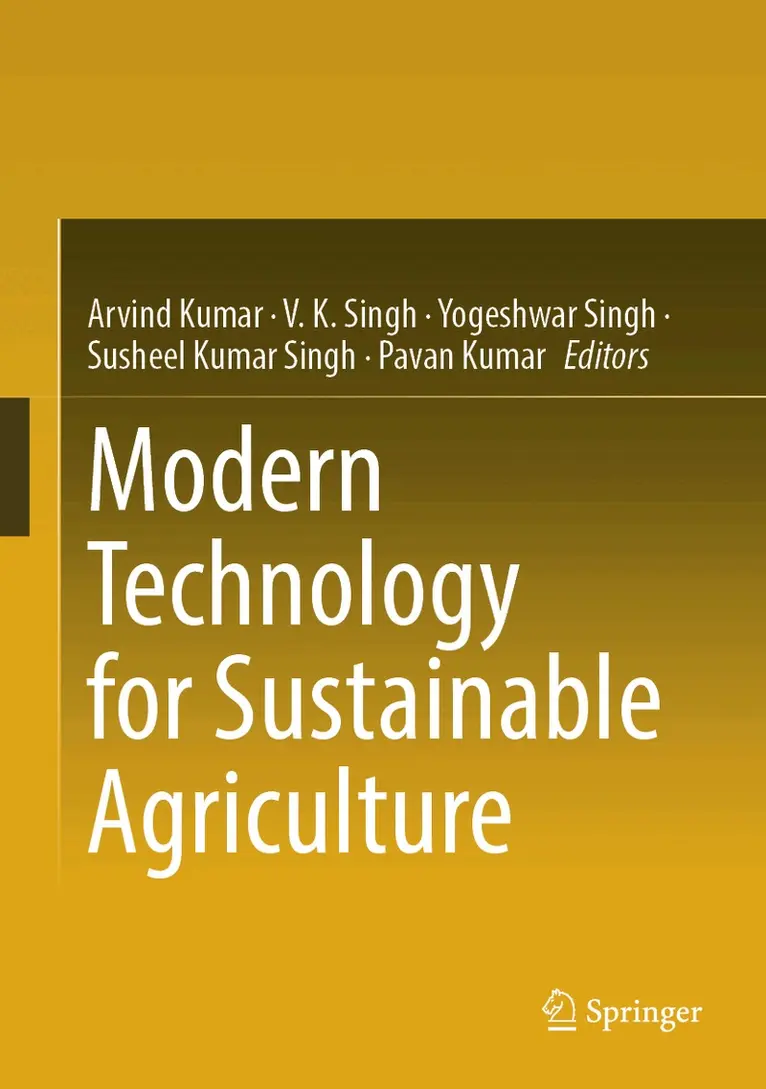
    Modern Technology for Sustainable Agriculture

    AvArvind Kumar,V. K. Singh

    Inbunden, Engelska, 2025

    1 949 kr

    Beställningsvara. Skickas inom 10-15 vardagar. Fri frakt över 249 kr.

    Beskrivning

    Modern technology for sustainable agriculture is based primarily on three platforms, namely science, innovation and spatial technologies. These are considered as the three pioneer pillars of nation building. Spatial technologies play a vital role in improving soil quality, reducing the waste of water during irrigation and sharing agricultural information with farmers. With the help of terrestrial, aquatic, and aerial sensors, satellites and surveillance equipment, a large volume of geo-spatial data from diverse sources is collected, analyzed, and utilized for smart farming and shielding of crops. During last five decades, agricultural research and extension has focused on the development of higher productivity of crop varieties, increased fertilizer use and other production technologies. These have enabled the farmers to grow more food, but at the same time it over exploited the resources and resulted in decreasing farm productivity and profitability. To tackle such problems, harmonious use of inputs through integration of various land- based enterprises and their compounded responses needs further attention to make the agriculture more productive, profitable and sustainable. Many technologies have been identified to support sustainable use of resources and facilities, including Natural Resource Management (NRM), Resource Conservation Technologies (RCTs), Integrated Farming System (IFS), Integrated Crop Management (ICM), Integrated Nutrient Management (INM), protected cultivation practices, secondary agricultural practices and post-harvest technologies.

    Produktinformation

    • Utgivningsdatum:2025-08-03
    • Mått:178 x 254 x 23 mm
    • Vikt:904 g
    • Format:Inbunden
    • Språk:Engelska
    • Antal sidor:315
    • Förlag:Springer International Publishing AG
    • ISBN:9783031883958

    Utforska kategorier

    • Miljövetenskap och miljöpolitik inom Naturvetenskap och teknik
    • Biovetenskap inom Naturvetenskap och teknik
    • Lantbruksteknik inom Naturvetenskap och teknik

    Mer om författaren

    Prof. Arvind Kumar, a renowned educationist and researcher having more than four decades of experience was given the responsibility from May 2014 to June 2022 by the President of India as first Vice Chancellor of Rani Lakshmi Bai Central Agricultural University, Jhansi. Prof. Kumar has an excellent academic record to his credit. He obtained M. Phil. (1971) and Ph. D. in Agronomy (1975) from Meerut University, Meerut. Prior to this assignment Prof. Kumar worked as DDG (Education), ICAR, New Delhi from 2009–2014, held the additional charge of DDG (Fisheries), ICAR, New Delhi about 5 months and was the Director of DRMR, Bharatpur from 2002 to 2009.Dr. V. K. Singh is currently Director, Central Research Institute for Dryland Agriculture, Hyderabad, India. Dr. Singh has made valuable contributions in the area of soil fertility appraisal and soil health restoration through site-specific nutrient management (SSNM) and inclusion of legumes in intensive cropping systems. His effort on soil fertility appraisal using geo-statistical tools in different agro-ecologies revealed widespread multi-nutrient deficiencies. The extensive studies by him at cultivators’ fields underlined the significance of SSNM for addressal of multi-nutrient deficiencies, improving yields, and profits under different cropping systems.Prof. Yogeshwar Singh, a researcher and educationist having eighteen years of experience has been given the responsibility as Founder Head (Agronomy) on April, 2020 at College of Agriculture, Rani Lakshmi Bai Central Agricultural University, Jhansi to develop the department as an excellence of teaching, research and extension. Prior to joining as Professor (Agronomy) at College of Agriculture, Rani Lakshmi Bai Central Agricultural University, Jhansi Dr Singh was serving as Principal Scientist, ICAR-National Institute of Abiotic Stress Management, Baramati, Pune, Maharashtra.Dr. Susheel Kumar Singh is currently serving as an Assistant Professor in the Department of Soil Science at the College of Agriculture, Rani Lakshmi Bai Central Agricultural University, Jhansi, (UP) India. He completed his Ph.D. in Soil Science and Agriculture Chemistry from the department of Soil Sciences and Agriculture Chemistry at Sardar Vallabhbhai Patel University of Agriculture and Technology, Meerut UP).Dr. Pavan Kumar is presently Assistant Professor at College of Horticulture and Forestry, Rani Lakshmi Bai Central Agricultural University, Jhansi, U.P., India. He obtained his Ph.D degrees from Faculty of Natural Sciences, Jamia Millia Islamia, New Delhi. He did B.Sc. (Botany) and M.Sc.  (Environmental Science) from Banaras Hindu University, Varanasi, India and subsequently obtained Master’s degree in Remote Sensing (M.Tech) from Birla Institute of Technology, Mesra Ranchi, India.

    Innehållsförteckning

    • 1. Linking of the past, present and future scenarios of soil.- 2. Land use planning based agriculture for better soil management.- 3. Soil mapping.- 4. Use of information technology in soil management.- 5. Cropping system based soil management.- 6. Presence scenario of water availability and its resources.- 7. Water recycling for irrigation practices.- 8. Methods of increasing water productivity.- 9. Sensors based irrigation for increasing crop and water productivity.- 10. Water budgeting based crop planning.