Häftad, Engelska, 2026
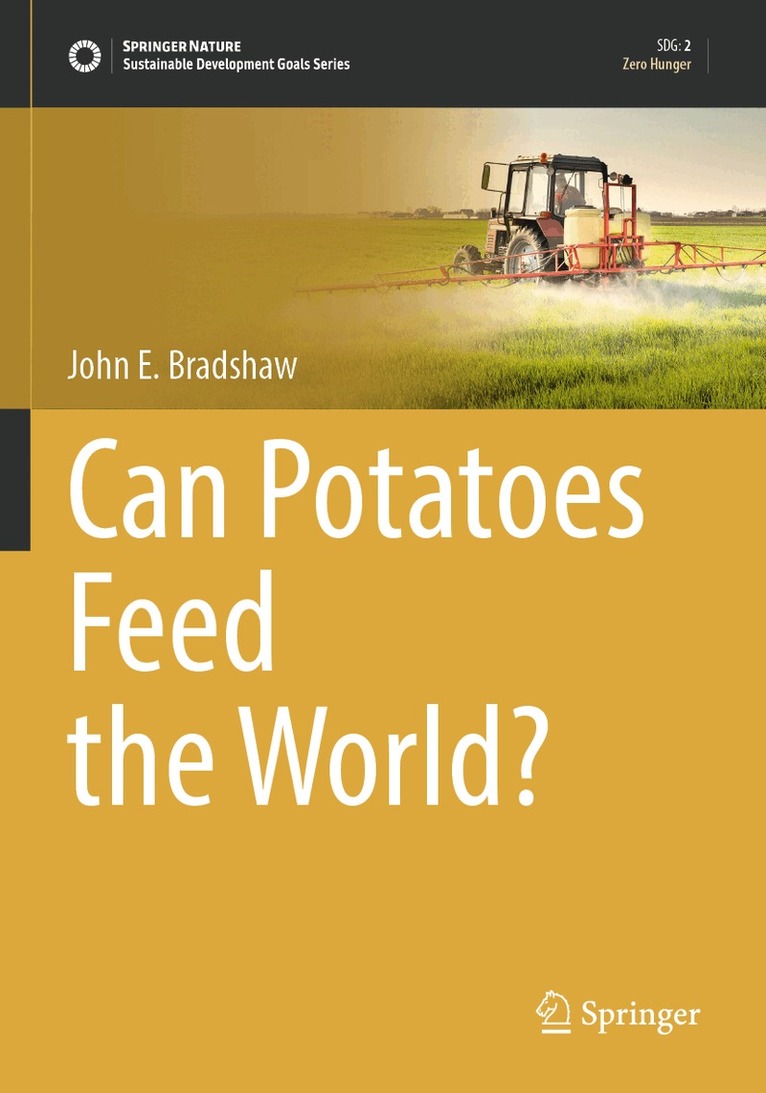
Can Potatoes Feed the World?
1643 kr
Beställningsvara. Skickas inom 10-15 vardagar. Fri frakt över 249 kr.
Beskrivning
By 2050 the United Nations (UN) predicts a world population of 9.7 billion compared with 8 billion in 2022. Increases in food and energy production and the supply of fresh water will be needed to sustain this population, whilst reducing greenhouse gas emissions to limit global warming. The average global temperature is likely to be 2 to 3 degrees Celsius above that in pre-industrial times, unless there is a greater sense of urgency following the UN Climate Change Conference (COP26) in Glasgow in 2021, which still wanted to limit the rise to 1.5 degrees. There is also increasing concern about the loss of biodiversity on Earth from human activity, including farming, as seen in the outcomes of the UN Biodiversity Conference (COP15) in Montreal in 2022. More encouragingly, on 1 December 2023, 134 countries at COP28 in Dubai endorsed the landmark sustainable agriculture, resilient food systems and climate action declaration which put food systems transformation on the global climate agenda. “While food systems are vital for meeting societal needs and enabling adaptation to climate impacts, they are also responsible for as much as a third of global greenhouse gas emissions.” A warmer climate and loss of biodiversity will make life more difficult for humankind; but can potatoes at least help with food security? It is a scientific and technological question set in a political, economic and societal context. It has arisen because potatoes have made the journey from wild species to global food crop. The contribution of the potato to the United Nations Millennium Development Goals of providing food security and eradicating poverty was recognized when an International Year of the Potato 2008 (IYP 2008) was officially launched at the United Nations (UN) headquarters in New York on 18 October 2007 by the Director-General of FAO (Food and Agriculture Organization of the United Nations).Today the importance of potatoes can be seen in the context of the United Nations “2030 Agenda for Sustainable Development” which was adopted in 2015 and started on 1 January 2016. The agenda has 17 goals, the second of which (SDG2) is to end hunger, achieve food security and improved nutrition, and promote sustainable agriculture. By 2030, the aim of the agenda is to ‘ensure access by all people, in particular the poor and people in vulnerable situations, including infants, to safe, nutritious and sufficient food all year round’. However, the projection in the 2023 Sustainable Development Goals Report was not zero-hunger but 600 million people still facing hunger. Hence a greater sense of urgency is required and also a need to look beyond 2030 to 2050. This book explores how potatoes can contribute to SDG2 by increasing potato production and improving the nutritional value of potatoes, in particular to alleviate micronutrient deficiencies (‘hidden hunger’), having first explained how potatoes became a major food crop and the lessons to be learnt from a major crop failure and resulting famine.
Produktinformation
- Utgivningsdatum: 2026-07-04
- Mått: 178 x 254 x 13 mm
- Vikt: 431 g
- Format: Häftad
- Språk: Engelska
- Serie: Sustainable Development Goals Series
- Antal sidor: 208
- Förlag: Springer International Publishing AG
- ISBN: 9783031928925
Utforska kategorier
Betyg & recensioner
0 recensioner
Inga recensioner tillgängliga.