• Fri frakt över 249 kr
  • •
  • Snabba leveranser
  • •
  • Billiga böcker
Kundservice

Du är på sajten för privatpersoner.

Företag, bibliotek eller offentlig verksamhet?

Du handlar på classic.bokus.com, där alla dina funktioner finns intakta.
Till classic.bokus.com
Bokus logotyp. Gå till startsidan.
  • Erbjudanden
  • Nyheter
  • Student
  • Topplistor
  • Barn & ungdom
  • Bokus Play
  • E-böcker
  • Pocketböcker
  • Spel & pussel

10% rabatt på allt med kod: NYSTART10 →

Sidfot

Mina sidor

    Hjälp

    • Kundservice
    • Vanliga frågor och svar
    • Frakt och leverans
    • Retur vid ångerrätt
    • Reklamera vara
    • Betalning
    • Köpvillkor
    • Allmänna villkor
    • Information om webbplatsens tillgänglighet

    Om Bokus

    • Om oss
    • Pressrum
    • För studenter
    • För företag
    • För bibliotek och offentlig verksamhet
    • För leverantörer
    • Hållbarhet

    Populärt

    • Aktuella erbjudanden
    • Presentkort
    • Studentlitteratur
    • Nya böcker
    • Topplistor
    • Signerade böcker
    • Engelska böcker

    Inspiration

    • Boktips
    • BookTok
    • Populära bokserier
    • Barnbokskaraktärer
    • Populära författare
    Logotyp för Bokus
    Följ oss på Facebook (extern länk)Följ oss på Instagram (extern länk)Följ oss på YouTube (extern länk)Följ oss på TikTok (extern länk)
    bokus @ CookiesAnpassa cookiesIntegritetspolicyKöpvillkor
    Till Citymail hemsida (extern länk)Till Budbee hemsida (extern länk)Till Postnord hemsida (extern länk)Till Schenker hemsida (extern länk)Till Early Bird hemsida (extern länk)Till Walleys hemsida (extern länk)
    1. Samhälle och politik
    2. Samhälle och kultur
    3. Kultur och medier
    4. Kulturvetenskap

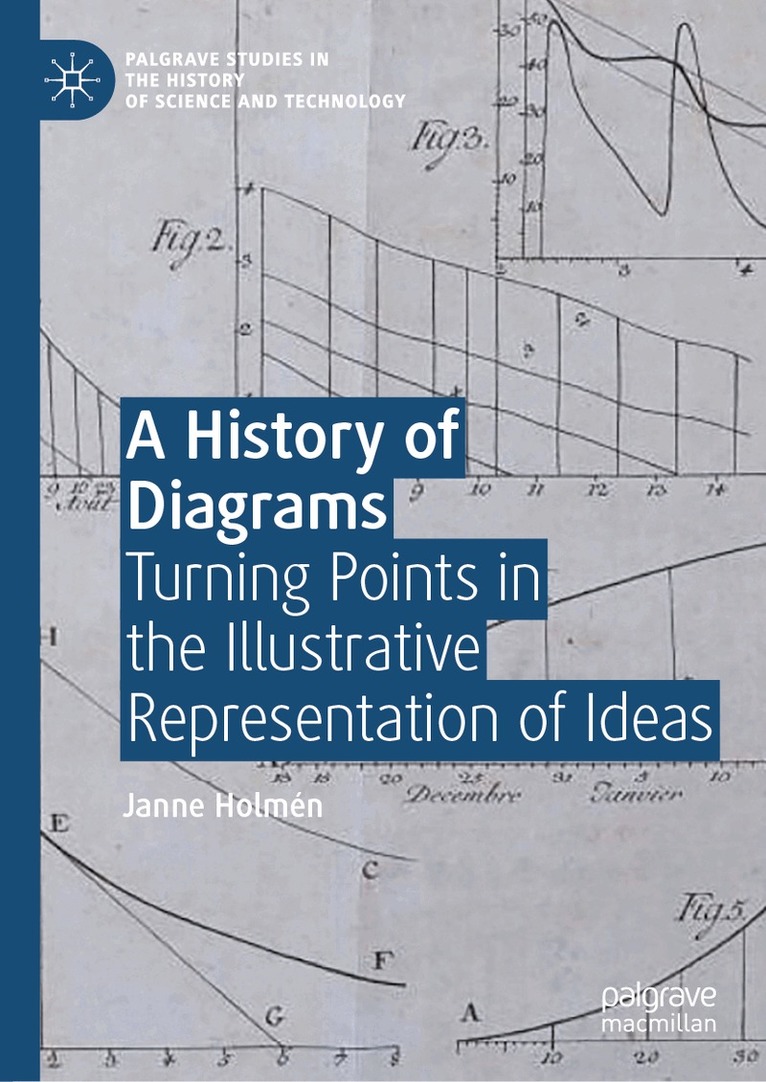
    History of Diagrams

    Turning Points in the Illustrative Representation of Ideas

    AvJanne Holmén

    Inbunden, Engelska, 2025

    Del i serien Palgrave Studies in the History of Science and Technology

    1 341 kr

    Beställningsvara. Skickas inom 10-15 vardagar. Fri frakt över 249 kr.

    Fler format och utgåvor

    E-bok

    1 780 kr

    Beskrivning

    This book examines the use of diagrams throughout history, from their Paleolithic antecedents to the present day. Drawing on theories and concepts from the cognitive sciences, the author explores the evolution of diagrammatic forms and their impact on the accumulation and dissemination of knowledge. This exploration reveals how paradigm shifts in worldviews and advances in image production technologies have shaped the way humans have given spatial form to abstract ideas. Highlighting global trends and regional variations, the book offers insights into how different societies have visualised complex ideas over time. Scholars, researchers and students in disciplines such as cognitive science, history and visual studies will find this book enlightening. It provides a comprehensive analysis that bridges historical and contemporary perspectives, making it essential reading for anyone seeking to understand the central role of diagrams in human thought and communication.

    Produktinformation

    • Utgivningsdatum:2025-11-10
    • Mått:148 x 210 x 25 mm
    • Vikt:586 g
    • Format:Inbunden
    • Språk:Engelska
    • Serie:Palgrave Studies in the History of Science and Technology
    • Antal sidor:347
    • Förlag:Springer International Publishing AG
    • ISBN:9783031996900

    Utforska kategorier

    • Kulturvetenskap inom Samhälle och politik
    • Socialhistoria och kulturhistoria inom Historia och arkeologi
    • Naturvetenskapens historia inom Naturvetenskap och teknik

    Mer om författaren

    Janne Holmén is Associate Professor of the History of Education at Uppsala University, Sweden. His research interests include textbook studies, conceptual history and cognitive history. Janne specialises in comparative studies of the history of education, often from a history of science perspective.

    Innehållsförteckning

    • Chapter 1. Introduction.- Part I. The Cognitive Foundations of the History of Diagrams.- Chapter 2. What Is a Diagram? Conceptual History and Semiotic Definition.- Chapter 3. Diagrams and the Limits of Consciousness.- Chapter 4. Diagrammatic Reasoning.- Chapter 5. The Neurology of Spatial and Abstract Thinking.- Chapter 6. The Evolution of Spatial Differentiation and Mythical Space.- Chapter 7. Brain, Culture, and Diagram.- Part II. The Prehistory of Diagrams.- Chapter 8. Language and Gestures.- Chapter 9.Terrain and Architecture: Structuring Knowledge in “Oral” Cultures and Early Civilizations.- Chapter 10. Quipu: Inca Infographics.- Chapter 11. Writing, Lists, and Tables.- Part III. Diagrams for the Structuring and Classification of Knowledge.- Chapter 12. Ancient Diagrams and Their Philosophical Foundations.- Chapter 13. The Square of Opposition and the Wheel of Reasons.- Chapter 14. Tree Diagrams.- Chapter 15. The Scholastic Diagram Habitus.- Chapter 16. Similarities and Differences between Scholastic, Byzantine, Arabic, and Chinese Tree Diagrams.- Chapter 17. Genealogical Trees and Diagrammatic Heraldry.- Chapter 18. Llullism: Incomprehensible Originality.- Chapter 19. Circles of Inclusion.- Part IV. Printing Diagrams of Systems.- Chapter 20. Printing and Spatial Cognition.- Chapter 21. The Musical Prelude to Diagrams of Scientific Systems.- Chapter 22. Petrus Ramus and the Editable Print Diagrams.- Chapter 23. The Shape of Life.- Chapter 24. The Periodic System of the Elements.- Part V. Spatial Representation of Data.- Chapter 25. Musical Notation as the First Time Series Graphs.- Chapter 26. Statistical Graphics.- Chapter 27. Diagrams of Heartbeats.- Chapter 28. Diagrams in Economic Theory.- Chapter 29. Stock Charts: Icons of Capitalism.- Chapter 30. Diagrams of Social Hierarchies.- Part VI. Diagramming Flows and Causality.- Chapter 31. Timelines: Spatial Representations of Time.- Chapter 32. Flow Charts: From Liquids to Paper and Back Again.- Chapter 33. Causal Path Diagrams and Fuzzy Cognitive Maps.- Part VII. Diagramming the Political Space.- Chapter 34. The Rise of the Left–Right Political Scale.- Chapter 35. The Inversion of the Swedish Political Scale.- Chapter 36. Revolutionary Diagrams: Breaking the Barrier.- Part VIII. Balancing Complexity and Simplification.- Chapter 37. Labyrinthic Chartjunk: Implication through Cognitive Overload.- Chapter 38. Diagrammatic Reasoning in Quantum Theory.- Chapter 39. String Theory: Post-Modern Platonism.- Part IX. Conclusions.- Chapter 40. The History of Diagrams and the Waves of Knowledge.- Chapter 41. Paradigmatic Shifts in Geometry, Philosophy, and Technology.- Chapter 42. History, Science, and Cognition.