• Fri frakt över 249 kr
  • •
  • Snabba leveranser
  • •
  • Billiga böcker
Kundservice

Du är på sajten för privatpersoner.

Företag, bibliotek eller offentlig verksamhet?

Du handlar på classic.bokus.com, där alla dina funktioner finns intakta.
Till classic.bokus.com
Bokus logotyp. Gå till startsidan.
  • Erbjudanden
  • Nyheter
  • Student
  • Topplistor
  • Barn & ungdom
  • Bokus Play
  • E-böcker
  • Pocketböcker
  • Spel & pussel

10% studentrabatt med kod TERM26

Sidfot

Mina sidor

    Hjälp

    • Kundservice
    • Vanliga frågor och svar
    • Frakt och leverans
    • Retur vid ångerrätt
    • Reklamera vara
    • Betalning
    • Köpvillkor
    • Allmänna villkor
    • Information om webbplatsens tillgänglighet

    Om Bokus

    • Om oss
    • Pressrum
    • För studenter
    • För företag
    • För bibliotek och offentlig verksamhet
    • För leverantörer
    • Hållbarhet

    Populärt

    • Aktuella erbjudanden
    • Presentkort
    • Studentlitteratur
    • Nya böcker
    • Topplistor
    • Signerade böcker
    • Engelska böcker

    Inspiration

    • Boktips
    • BookTok
    • Populära bokserier
    • Barnbokskaraktärer
    • Populära författare
    Logotyp för Bokus
    Följ oss på Facebook (extern länk)Följ oss på Instagram (extern länk)Följ oss på YouTube (extern länk)Följ oss på TikTok (extern länk)
    bokus @ CookiesAnpassa cookiesIntegritetspolicyKöpvillkor
    Till Citymail hemsida (extern länk)Till Budbee hemsida (extern länk)Till Postnord hemsida (extern länk)Till Schenker hemsida (extern länk)Till Early Bird hemsida (extern länk)Till Walleys hemsida (extern länk)
    1. Samhälle och politik
    2. Samhälle och kultur
    3. Kultur och medier
    4. Referensverk och tvärvetenskap

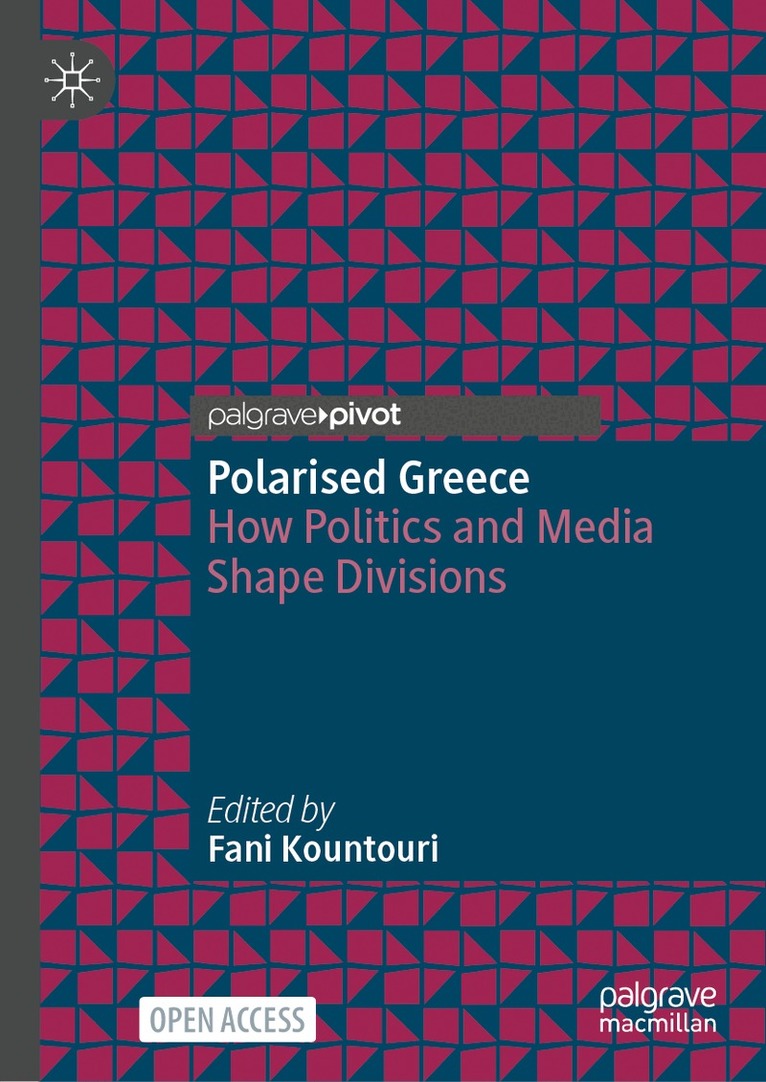
    Polarised Greece

    How Politics and Media Shape Divisions

    AvFani Kountouri

    Inbunden, Engelska, 2026

    547 kr

    Beställningsvara. Skickas inom 10-15 vardagar. Fri frakt över 249 kr.

    Beskrivning

    This open access book of a collective volume offers a comprehensive understanding of political polarization and its implications for democracy. The recent revival of the concept in political debates and academic literature reflects growing concerns about how polarized societies affect democratic norms. In increasingly divided environments, opposing camps express mutual distrust or even hostility, fuelling the rise of extremist parties, hate speech, and anti-political sentiment. Based on a funded research project (Hellenic Foundation for Research and Innovation (H.F.R.I.) Project No 4527) the volume develops a theoretical and methodological framework to explore how oppositions are constructed across different actors and levels, contributing to an integrated and comprehensive approach of political polarization enriching the study of political competition and cleavages in Greece, while also offering insights of broader comparative and international significance.Internationally, studies on political polarization are reviving but remain fragmented across disciplines. In Greece, systematic interdisciplinary research has been scarce. This volume bridges that gap by integrating political science, sociology, and communication, analyzing the shift from issue-based to affective polarization through mixed qualitative and quantitative methods. Focusing on the profoundly polarizing decade between 2010 and 2020, the book situates polarization within multiple overlapping crises—the debt crisis, the refugee crisis, democratic backsliding, the COVID-19 pandemic, and the Prespa Agreement. These crises redefined the socio-political landscape intensifying existing divisions and generating new lines of conflict: memorandum versus anti-memorandum, pro versus anti-immigration, pro versus anti Europe and nationalist versus cosmopolitan identities. By analyzing how antagonistic narratives construct enemies—political opponents, minorities, or external actors like the EU—as threats to national, economic, or cultural stability, the volume demonstrates how such rhetoric fuels polarization. This process solidifies in-group and out-group dynamics deepening affective polarization. This book addresses scholars, policymakers, and engaged citizens seeking to understand how historical, cultural, and institutional dynamics shape contemporary political conflicts in Greece and comparable contexts.

    Produktinformation

    • Utgivningsdatum:2026-03-17
    • Mått:148 x 210 x 17 mm
    • Vikt:391 g
    • Format:Inbunden
    • Språk:Engelska
    • Antal sidor:196
    • Förlag:Springer Nature Switzerland AG
    • ISBN:9783032152022

    Utforska kategorier

    • Referensverk och tvärvetenskap inom Samhälle och politik
    • Statsskick och politiska processer inom Samhälle och politik
    • Politiska ideologier och rörelser inom Samhälle och politik

    Mer om författaren

    Fani Kountouri received her Ph.D. (with distinction) in Political Science from the Department of Political Science, University Pantheon Sorbonne I Paris. She is Associate Professor of Political Communication at the Department of Political Science and History of the  Panteion University of Athens. She teaches courses on political science, political communication, sociology of public problems, public policy, political elites and methods in political science. She is the author of two books (in Greek): Political Publicity and Power.Political Parties and Media during the 2000's (Tipothito G. Dardanos, 2011) and Public Problems on Political Agenda (e-book, Kallipos, 2015). She is co-editor (with M. Kakepaki)of the edited volume Parliamentary Elites in Transition. Political Representation in Greece (Palgrave, 2023). She has published in Greek, French and English in edited volumes and peer reviewed journals. She is a visiting professor at the University of Paris VIII, Vincennes-SaintDenis, a member of the Horizon research programme on trust in governance and director of an ELIDEK research programme on political polarisation. Her research interests include political strategies,political communication, political representation, the impact of the media in contemporary democracies, and the agenda and framing process of public issues.

    Innehållsförteckning

    • CHAPTER 1.- Divided we stand?- Mapping Polarization IN POLITICS AND MEDIA IN GREECE.- CHAPTER 2.- Democracy Threat Framing and Polarization in Parliamentary Discourse.- CHAPTER 3.- Who is the enemy?- Top-Down Polarization in Party Manifestos and Parliamentary Discourse (2012–2023).- CHAPTER 4.- Framing Affective Polarization: The Memoranda Debates in Greece (2010-2015).- CHAPTER 5.- From Threat to Humanitarianism: The Evolving Polarization of Migration in Greek Parliamentary and Press Narratives.- CHAPTER 6.- The Nation under threat.- Greek political debate on the Prespa Agreement: polarisation and realignment.- Athena Skoulariki.- CHAPTER 7.- The Emotional Politics of Polarization.- Media Responses to Parliamentary Discourse in Greece (2010-2022).