• Fri frakt över 249 kr
  • •
  • Snabba leveranser
  • •
  • Billiga böcker
Kundservice

Du är på sajten för privatpersoner.

Företag, bibliotek eller offentlig verksamhet?

Du handlar på classic.bokus.com, där alla dina funktioner finns intakta.
Till classic.bokus.com
Bokus logotyp. Gå till startsidan.
  • Erbjudanden
  • Nyheter
  • Student
  • Topplistor
  • Barn & ungdom
  • Bokus Play
  • E-böcker
  • Pocketböcker
  • Spel & pussel

10% rabatt på allt med kod: NYSTART10 →

Sidfot

Mina sidor

    Hjälp

    • Kundservice
    • Vanliga frågor och svar
    • Frakt och leverans
    • Retur vid ångerrätt
    • Reklamera vara
    • Betalning
    • Köpvillkor
    • Allmänna villkor
    • Information om webbplatsens tillgänglighet

    Om Bokus

    • Om oss
    • Pressrum
    • För studenter
    • För företag
    • För bibliotek och offentlig verksamhet
    • För leverantörer
    • Hållbarhet

    Populärt

    • Aktuella erbjudanden
    • Presentkort
    • Studentlitteratur
    • Nya böcker
    • Topplistor
    • Signerade böcker
    • Engelska böcker

    Inspiration

    • Boktips
    • BookTok
    • Populära bokserier
    • Barnbokskaraktärer
    • Populära författare
    Logotyp för Bokus
    Följ oss på Facebook (extern länk)Följ oss på Instagram (extern länk)Följ oss på YouTube (extern länk)Följ oss på TikTok (extern länk)
    bokus @ CookiesAnpassa cookiesIntegritetspolicyKöpvillkor
    Till Citymail hemsida (extern länk)Till Budbee hemsida (extern länk)Till Postnord hemsida (extern länk)Till Schenker hemsida (extern länk)Till Early Bird hemsida (extern länk)Till Walleys hemsida (extern länk)
    1. Samhälle och politik
    2. Social välfärd och brottslighet
    3. Socialt arbete och välfärd

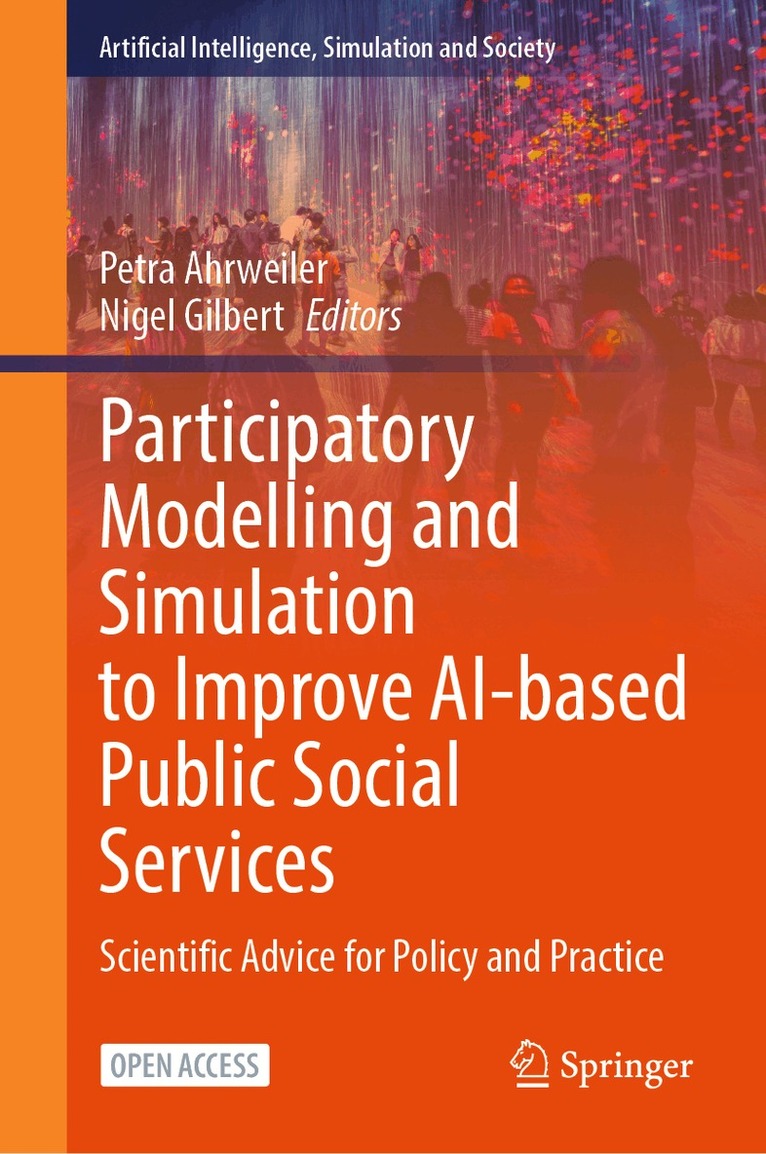
    Participatory Modelling and Simulation to Improve AI-based Public Social Services

    Scientific Advice for Policy and Practice

    AvPetra Ahrweiler,Nigel Gilbert

    Inbunden, Engelska, 2026

    Del i serien Artificial Intelligence, Simulation and Society

    438 kr

    Beställningsvara. Skickas inom 10-15 vardagar. Fri frakt över 249 kr.

    Beskrivning

    This open access volume showcases a series of models - particularly agent-based simulations - that explore pressing issues on national policy agendas, engaging with frontier questions around artificial intelligence (AI), welfare-related social assessment, and value diversity. These themes have profound implications for policy, cultural and societal life. The volume underscores the role of policy modelling in addressing how AI can be made context-specific, adaptive, and responsive within the public sector. Drawing on case studies from nine countries with differing value frameworks, the models examine welfare service provision choices and assess the demands, limitations, and effects of using AI to augment or replace traditional practices. The analyses reflect the pluralism of societal norms and values, while also considering the political, economic, and social pressures that shape them. The volume advocates for a participatory methodology and socio-technical infrastructure that can enable the development of more responsible, value-sensitive, and context-aware AI, and policies to implement it. By situating AI research, innovation and policy in close collaboration with society, it offers a fresh perspective for industry and innovation leaders. Ultimately, it presents a model for how participatory design and responsible technology production can better meet societal needs.

    Produktinformation

    • Utgivningsdatum:2026-03-26
    • Mått:155 x 235 x 18 mm
    • Vikt:498 g
    • Format:Inbunden
    • Språk:Engelska
    • Serie:Artificial Intelligence, Simulation and Society
    • Antal sidor:206
    • Förlag:Springer Nature Switzerland AG
    • ISBN:9783032152824

    Utforska kategorier

    • Socialt arbete och välfärd inom Samhälle och politik
    • Regionalt styre och förvaltning inom Samhälle och politik
    • Systemvetenskap och AI inom Data och IT

    Mer om författaren

    Petra Ahrweiler (Prof, Dr) is Full Professor of Sociology of Technology and Innovation, Social Simulation, at Johannes Gutenberg University Mainz, Germany. She was on lien until 2017 to work as Director and CEO at the EA European Academy of Technology and Innovation Assessment in Bad Neuenahr-Ahrweiler, Germany. Previously, she was Full Professor of Technology and Innovation Management at Michael Smurfit School of Business, University College Dublin, Ireland, and Director of its Innovation Research Unit. She was also a research fellow of the Engineering Systems Division at the Massachusetts Institute of Technology. She started her professional career by studying social sciences at the University of Hamburg, Germany. At the Free University Berlin, Germany, she received her PhD for a study on artificial intelligence, and got her habilitation at the University of Bielefeld, Germany, for a study on simulation in Science and Technology Studies. Petra won various research prizes, has long experience in coordinating and completing international, mostly European research projects, publishes inter-disciplinarily in international journals, and has been awarded fellowships of various scientific societies such as the German Academy of Technical Sciences (acatech), and AcademiaNet, the network of excellent female scientists in Germany.Nigel Gilbert is Professor of Sociology at the University of Surrey UK. He is the Director of the ESRC-funded Centre for the Evaluation of Complexity Across the Nexus (CECAN), which develops and tests methods for the evaluation of complex public policies.  A common feature of almost all the projects in which he has been involved is that they are multi-disciplinary and collaborative, bringing together social scientists, public sector and civil society organisations. He is a recognised expert in computational social science with a background in engineering. He was one of the first to use agent-based models in the social sciences, in the early 1990s, and has since published widely on the methodology underlying computer modelling, and on the application of simulation, system dynamics and artificial intelligence for applied and policy related problems such as understanding commercial innovation, managing environmental resources such as energy and water, and supporting public policy decision-making. He was appointed Commander of the Order of the British Empire (CBE) in the Queen’s Birthday Honours of 2016 for services to engineering and the social sciences. He is a Fellow of the Royal Academy of Engineering, a Chartered Engineer, and a Fellow of the Academy of the Social Sciences, the British Computer Society and the Royal Society of Arts. Gilbert was a Pro Vice-Chancellor of the University of Surrey for eight years and now has a Distinguished Chair there.  He has been on the Board of Directors of three start-up companies and has founded two successful academic journals. He is also the founder and Director of CECAN Ltd, a spin-off from the research centre.

    Innehållsförteckning

    • Chapter 1. Participatory Artificial Intelligence in Public Social Services: Modelling for Policy and Practice.- Part I: Agent-based Models for Social Services Assessment.- Chapter 2. Agent-Based Modelling for Context-Aware AI Systems: Reflections from AI FORA.- Chapter 3. Modelling Together for AI-based Social Services.- Chapter 4. Using Agent-Based Modelling to explore possible implications of AI use in the asylum procedure in Germany.- Chapter 5. Gamifying Fairness: Exploring Algorithmic Decision-Making in Estonia’s Welfare System.- Chapter 6. Targeted Subsidies Plan: An Agent-Based Modeling Approach.-Chapter 7. Agent-Based Modelling of the Indian Public Distribution System in AI FORA.- Part I: Policy Modelling for Policy Practice.- Chapter 8. Policy Learnings and Policy Change for AI-based Social Services.- Chapter 9. Policy Perspectives on AI Use for Asylum-Related Assessment Processes in Germany.- Chapter 10. Bridging Data and Policy: Disseminating Scientific Insights in Estonia’s AI-Driven Welfare Governance.- Chapter 11. Translating Evidence to Practice - A Trojan Horse Approach.- Part III: Looking to the Future.- Chapter 12. Better AI for Public Good: Participatory Modelling and Simulation in Social Services.- Chapter 13. How Participatory Modeling Can Enable Collective Bias Mitigation when AI is Used Across Systems and Institutions.- Chapter 14. Transferring the AI FORA Approach to another Domain: Participatory AI for Climate.- Chapter 15. Collaborative Creativity in Extended Realities Findings from Co-Creative Design Sessions in Augmented and Virtual Reality.- Chapter 16. Participatory Modelling for ‘Better AI’.