• Fri frakt över 249 kr
  • •
  • Snabba leveranser
  • •
  • Billiga böcker
Kundservice

Du är på sajten för privatpersoner.

Företag, bibliotek eller offentlig verksamhet?

Du handlar på classic.bokus.com, där alla dina funktioner finns intakta.
Till classic.bokus.com
Bokus logotyp. Gå till startsidan.
  • Erbjudanden
  • Student
  • Topplistor
  • Barn & ungdom
  • Bokus Play
  • E-böcker
  • Ljudböcker
  • Pocketböcker
  • Spel & pussel

10% rabatt på allt med kod NYSTART10 →

Sidfot

Mina sidor

    Hjälp

    • Kundservice
    • Vanliga frågor och svar
    • Frakt och leverans
    • Retur vid ångerrätt
    • Reklamera vara
    • Betalning
    • Köpvillkor
    • Allmänna villkor
    • Information om webbplatsens tillgänglighet

    Om Bokus

    • Om oss
    • Pressrum
    • För studenter
    • För företag
    • För bibliotek och offentlig verksamhet
    • För leverantörer
    • Hållbarhet

    Populärt

    • Aktuella erbjudanden
    • Presentkort
    • Studentlitteratur
    • Nya böcker
    • Topplistor
    • Signerade böcker
    • Engelska böcker

    Inspiration

    • Boktips
    • BookTok
    • Populära bokserier
    • Barnbokskaraktärer
    • Populära författare
    Logotyp för Bokus
    Följ oss på Facebook (extern länk)Följ oss på Instagram (extern länk)Följ oss på YouTube (extern länk)Följ oss på TikTok (extern länk)
    bokus @ CookiesAnpassa cookiesIntegritetspolicyKöpvillkor
    Till Citymail hemsida (extern länk)Till Budbee hemsida (extern länk)Till Postnord hemsida (extern länk)Till Schenker hemsida (extern länk)Till Early Bird hemsida (extern länk)Till Walleys hemsida (extern länk)
    1. Naturvetenskap och teknik
    2. Matematik och naturvetenskap
    3. Biologi

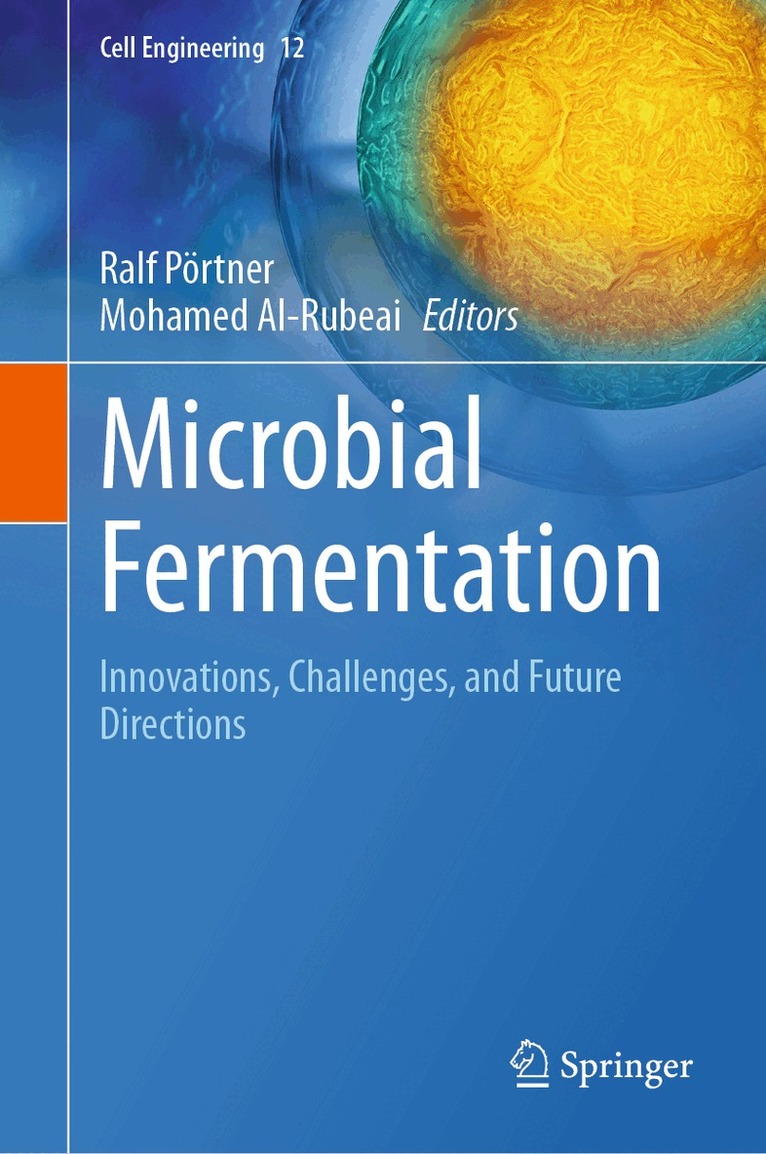
    Microbial Fermentation

    Innovations, Challenges, and Future Directions

    AvRalf Pörtner,Mohamed Al-Rubeai

    Inbunden, Engelska, 2026

    Del 12 i serien Cell Engineering

    1 946 kr

    Beställningsvara. Skickas inom 10-15 vardagar. Fri frakt över 249 kr.

    Beskrivning

    Microbial fermentation is a powerful tool with a bright future, but it also faces some challenges. This contributed volume is dedicated toward some of the current and contemporary issues in this field, such as:Scaling up production: Many exciting products can be created through fermentation, but scaling these processes from the lab to industrial production can be difficult. This involves optimising conditions for large-scale fermentation tanks, ensuring consistent product quality, and keeping costs competitive.Strain development: Finding or engineering the most efficient and productive microbial strains is crucial. Researchers are looking for ways to improve the yield and desired product formation of these microbes. This might involve techniques like genetic modification or harnessing the vast diversity of the microbial world to find new players.Sustainability: Fermentation processes need to be environmentally friendly. Finding sustainable feedstocks (the starting materials for fermentation) is important, especially as we move away from reliance on fossil fuels. Additionally, minimizing waste products and energy consumption during fermentation are key areas of focus.Integration with other technologies: The future of fermentation is likely to involve its integration with other technologies. For instance, combining fermentation with advanced materials science or artificial intelligence could lead to even more innovative applications.By addressing these issues, researchers and industry leaders can unlock the full potential of microbial fermentation and create a more sustainable and innovative future.

    Produktinformation

    • Utgivningsdatum:2026-05-05
    • Mått:155 x 235 x 28 mm
    • Vikt:774 g
    • Format:Inbunden
    • Språk:Engelska
    • Serie:Cell Engineering
    • Antal sidor:397
    • Förlag:Springer Nature Switzerland AG
    • ISBN:9783032175137

    Utforska kategorier

    • Biologi inom Naturvetenskap och teknik
    • Miljövetenskap och miljöpolitik inom Naturvetenskap och teknik
    • Biokemisk teknik inom Naturvetenskap och teknik

    Mer om författaren

    Prof. Dr.-Ing. Ralf Pörtner: Senior research associate and group leader at Technical University Hamburg, Institute of Bioprocess and Biosystems Engineering until 2024 and Honorary Professor at TH Mittelhessen University of Applied Sciences, Giessen. The main research interests of Prof. Pörtner are development and optimization of bioreactor techniques and process strategies, in particular for cell cultures and microbial reactions, including model-based control concepts, and tissue engineering. He has in total published about 150 peer-reviewed papers.M. Al-Rubeai is an emeritus professor at the University College Dublin. Previously he was a professor at the University of Birmingham, UK. He is the author of over 500 professional papers, reviews, books, book chapters, patents, and articles that reflect his broad interest in mammalian cell culture, production of biopharmaceuticals, tissue engineering, stem cell bioprocessing, and biomaterials. He is a recipient of many scientific awards, including the Donald Medal, SFI award, honorary Doctorate (DSc) and Asellus Prize. He is also interested in Education in which he published several books.

    Innehållsförteckning

    • Part I: Strain Development.- Chapter 1: Process-guided engineering of whole-cell biocatalysts for enhanced performance in fermentations at scale.- Part II: Fermentation technology and process development.- Chapter 2: Bioprocess monitoring – how much do we need to know for successful scale-up?.- Chapter 3: Miniaturized bioreactor systems for speeding up the development of microbial fermentation processes.- Chapter 4: Parallelized bioprocess development in small-scale bioreactors.- Chapter 5: High-Cell-Density Cultivation of Microorganisms.- Chapter 6: Photoautotrophic fermentation.- Chapter 7: Solid-state fermentation as a sustainable bioprocessing approach.- Chapter 8: Precision Fermentation for Functional Protein Production.- Chapter 9: Microbial Fermentation for Lipase Production: Advances in Enzyme Engineering and Industrial Applications.- Part III: Model assisted process development.- Chapter 10: Standardized process engineering characterization and biological evaluation of stirred bioreactors for microbial processes.- Chapter 11: CFD simulations for modelling of transport phenomena in large scale bioreactors.- Chapter 12: Simultaneous Process and Mathematical Model Design for Microbial Cultivations.- Chapter 13: Fermentations in the era of metagenomics and machine learning.- Part IV: Downstream techniques.- Chapter 14: Membrane separation and purification in downstream processing - novel approaches to classical problems.