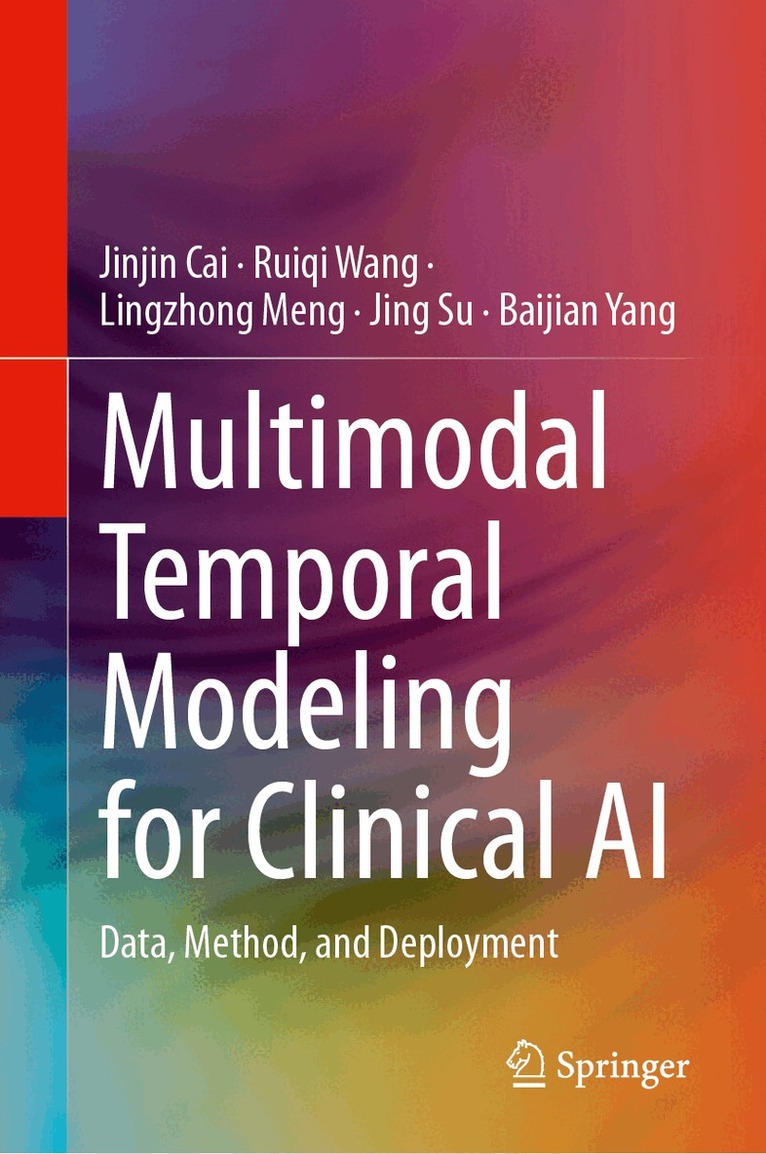
Jinjin Cai is a Ph.D. candidate in the School of Applied and Creative Computing at Purdue University. Her research focuses on developing data-driven, human-centric AI methodologies for healthcare, with particular emphasis on representation learning and disease trajectory modeling to elucidate complex pathological processes. By integrating and extracting meaningful features from diverse multimodal medical data, she aims to enable earlier disease detection, enhance patient monitoring, and tailor interventions to individual needs. Her broader objective is to advance efficient, interpretable, and practical AI solutions that can inform clinical decision-making, streamline healthcare delivery, and improve patient outcomes.Ruiqi Wang is a Ph.D. candidate in the School of Applied and Creative Computing at Purdue University. His research interests include multimodal perception and reasoning, human-centered adaptive systems, and human-in-the-loop robot learning. His work has been disseminated through leading journals and conferences in AI and robotics. His long-term goal is to enable the seamless integration of human- centered AI systems into everyday human life.Lingzhong “LZ” Meng, M.D., is Professor of Clinical Anesthesia and Vice Chair for Clinical and Outcomes Research at Indiana University School of Medicine, with more than 20 years of experience across leading academic medical centers including Yale, UCSF, Duke, and Mayo Clinic. He is internationally recognized for pioneering research in perioperative cerebral blood flow, tissue perfusion monitoring, and integrating artificial intelligence into clinical decision-making—developing AI-enabled frameworks like HM- TARGET and DynaCEL for personalized hemodynamic management in critical care. An accomplished scholar with over 150 peer-reviewed publications, he has authored groundbreaking work in journals such as British Medical Journal, Nature Communications, npj Digital Medicine, Anesthesiology, and British Journal of Anaesthesia. As a committed educator and mentor, Dr. Meng founded the Global Perioperative Case Discussion Forum and has trained over 100 students, residents, and junior faculty worldwide.Jing Su, Ph.D, is an Associate Professor in the Department of Biostatistics and Health Data Science at Indiana University School of Medicine. Dr. Su earned his Ph.D. in Biomedical Engineering from the Georgia Institute of Technology and Emory University. His work focuses on biomedical informatics, graph-based machine learning, and data management and the integration of longitudinal complex real- world clinical data. His research advances precision medicine through the development of temporal and multimodal analytical frameworks such as digital twin models and the implementation of graph models in real- world clinical care.Baijian Yang, Ph.D., is the Associate Dean for Research at Purdue Polytechnic Institute and a Professor in the School of Applied and Creative Computing at Purdue University. With a Ph.D. in Computer Science from Michigan State University and degrees in Automation from Tsinghua University, he has authored over 100 peer-reviewed publications and two books on Smartphone programming. His research spans applied machine learning, big data analytics, cybersecurity, and notably, healthcare AI, where his work on multimodal, time-aware modeling (e.g., spatial transcriptomics methods like SpaRx) exemplifies the cutting edge of clinical AI. Dr. Yang also brings industry edge with CISSP, MCSE, and Six Sigma Black Belt certifications, bridging rigorous engineering with health-focused innovation.