Beställningsvara. Skickas inom 5-8 vardagar. Fri frakt över 249 kr.
Beskrivning
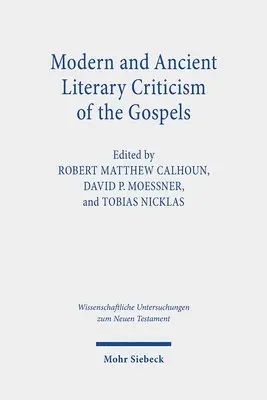
Die kontrovers diskutierte Frage nach dem Genre der Evangelien erfährt durch die Beiträge des vorliegenden Bandes vielfältige neue Impulse. Ins Spiel gebracht werden literarische, rhetorische, aber auch kulturwissenschaftliche Zugänge, die alle in fruchtbarer Weise neue Beobachtungen an den antiken Erzählungen ermöglichen.
Robert Matthew Calhoun (Herausgegeben von) Born 1971; 2011 PhD in New Testament and Early Christian Literature from the University of Chicago; since 2016 Research Assistant to the A. A. Bradford Chair, Texas Christian University (USA).David P. Moessner (Herausgegeben von) 1983 Dr.theol., University of Basel (Switzerland); since 2008 Honorary Research Associate in the Faculty of Theology, University of Pretoria (South Africa); since 2010 Faculty Associate in New Testament, Radboud University (Nijmegen, the Netherlands); since 2012 A.A. Bradford Chair and Professor of Religion, Texas Christian University (Fort Worth, Texas, USA); since 2019 Senior Fellow of the 'Centre for Advanced Studies' (Regensburg, Germany).Tobias Nicklas (Herausgegeben von) Geboren 1967; 2000 Promotion und 2004 Habilitation an der Universität Regensburg; Professor für Exegese und Hermeneutik des Neuen Testaments an der Fakultät für Katholische Theologie der Universität Regensburg.
Innehållsförteckning
David P. Moessner/Tobias Nicklas/Robert Matthew Calhoun: IntroductionPart One: The Question of Genre and the GospelsRichard A. Burridge: The Gospels and Ancient Biography: 25 Years On, 1993-2018 - Werner H. Kelber: On "Mastering the Genre" - Michal Beth Dinkler: What Is a Genre? Contemporary Genre Theory and the Gospels - Elizabeth E. Shively: A Critique of Richard Burridge's Genre Theory: From a One-Dimensional to a Multi-Dimensional Approach to Gospel Genre - Carl Johan Berglund: The Genre(s) of the Gospels: Expectations from the Second Century - Sandra Huebenthal: What's Form Got to Do with It? Preliminaries on the Impact of Social Memory Theory for the Study of Biblical IntertextualityPart Two: Mark as Narrative in the Light of Ancient and Modern CriticismCilliers Breytenbach: The Gospel According to Mark: The Yardstick for Comparing the Gospels with Ancient Texts - Margaret M. Mitchell: Mark, the Long-Form Pauline εὐαγγέλιον - Stefan Alkier: Das Markusevangelium als Tragikomödie lesen - David P. Moessner: Mark's Mysterious 'Beginning' (1:1-3) as the Hermeneutical Code to Mark's 'Messianic Secret' - C. Clifton Black: The Kijé Effect: Revenants in the Markan Passion Narrative - Justin Marc Smith: Famous (or Not So Famous) Last Words: Last and Dying Words in Greco-Roman Biography and Mark 15:34 Revisited - Geert Van Oyen: Actio According to Quintilian ( Institutio oratoria 11.3) and the Performance of the Gospel of MarkPart Three: The Growth of the Gospel Tradition in Early Christian Literary CultureR. Alan Culpepper: The Foundations of Matthean Ethics - Wolfgang Grünstäudl: Continuity and Discontinuity in Luke's Gospel: Luke 9:51 and the Pre-Jerusalem Phase as a Test Case - John A. Darr: Reading Luke-Acts as Scriptural History and Philosophical Biography: A Pragmatic Approach to Lukan Intertextuality and Genre - Thomas R. Hatina: Intertextual Transformations of Jesus: John as Mnemomyth - Paul N. Anderson: Revelation and Rhetoric in John 9:1-10:21: Two Dialogical Modes Operative within the Johannine Narrative - Tobias Nicklas: Second-Century Gospels as "Re-Enactments" of Earlier Writings: Examples from the Gospel of Peter