• Fri frakt över 249 kr
  • •
  • Snabba leveranser
  • •
  • Billiga böcker
Kundservice

Du är på sajten för privatpersoner.

Företag, bibliotek eller offentlig verksamhet?

Du handlar på classic.bokus.com, där alla dina funktioner finns intakta.
Till classic.bokus.com
Bokus logotyp. Gå till startsidan.
  • Erbjudanden
  • Nyheter
  • Student
  • Topplistor
  • Barn & ungdom
  • Bokus Play
  • E-böcker
  • Pocketböcker
  • Spel & pussel

Må bättre, för mindre! Upp till 50% rabatt på hälsoböcker

Sidfot

Mina sidor

    Hjälp

    • Kundservice
    • Vanliga frågor och svar
    • Frakt och leverans
    • Retur vid ångerrätt
    • Reklamera vara
    • Betalning
    • Köpvillkor
    • Allmänna villkor
    • Information om webbplatsens tillgänglighet

    Om Bokus

    • Om oss
    • Pressrum
    • För studenter
    • För företag
    • För bibliotek och offentlig verksamhet
    • För leverantörer
    • Hållbarhet

    Populärt

    • Aktuella erbjudanden
    • Presentkort
    • Studentlitteratur
    • Nya böcker
    • Topplistor
    • Signerade böcker
    • Engelska böcker

    Inspiration

    • Boktips
    • BookTok
    • Populära bokserier
    • Barnbokskaraktärer
    • Populära författare
    Logotyp för Bokus
    Följ oss på Facebook (extern länk)Följ oss på Instagram (extern länk)Följ oss på YouTube (extern länk)Följ oss på TikTok (extern länk)
    bokus @ CookiesAnpassa cookiesIntegritetspolicyKöpvillkor
    Till Citymail hemsida (extern länk)Till Budbee hemsida (extern länk)Till Postnord hemsida (extern länk)Till Schenker hemsida (extern länk)Till Early Bird hemsida (extern länk)Till Walleys hemsida (extern länk)
    1. Ekonomi och Ledarskap
    2. Nationalekonomi
    3. Ekonomisk politik

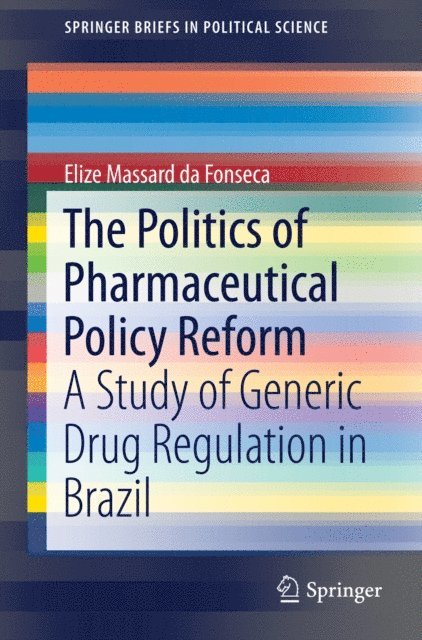
    Politics of Pharmaceutical Policy Reform

    A Study of Generic Drug Regulation in Brazil

    AvElize Massard da Fonseca

    Häftad, Engelska, 2014

    Del 26 i serien SpringerBriefs in Political Science

    547 kr

    Beställningsvara. Skickas inom 10-15 vardagar. Fri frakt över 249 kr.

    Fler format och utgåvor

    E-bok

    710 kr

    Beskrivning

    Brazil is renowned worldwide for its remarkable reforms in pharmaceutical regulation, which have enhanced access to essential medicines while lowering drug costs. This book innovates by analysing the generic drug  reform in Brazil, demonstrating that pharmaceutical regulation is only partially influenced by non-state actors. Little is known about the institutional antecedents and policy process that channeled this regulatory reform. This is particularly intriguing because a regulatory shift in the pharmaceutical sector requires the participation of a number of stakeholders and interest groups in the policy process. Fonseca examines the generic drug reform’s causes and consequences. No study has approached the generic drug regulation in Brazil from this perspective.  The Politics of Pharmaceutical Policy Reform: A Study of Generic Drug Regulation in Brazil, explores the following: ·         The politics of pharmaceutical regulation in Brazil over the last 25 years.·         The political negotiations to approve the Generic Drug Act, which involved a hard-to-reach agreement between the pharmaceutical industry (national and multinational), the Ministry of Health, and Congress·        The controversial decisions to regulate packaging and pharmaceutical equivalence.·         The surprising success of Brazilian pharmaceutical firms, which became market champions in a sector largely dominated by multinational firms.·         Comparative lessons from the Brazilian case for the political construction of regulatory standards to regulate generic drugs and its effects on global health. This book will interest political scientists and health policy scholars concerned with the political conflicts in the pharmaceutical sector. It argues against well-established approaches to regulatory capture such as control of the regulatory process by interest groups and policy diffusion. It can be used as evidence for graduate courses in public policy, health policy and political science. Because Brazil is one of the largest markets for pharmaceuticals in the world, business leaders and consultancy firms would also be interested.

    Produktinformation

    • Utgivningsdatum:2014-12-01
    • Mått:155 x 235 x 8 mm
    • Vikt:213 g
    • Format:Häftad
    • Språk:Engelska
    • Serie:SpringerBriefs in Political Science
    • Antal sidor:117
    • Upplaga:2015
    • Förlag:Springer International Publishing AG
    • ISBN:9783319125640

    Utforska kategorier

    • Ekonomisk politik inom Ekonomi och Ledarskap
    • Regionalt styre och förvaltning inom Samhälle och politik
    • Socialt arbete och välfärd inom Samhälle och politik

    Mer om författaren

    Elize Massard da Fonseca is a postdoctoral fellow in Public Administration and Management at the Getulio Vargas Foundation (FGV) in Sao Paulo, Brazil. She holds a doctoral degree in Social Policy from the University of Edinburgh, United Kingdom, and a doctoral degree in Public Health from Fiocruz. Her research interests are in the areas of pharmaceutical regulation and health politics.

    Recensioner i media

    "Brazil, in public health as in so many other things, is much discussed but frequently misunderstood. For all the ink spilt discussing access to medicines, astonishingly little work has investigated the actual politics and effects of Brazil's famously innovative access to medicines policy. Fonseca's pathbreaking book solves this problem, bringing Brazilian politics into the analysis. She brings the rigor and comparative perspective of political economy together with deep research to map out the political economy of a policy shift that changed global debates. This book should be required reading in global and comparative health policy, for very few are so rigorous in their understanding of the politics of pharmaceuticals, global health, or Brazil". -- Scott L. Greer, University of Michigan and European Observatory on Health Systems and Policies. "This book is based on extensive research on the politics of pharmaceutical regulations in Brazil, a subject that has received insufficient attention but will be of increasing importance. Reconciling the objectives of stimulating competition to achieve lower prices of drugs, and raising quality standards, is a major challenge faced by regulators in developing countries throughout the world. Brazil has been a leader in this regard. Fonseca's astute analysis of the Brazilian case provides key insights for understanding these processes". -- Ken Shadlen, London School of Economics and Political Science

    Innehållsförteckning

    • Introduction.- Contextualising drug regulation.- The generic drug reform in Brazil.- Assessing the generic drug regulatory process in the 2000s: governmental intervention, market demand and local pharmaceutical industries.- Public production of medicines and HIV/AIDS activists: new actors in the generic drug regulatory process.- Conclusion.- Postscript.- Index.- References.- Annex - Notes on research methodology